📚 lexical recurrence lab
Dis Legomena Counter
Paste a chapter, manuscript sample, review, or reading note to find words that appear exactly twice, then compare them with hapax legomena and repeated core terms.
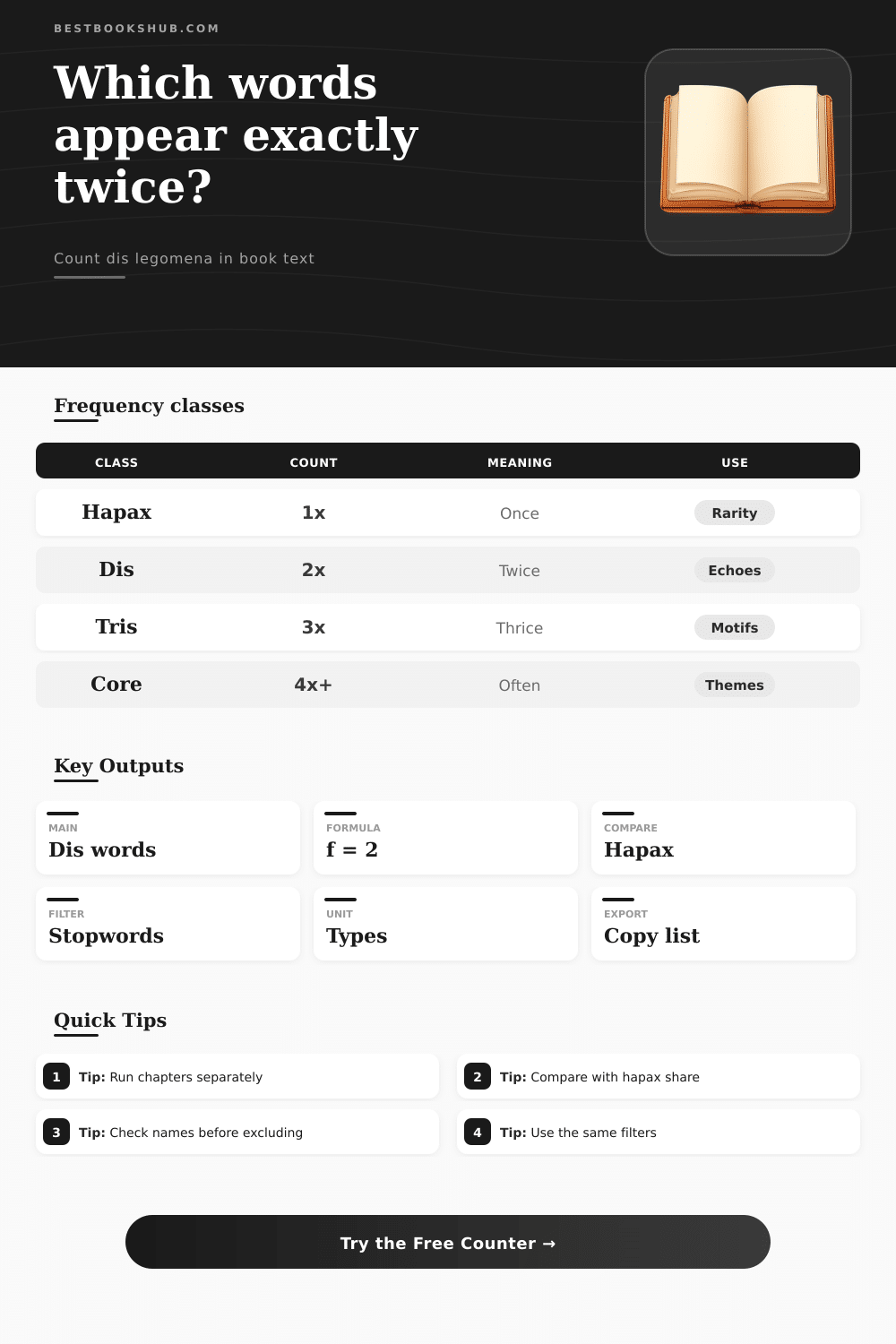
| Frequency class | Symbol | Definition | What it suggests |
|---|---|---|---|
| Hapax legomenon | V1 | Word appears exactly once | Rare diction, names, typos, or highly specific details |
| Dis legomenon | V2 | Word appears exactly twice | A light lexical echo without becoming a core repeated word |
| Tris legomenon | V3 | Word appears exactly three times | A noticeable motif candidate in shorter passages |
| Repeated core | V4+ | Word appears four or more times | Topic vocabulary, function words, character names, or theme words |
| Text type | Common D2 pattern | Watch for | Best comparison |
|---|---|---|---|
| Novel chapter | Character details and scene nouns often repeat twice | Proper names may inflate the repeated core | Compare D2 share across chapters |
| Poem or stanza set | Small texts can show sharp D2 spikes from deliberate echoes | Line breaks do not change token counts unless punctuation differs | Compare D2 list with imagery clusters |
| Academic abstract | Technical terms may move quickly from D2 to core | Acronyms and hyphenated compounds need consistent handling | Compare V2 with keyword repetition |
| Book review | Evaluation words often appear twice in balanced paragraphs | Stopword removal changes style signals | Compare hapax contrast before and after edits |
| Reading notes | Names, motifs, and quoted terms often land at f = 2 | Quote fragments may produce artificial duplicates | Compare first-appearance order |
| Metric | Formula | Reads high when | Use with dis legomena |
|---|---|---|---|
| Dis legomena count | D2 = count(types where f = 2) | Many words recur once after introduction | Main output for twice-used vocabulary |
| Dis share | D2 / V x 100 | Vocabulary has many light echoes | Normalize across different passage lengths |
| Hapax share | V1 / V x 100 | Many words are used only once | Compare novelty against recurrence |
| Type-token ratio | V / N x 100 | Unique vocabulary is dense | Explain why a D2 count feels high or low |
| Repeat density | (N - V) / N x 100 | Tokens reuse existing word types | Separate overall repetition from exact-twice terms |
| Control | Strict setting | Merging setting | Effect on D2 count |
|---|---|---|---|
| Case handling | Case-sensitive forms apart | Merge upper/lowercase | Merging can turn two singletons into one dis legomenon |
| Hyphen treatment | Keep compound as one word | Split compound parts | Splitting raises counts for shared roots and modifiers |
| Possessives | Keep apostrophe forms | Strip possessive endings | Stripping joins reader and reader's style variants |
| Stopwords | Keep function words | Remove common stopwords | Removal shifts attention toward content vocabulary |
| Minimum length | 1+ or 2+ characters | 3+ or longer | Longer thresholds suppress initials, abbreviations, and short words |
DISCLOSURE: This post may contain affiliate links, meaning when you click the links and make a purchase, I receive a commission. As an Amazon Associate I earn from qualifying purchases.
Lexical Echoes across Chapters/Drafts involve counting words that appear only once (rare words) and counting the words that appear exactly twice (dis legomena counter). Compare these two group of words to see how the rare one-time word stack up against the dis legomena. When you hear a word pop up twice for the first time, it’s like a whisper rather than a shout. It isn’t so common as to overwhelm but not so rare that it dissapears. We’ve used the Greek term dis legomena for these words that appear exactly twice. There is something pleasantly quiet about this repetition.
It is a matter of taste that say a lot about both structure and voice, more than most realize when they hear that count. Drop a long note or even a single chapter in the tool, and it will sort all of the tokens based off your chosen set of rules. Hyphenated compounds: sound technical until you see them merge into a fake echo when the capital letter at their head fuses with the lower-case version that follows, and before you know it, “well-known” has been split apart into two silent versions of “well” and “known,” each doubled rather than singular. Leave it intact and compound is one silent pair.
How to Find Word Patterns
Capital letters sound technical until you remember how often a capitalized word at the start of a sentence match its lowercase version later on, creating a fake echo where there wasn’t one before. Each decision affects the way the page judge repetition, and isn’t neutral. But things start to get interesting when you begin to contrast words used exactly twice with ones seen only once.
Hapax legomena tend to indicate specialized vocabulary or new details. By comparison, a corresponding harvest of dis legomena typically indicates your own subconscious motifs, which you sowed unawares. For instance, one manuscript I examined included “rope,” “fog,” and “lantern,” all of which were used twice in a single harbor setting. It wasn’t anything the author did deliberately, but it subtly underscored the mood of uncertainty. The calculator just revealed the pattern, allowing the author to choose whether to play up or throw off the rhythm.
Newcomers underestimate importance of their stopword selections. If you leave in common function words, “the,” “and,” or “of” will bulk up the repeated-core category and hide more subtle content echoes. If you take them out, then attention shifts to the verbs and nouns, the content elements that truly advance a theme. Likewise, minimum length filters operates on this same principle. Eliminating one- and two-letter tokens removes noise, but with it goes purposeful short words an author may have repeated for rhythmic effect.
And then there’s the length of your sample. When you’re dealing with just a few paragraphs, luck becomes a greater factor. That’s why running the same numbers on different passages of text can generate crazy differences. With a thousand or more tokens it stabilizes. You stop getting a weather report and start having something closer to a map. The twice-used list become dependable enough that you can apply the same parameters to another chapter. This allows you to observe the ebb and flow of word density throughout the story, from the build-up to the peak moment.
Be careful, because names are particularly tricky. When a name appears twice in Chapter 1, then again in Chapter 2, you might assume it’s being used deliberately as a pattern. But what if that’s just how the story require? The tool will surface them alongside every other pair. Again, numbers don’t do the interpretation; they only blow away the fog. That remains for the author to do.
Finally, it sharpens your ear. Soon enough, even before anyone can prove that a certain word was used by mistake, you know it’s been used too many times and has become a pattern. It no longer sounds like a judgment but rather a conversation partner, pushing you toward determining what repetition serves the story and what, instead, subtly thins it out.
At the end of the process, the strongest manuscripts aren’t repetition-free, but filled with the right type of repetition, in just the right places where the rhythm begs for a gentle second tap.