🔤 Repeated letter word analyzer
Double letter word counter
Find words that contain repeated adjacent letters, group them by pairs such as ll, ss, ee, and oo, spot words with multiple doubles, and measure density per 100 words.
Load a sample, then adjust word cleanup, punctuation, pair filters, and density rules. This tool counts words containing double letters, not every adjacent letter pair in the text.
| # | Word | Double pairs | Word hits | Density | Multiple? | Share |
|---|---|---|---|---|---|---|
| Paste text or load a preset to see matching words. | ||||||
| Pair | Category | Word hits | Pair hits | Share | Common signal |
|---|---|---|---|---|---|
| Double-letter pair totals will appear here. | |||||
| Pair | Category | Example words | Editing use |
|---|---|---|---|
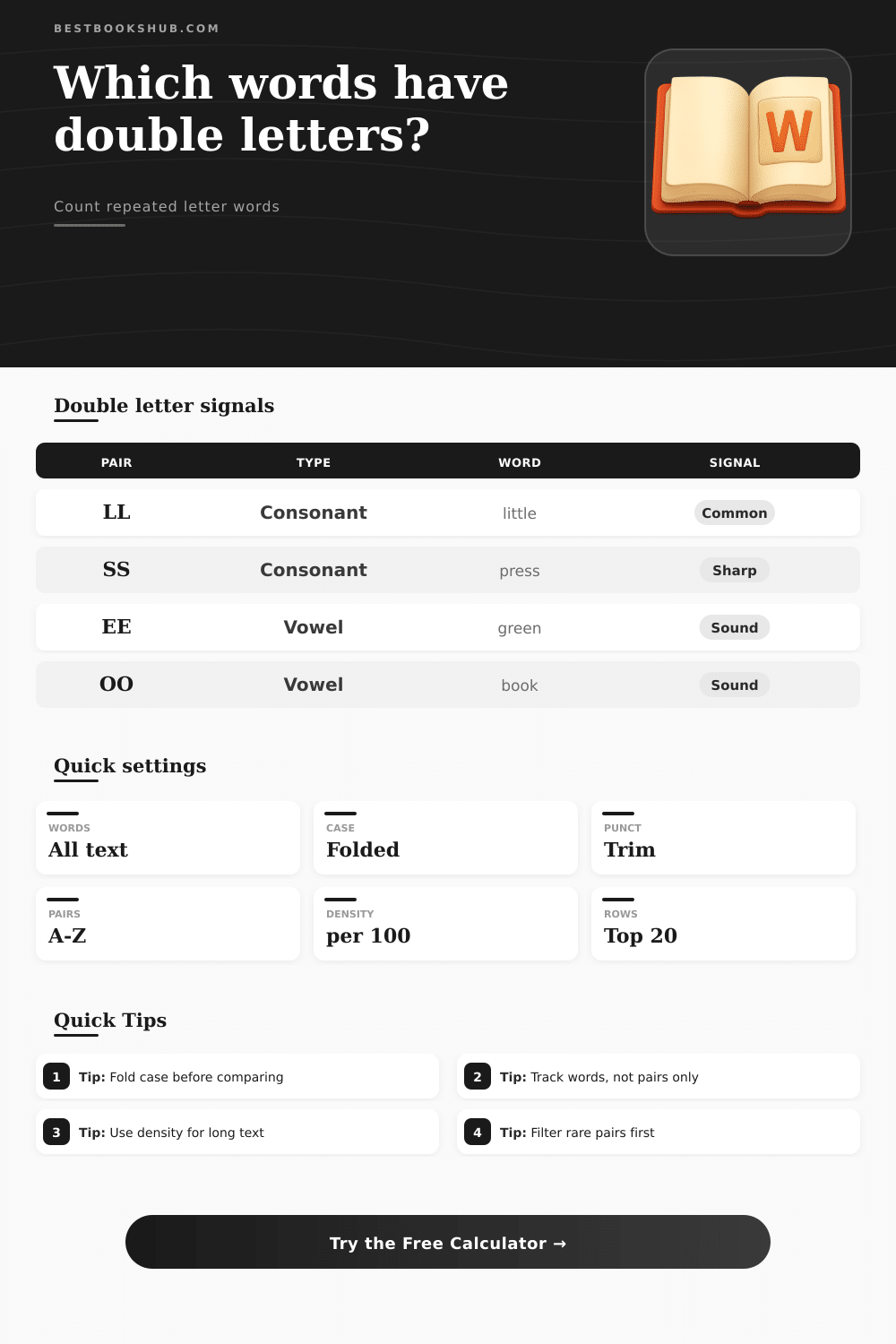
| LL | Consonant double | little, still, yellow | Common in prose; useful for spelling lists and rhythm checks. |
| SS | Consonant double | press, class, across | Can cluster in academic or process-heavy writing. |
| EE | Vowel double | green, see, between | Often marks long vowel sound and repeated description words. |
| OO | Vowel double | book, room, soon | Common in bookish samples and sound-focused passages. |
| TT | Consonant double | letter, written, sitting | Useful for spotting -ing and -er form repetition. |
| RR | Consonant double | mirror, carry, narrow | Often appears in names, motion verbs, and descriptive prose. |
| Density per 100 words | Reading band | Likely pattern | Review note |
|---|---|---|---|
| 0 to 4 | Light | Few repeated-letter words | Normal for short notes, sparse titles, and technical lists. |
| 5 to 9 | Moderate | Common prose level | Usually natural unless one pair dominates the passage. |
| 10 to 16 | Dense | Many doubled spellings | Check whether repeated words are intentional emphasis. |
| 17+ | Very dense | Strong sound or spelling pattern | Review OCR noise, spelling drills, alliteration, or name-heavy text. |
| Option | Best for | Effect on words | Example |
|---|---|---|---|
| Trim punctuation | Most prose | Removes edge marks but keeps word body | "class," counts as class. |
| Split punctuation | OCR and noisy text | Breaks at punctuation marks | well-read becomes well and read. |
| Keep inside marks | Hyphenated drafts | Displays marks while scanning letters | book-filled can show as one row. |
| Custom pairs | Targeted editing | Counts only selected pairs | ll, ss, ee for a spelling lesson. |
DISCLOSURE: This post may contain affiliate links, meaning when you click the links and make a purchase, I receive a commission. As an Amazon Associate I earn from qualifying purchases.
Check out these double letter word counting pages and see how many double-letter words you can spot. Compare the number of oo’s, ss’s, ee’s, and ll’s in each. How many double-letters is there for every 100 words?
Unless you notice it, there are double letters all over English. They can pops up on the page out of nowhere. A seemingly simple-sounding word in everyday usage can turn out weighty-looking when transcribed, or the press of ss starts to feel like a hiss. This is why having a counter for such word patterns is not just interesting but practical.
How to Use the Double Letter Counter
Knowing why double letters appear in English makes you more aware of what is going on when you read words. Vowel doubles (e.g., oo, ee) change how a word sounds by making it longer. Consonant doubles (e.g., ss, ll, tt, rr) shows where syllables break. These are not accidental; rather they reflect old practices about how to write words, which in turn reflects expectations regarding their pronunciation.
With the calculator you can view this without having to hunt around for each example yourself. When it comes to rhythm, this means double letters is now measured differently, and you can change the density accordingly to suit your purposes. For instance, lots of doubles could be used for bounce in a childrens tale, while technical words may bunch together doubles creating a very dense feel on the page. The density reading bands shows whether the text is very dense, moderate, or light. That number also tells you more about how the writing feels different than just giving you a list of spellings.
Finally, you can adjust things in the settings, like choosing whether to fold everything to lowercase so the pattern realy stands out. The last one?) and then fold everything to lowercase if you like, which gets rid off the distraction of capitalization and lets the pattern really stand out. Also, whether to count punctuation as part of the word makes a difference; sometimes a word split by a hyphen will either obscure or reveal a double letter based on where it’s broken. Shorter words don’t carry a lot of weight, so there’s a minimum word length filter for those too. These settings tells you what you’re looking for in the results.
I see lots of writers fretting about using some of these too much, but the list by pair tell us who’s carrying the weight there. It may be a passage with too many e’s or something else, but each part on its own isn’t bad. You need to know if it supports your developing voice or if it overpower it. And with the top pair and what percent it represents, you quickly have your answer.
Editors apply this count differentally. In poetry, vowel doubles are part of the sound. In copyediting, they is an alert to check spelling consistency. In fantasy names, doubled letters might sound silly or magical depending on how often they occur. The tool is there to give you a map of what works for your taste, not replace it with its own.
It’s also prone to common mistakes where people will count all repeated letters within a word (instead of just adjacent), making their number incorrect. This makes it more accurate but also inflates the result; you’re not getting any signal from this data; you’re just getting noise. You’re counting pairs that aren’t actualy doubled up in a word.
Keep your eyes on the ball here: keep it on the words. The point is in the conversation you have with your own text (then you’ll know why a pattern works), and that’s where the value lies. Maybe the lesson for this student list are about using doublets, or maybe it is just that something feels right in a description. The patterns were always there but now you see them.” Using the counter helps with that: “now you see them, clearly, and that’s what it’s all about.