Flash Fiction Counter
Drabble Word Count Checker
Paste a drabble draft, choose the counting rule, and check whether the piece lands exactly on the classic 100-word target or within a custom contest tolerance.
Use these samples to test target behavior, title handling, compound words, and contest-style tolerance before checking your own piece.
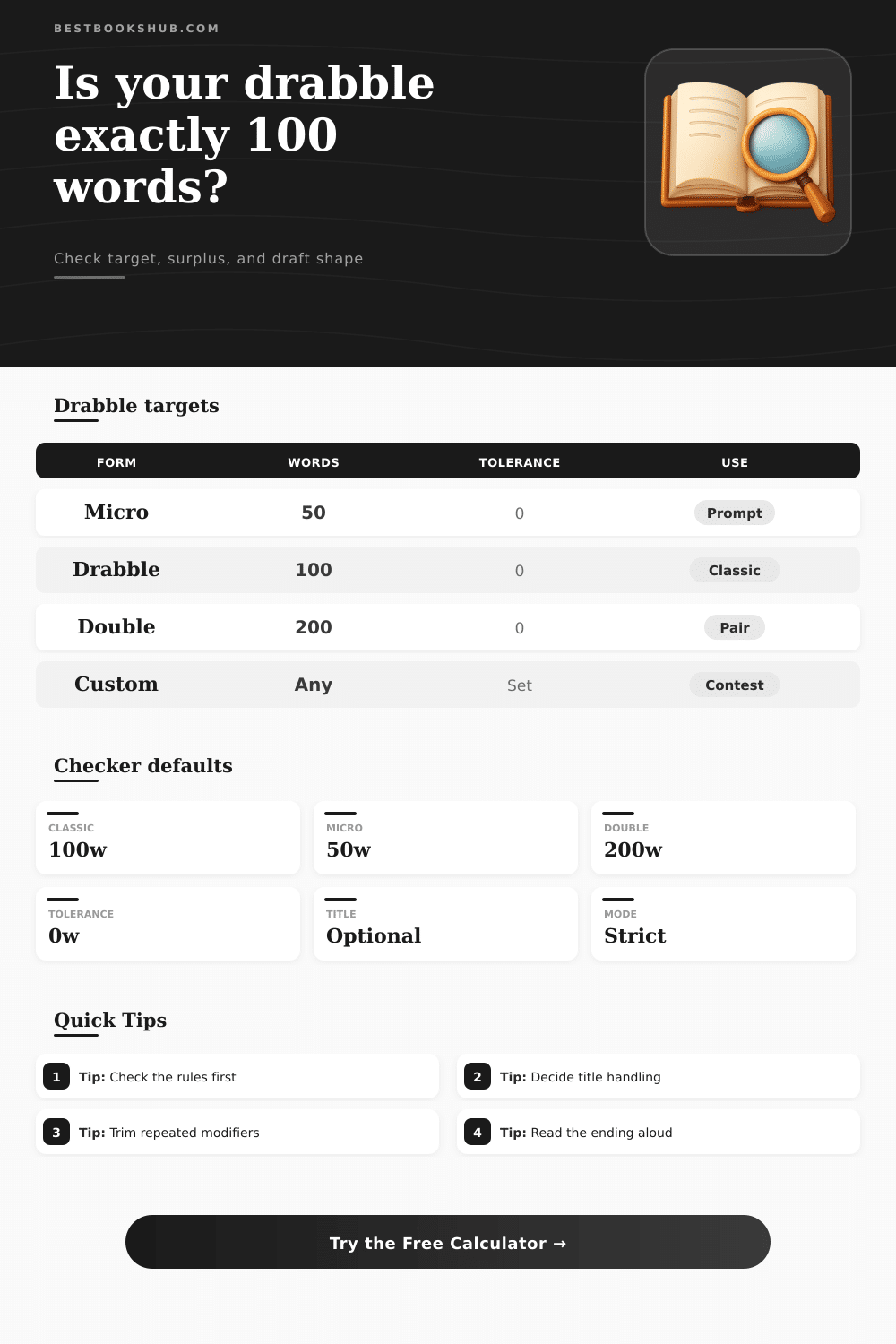
| Form | Target words | Typical rule | Best use |
|---|---|---|---|
| Micro drabble | 50 | Exact or prompt-host tolerance | One image, one turn, one compressed beat. |
| Classic drabble | 100 | Exactly 100 words | Challenge posts, anthology exercises, flash practice. |
| Double drabble | 200 | Exactly 200 words | Paired scenes, before-and-after turns, richer setup. |
| Custom drabble | Any target | Contest-specific | Hosts that allow 99-101, 95-105, or special themed counts. |
| Counting issue | Strict words | Split hyphens | Loose contest |
|---|---|---|---|
| Contractions | Don't = 1 | Don't = 1 | Don't = 1 |
| Hyphen compounds | Well-worn = 1 | Well-worn = 2 | Well-worn = 1 |
| Numbers | Twenty-one = 1 | Twenty-one = 2 | 21 = 1 |
| Em dash breaks | Words stay separate | Words stay separate | Punctuation ignored |
| Problem | Signal | Likely fix | Fast check |
|---|---|---|---|
| One word over | 101/100 | Cut a hedge word, repeated adjective, or dialogue beat. | Search for very, just, really, almost. |
| Three words short | 97/100 | Add a concrete image rather than a filler phrase. | Name an object, gesture, or sensory detail. |
| Long sentence | 35+ words | Split or tighten clauses for better final cadence. | Read the last two sentences aloud. |
| Low unique ratio | Under 55% | Trim repeated nouns or swap vague pronouns for specifics. | Check the repeated word count. |
DISCLOSURE: This post may contain affiliate links, meaning when you click the links and make a purchase, I receive a commission. As an Amazon Associate I earn from qualifying purchases.
For flash fiction writers, a couple extra words makes us panic. We’ve got the twist just right and placed the last image like a master touch. We double-checked to make sure we didn’t go over, only to find out we’re at one-hundred-and-one words. A gratuitous pronoun, a misplaced adjective, and the whole thing cave in on itself.
Every day, flash fiction writers treats these constraints as design parameters rather than limitations. Drabbles is precisely one-hundred words long. No more, no less. Sounds easy enough, until you try and find yourself breaking the contract by adding a single word.
Tips for Writing Flash Fiction
With this tool, you need only worry about the craft; the rest is left to it (above). Paste in your draft. Choose the target length you want. It tell you whether you made it or not. But it is also useful in other ways.
It’s got options for hyphen rules and title handling that account for actual variations seen in contests where first-time writers gets tripped up. Does the judge count any word she sees, even the title? Or does the judge not count the title at all? If it’s the former, a piece with a five-word title sent to a strict judge who counts titles will turn your ninety-five word story into one-hundred words. If it’s the latter, then you’re five words shy when your piece is submitted because the judge didn’t count the title. Knowing which variation apply makes all the difference before hitting submit.
Then there are all those hyphen things, which is another complication that’s easy to forget. In strict mode, for example, the word well-worn would technicly be considered a single unit (a compound word), whereas according to the contest rules requiring a break at each hyphen, that same word would been counted separately. That’s why knowing which side of the hyphen fence you’re on matters, because it shifts your word count up or down and may make the difference between a flawless draft and a soulless one. The calculator lets you switch between these options so you can see what works under various judging rules.
Who knows? Maybe your piece was written with a weary editor or other automated system in mind. One hundred-word writing require brutal editing. There is no time to waste on explanation; each sentence has to earns its keep, whether it sets up the scene, reveals the character, or moves the plot forward. Filler words like very and just have no place here; they fill space but don’t carry meaning. First things first if you’re over the limit: Check your hedge words. Remove ’em, and you’ll likely reclaim not only some words but also some clarity.
Another sign of density is repeated words which slow down the text. Too much repetition might point to lazy phrasing or a limited range of word.
There are other kinds of drabbles. There are fifty-word micro drabbles to learn how to compress. There are also double drabbles of two-hundred words that gives you a little more breathing room. Regardless of length, however, it’s still three parts, a beginning, a middle, and an end that resonates. And this is where many writers get hung up, because they haven’t written enough yet to pull off the emotional release or punch line.
Read your last few lines out loud. That’s when you discover awkward rhythms. If it trips you up in your mouth, it’ll trip the reader up in their head.
A drabble’s purpose isn’t to reach a specific word count; it’s to produce a whole story in limited space. Constraints leads to creative thinking and require an out-of-the-box approach. You might imply something rather then stating it, or weave two concepts into a single sentence. Practicing this form can help make you a better writer no matter what genre you’re working on. Every word has to work hard to convey meaning, and that means learning how to say as much as possible without saying much at all. That is true both literal and figuratively. Whether you participate in a contest or write drabbles only for yourself, they will sharpen your ear for punchy prose.
So in conclusion: The constraint is the point. It removes the fluff and exposes the signal. Once you get comfortable writing a piece in a hundred words, you’ll find it’s not so bad when you stretch out for longer. There’s no need to fret about going three words over when you’ve developed an understanding of how briefly a story can be told. Internalise the pace, allow the constraints to inform your narrative instead of limiting it, trim mercilessly and start small. The number is just the starting point: what lingers after the read are the resonances.