✍ Editing workflow lab
Editing pace calculator
Estimate focused editing speed, total hours, pages per day, calendar weeks, and deadline fit for proofreads, copyedits, line edits, developmental passes, and revision review.
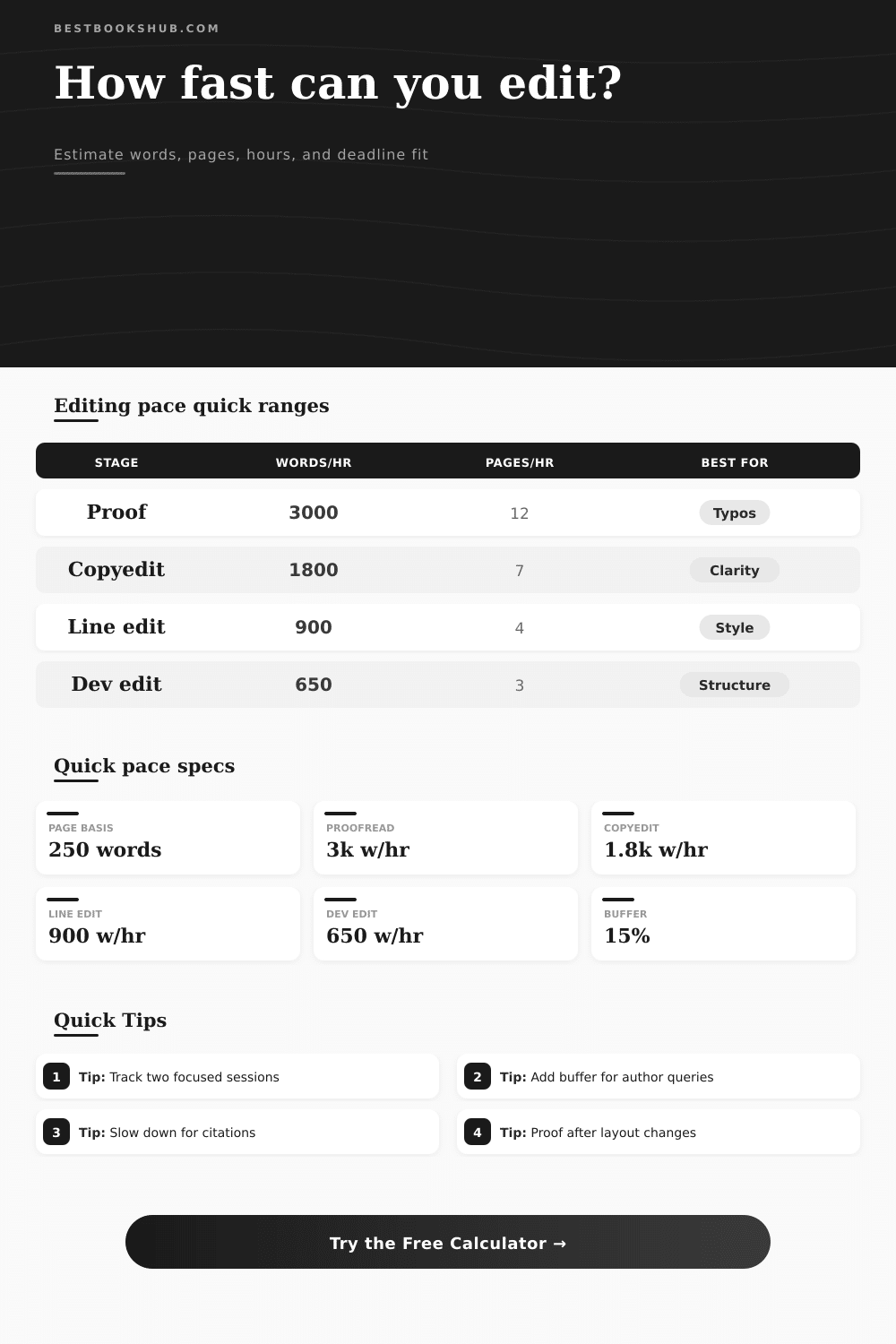
| Editing stage | Typical words per hour | Pages per hour at 250 words | What the pace includes |
|---|---|---|---|
| Layout proofread | 2,400 to 3,500 | 9.6 to 14.0 | Typos, running heads, page breaks, captions, missing words, and final consistency. |
| Clean copyedit | 1,700 to 2,300 | 6.8 to 9.2 | Grammar, punctuation, spelling, light clarity, style sheet entries, and brief queries. |
| Standard copyedit | 1,300 to 1,900 | 5.2 to 7.6 | Sentence cleanup, continuity checks, citation flags, consistency, and author questions. |
| Line edit | 700 to 1,100 | 2.8 to 4.4 | Voice, paragraph flow, repetition, transitions, scene texture, and sentence-level revision notes. |
| Developmental edit | 500 to 800 | 2.0 to 3.2 | Structure, pacing, logic, narrative arc, argument order, margin notes, and editorial memo thinking. |
| Academic edit | 550 to 950 | 2.2 to 3.8 | Dense prose, terminology, tables, references, citations, discipline style, and cautious querying. |
| Project size | Words | Pages at 250 words | Copyedit at 1,800 w/hr | Line edit at 900 w/hr |
|---|---|---|---|---|
| Sample chapter | 5,000 | 20 pages | 2.8 hours | 5.6 hours |
| Long essay pack | 18,000 | 72 pages | 10.0 hours | 20.0 hours |
| Novella | 35,000 | 140 pages | 19.4 hours | 38.9 hours |
| Trade novel | 80,000 | 320 pages | 44.4 hours | 88.9 hours |
| Large fantasy | 125,000 | 500 pages | 69.4 hours | 138.9 hours |
| Complexity setting | Pace multiplier | Why it changes speed | Typical use case |
|---|---|---|---|
| Clean prose | 1.15x | Few repeated issues, stable style, and light author querying keep momentum high. | Polished draft, experienced author, final pre-copyedit pass. |
| Standard trade manuscript | 1.00x | Normal mix of corrections, comments, continuity checks, and style decisions. | Novel, memoir, narrative nonfiction, or practical nonfiction. |
| Messy draft | 0.78x | Repeated patterns require more queries, more checking, and more judgment per page. | Early draft, rushed revision, inconsistent voice, or continuity problems. |
| Technical or citation-heavy | 0.68x | Terms, tables, citations, references, and factual flags slow each decision. | Academic chapters, manuals, textbooks, reports, or endnote-heavy nonfiction. |
| Translated or ESL-heavy | 0.62x | Sentence repair, idiom decisions, and meaning checks require extra attention. | Translated fiction, international authors, or heavily localized prose. |
| Availability pattern | Focused hours per week | 40-hour edit | 80-hour edit | Best planning note |
|---|---|---|---|---|
| Weekend-only editor | 8 hours | 5.0 weeks | 10.0 weeks | Use a larger buffer because restarts cost time between sessions. |
| Part-time weekday block | 15 hours | 2.7 weeks | 5.3 weeks | Good for copyedits if author queries are answered between work blocks. |
| Half-time editorial schedule | 25 hours | 1.6 weeks | 3.2 weeks | Strong pace for book-length line edits and developmental reports. |
| Full-time focused edit | 35 hours | 1.2 weeks | 2.3 weeks | Protect breaks; daily speed often drops late in dense manuscripts. |
DISCLOSURE: This post may contain affiliate links, meaning when you click the links and make a purchase, I receive a commission. As an Amazon Associate I earn from qualifying purchases.
When you’re editing a book, you go back and forth through it, stopping to address things like tone and structure. So you’re doing two different kinds of work at the same time. Planning becomes tricky, since most editors estimate how quickly they’ll get through a manuscript by guessing based off the top of their head (i.e., relying on intuition or memory).
But this won’t help you much; after all, every editor edit differently depending on difficulty level of the material before them. Once you enter your edit type and word count into the calculator, it do the math for you, no need to guess if you can finish within an arbitrary deadline. All it takes is the distinction between proofreading vs. It’s called developmental editing. Most people don’t think about it, but those distinctions matters more than you’d think:
How to Plan Your Editing Time
It also changes the baseline pace based on your stage: the pace of a line edit that’s paying attention to flow and voice are not the same as the pace for a standard copyedit. That way, it doesn’t tempt us to plan a structural overhaul on proofreading timelines (which many people has done!). You’re also slowed down by complexity.
An established writer produce a clean draft, one that’s smooth reading, so you can crank out words at a fast rate, hour after hour. If yours is a messy draft filled with mistakes and inconsistencies that need constant judgment calls, every choice add time. You can’t automate the process of determining what needs correcting and how.
That’s why calculator lowers the estimated speed for translated text and other complex writing (e.g., technical). It captures the fact that technical work take more time, that vetting facts and terms and citations will take longer than spotting a comma splice. Your estimate will reflect the weight of the thinking involved in heavy lifting, as well as the work of actualy typing in the changes.
A buffer is the unsung hero of accurate scheduling. File versions, style sheet updates, and answers to an author’s questions adds up fast on a long project, yet even seasoned editors under-estimate how much time they take. A buffer provides protection from fatigue and interruptions (and yes), it also recognize that spending hours staring at text dulls focus. If there’s no buffer in place, each little formatting tweak and unexpected question move your due date further into the red.
You get to specify exactly what that buffer is with this tool, turning a hazy wish for some wiggle room into a real part of the plan. More than just raw speed are at play here. How many hours per day is available? That factors into the overall length of time as much as anything.
You may be able to bang through edits in a couple of hours one day a week, but now it’ll take months. What matters is not just speed but also being consistent every day. This builds momentum and make the work feel doable instead of impossible.
The page breaks this down with a helpful reference table that display the date when different amounts of hour per week will complete a project. This lets you see what your current workload allows. If the math is close, you can plan to expand the timeline or shift the scope of your daily effort before promising something you won’t be able to deliver.
The last part is calibration. Test these estimates with your own pace by inputting a brief snippet from an actual manuscrit. How do you fare? Are you faster or slower then the tool predicted? Adjust accordingly.
That is how you make this work for yourself. That is how you fill in gaps between you and industry standards. That’s how you take broad statistics and turn them into a custom road map.
What’s that got to do with planning your own edit? Speed isn’t everything, expectations are. Understanding what slows you down let you create schedules that survive a collision with reality. You aren’t trying to get something done in half the time, it’s about giving yourself enough time to get it right. A sensible schedule takes the panic out of editing so you can spend your time on the words instead of the clock. That perspective is more useful than a higher per-hour fee.