📖 Reading pace lab
Effective reading rate calculator
Measure real reading pace after focus time, breaks, note-taking, rereading, and comprehension are applied to pages or word counts.
| Reading task | Typical gross pace | Useful adjustment | Effective range |
|---|---|---|---|
| Light fiction | 220-320 wpm | 0.75-0.90 recall factor | 165-288 wpm |
| Trade nonfiction | 180-260 wpm | 0.65-0.85 recall factor | 117-221 wpm |
| Textbook study | 120-200 wpm | 0.55-0.80 recall factor | 66-160 wpm |
| Academic paper | 90-170 wpm | 0.50-0.75 recall factor | 45-128 wpm |
| Technical manual | 80-150 wpm | 0.50-0.70 recall factor | 40-105 wpm |
| Page type | Words per page | 40 pages | 80 pages |
|---|---|---|---|
| Sparse novel page | 220-270 | 8,800-10,800 words | 17,600-21,600 words |
| Trade paperback | 280-330 | 11,200-13,200 words | 22,400-26,400 words |
| Textbook page | 360-480 | 14,400-19,200 words | 28,800-38,400 words |
| Academic article page | 450-650 | 18,000-26,000 words | 36,000-52,000 words |
| Adjustment | Use when | Typical entry | Calculation effect |
|---|---|---|---|
| Note-taking add-on | You pause to outline or quote | 10-35% | Adds work time |
| Reread share | You revisit dense sections | 5-30% | Adds equivalent text |
| Comprehension score | You test immediate understanding | 60-90% | Reduces useful words |
| Retention score | You care about recall later | 50-85% | Reduces useful words |
| Focus quality | You read in sprints or distraction | 0.90-1.15 | Adjusts planning rate |
DISCLOSURE: This post may contain affiliate links, meaning when you click the links and make a purchase, I receive a commission. As an Amazon Associate I earn from qualifying purchases.
Do you have any idea how many pages you can read per hour? If you’re like most people, you do. And if you’re realy good at it, you’ve trained yourself to use a stopwatch to measure how quickly you read. Faster is better. Right? Wrong. Speed is a red herring.
How quickly you move your eyes across the page doesn’t tell you anything about whether or not you’ll remember what’s inside of the book when you close the cover. How much information will stick? That is what counts.
Why Reading Slower Is Better
Effective reading rate vs. Gross reading rate Most people ignore the difference between these two concept: gross reading rate versus effective reading rate. The gross rate are the number of words per minute. It is a vanity number. The effective rate is the rate adjusted for rereading, note-taking, memory, and understanding. You can read a hundred pages an hour but if you don’t remember anything, then your effective rate is zero.
Once you enter your session details into the calculator above, it does the math for you, saving you from having to guess how long it will realy take you to absorb all that dense material. It forces you to face the price of attention. How long will you take on each page?
Think about this: how many times have you used note taking as a study technique? Sure, note taking helps but it also slows you down. Every fifteen percent of time spent summarizing paragraphs or copying down quotes means you’re sacrificing speed for depth. Usually that’s a good thing. Except when you don’t factor in that sacrifice. When you ignore the time lost, you become overconfident in your progress. You assume you’re halfway through the chapter when you’re barely scratching the surface. This is what the tool asks for, so you can see exactly how much you’re learning and how much you’re simply looking at words.
Rereading is another silent productivity killer. This one’s also universal. You’re reading a dense paragraph and it blurs, time to reread. Ten percent of the words gets double-read. You should of doubled the time spent on that section, but no extra words is added to your overall word count. If you don’t account for rereading in your estimates, you’ve created an unrealistically short deadline.
It’s not much but it’s important; it’s the resistance of hard-to-understand material. Light fiction never asks for as many passes through than a textbook does. Now let’s look at comprehension. Speed reading doesn’t always lead to better comprehension. In fact, when you read quickly, you may understand less. High gross rate + low retention = eye exercise. You can run your eyes over three thousand words but retain only a fraction of them.
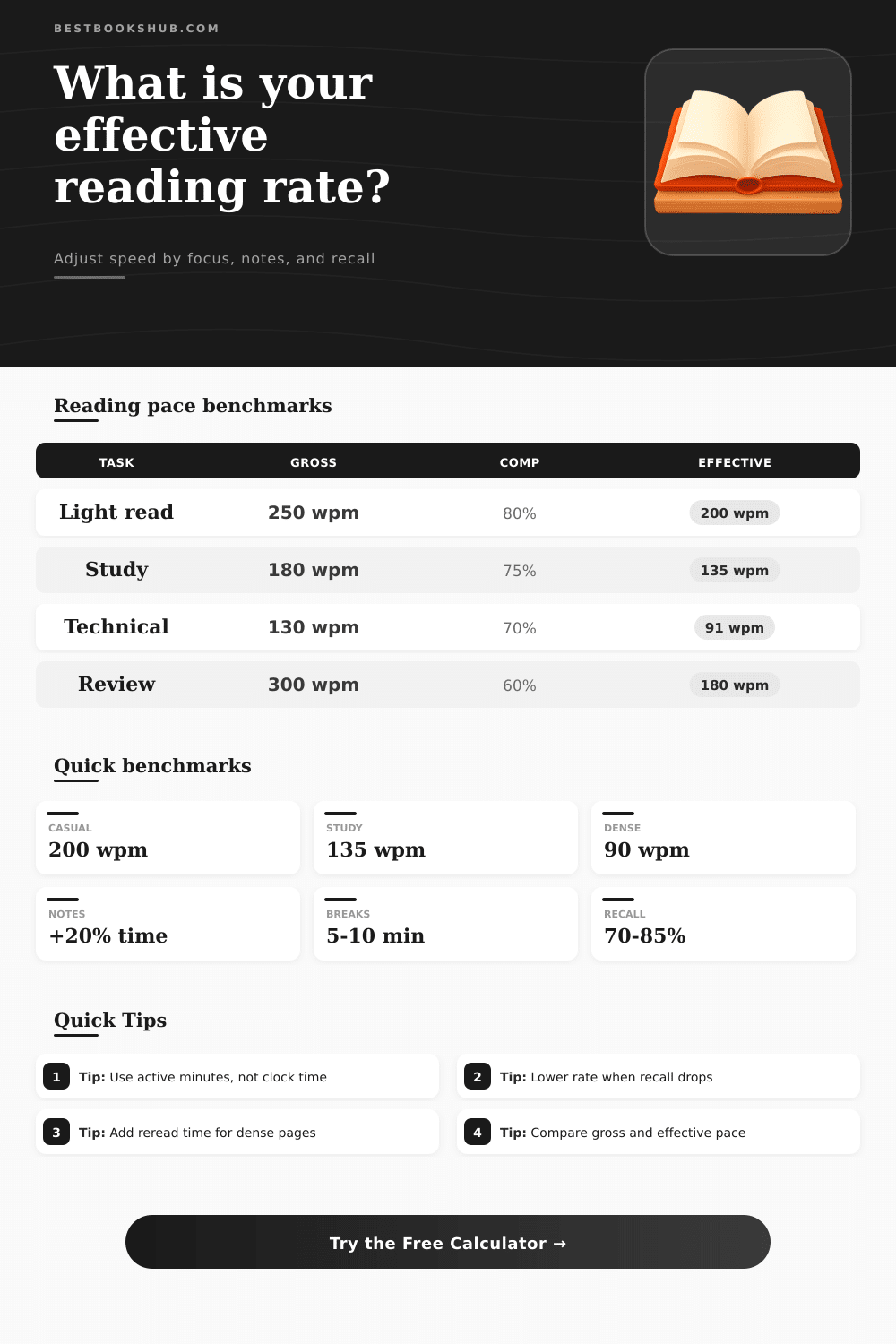
That’s why we have the idea of “useful words.” It removes the noise and reveals how much actual knowledge you took from what you’ve read. Below, on the same page, we have a reference table which compares standard gross paces against adjusted effective ranges for various tasks. It demonstrate how academic papers tend to produce lower effective rates, not because you’re a slow reader, but because information requires more mental effort.
Quality of focus also matters. You can get more meaning out of each minute spent in deep work mode. When distracted, attention is broken up and your brain has to keep restarting the context. Taking a time-sprint may increase your raw metrics, but it usually destroys retention. What are you optimizing for?
If you’re studying for an exam where specific recall matters, then a focused study session make sense. But if you’re reviewing material you already know well for a general overview, then the type of input changes. That’s the beauty of this approach: it takes away the guilt of slow reading. If the material is dense and your retention is high, then slowness is not failure. It’s simply an exercise in accurate accounting.
It’s a measure of your progress in understanding, rather than page turns. And so stop chasing some arbitrary notion of speed. Start tracking what you keep. What’s called “real” learning happens in the gap between looking at a page and owning its contents. Measure that gap, and you’ll read slower, but you’ll read better.