✍ Ellipsis pause analyzer
Ellipsis counter
Count three-dot ellipses, Unicode ellipses, spaced ellipses, repeated clusters, sentence-level flags, and likely trailing-off versus omission signals in pasted text.
Load a sample to test dialogue pauses, academic omissions, spaced editorial style, clustered punctuation, and mixed manuscript formatting.
DISCLOSURE: This post may contain affiliate links, meaning when you click the links and make a purchase, I receive a commission. As an Amazon Associate I earn from qualifying purchases.
Tables update from the current controls. The proxy labels are review hints, not grammar verdicts, because context decides whether a mark trails off or omits text.
| # | Form | Units | Proxy | Zone | Context |
|---|---|---|---|---|---|
| No ellipses analyzed yet. | |||||
| Unit | Ellipses | Words | Trailing | Omission | Preview |
|---|---|---|---|---|---|
| No sentence-level flags yet. | |||||
| Cluster size | Groups | Share | Signal | Review note |
|---|---|---|---|---|
| No clusters above threshold yet. | ||||
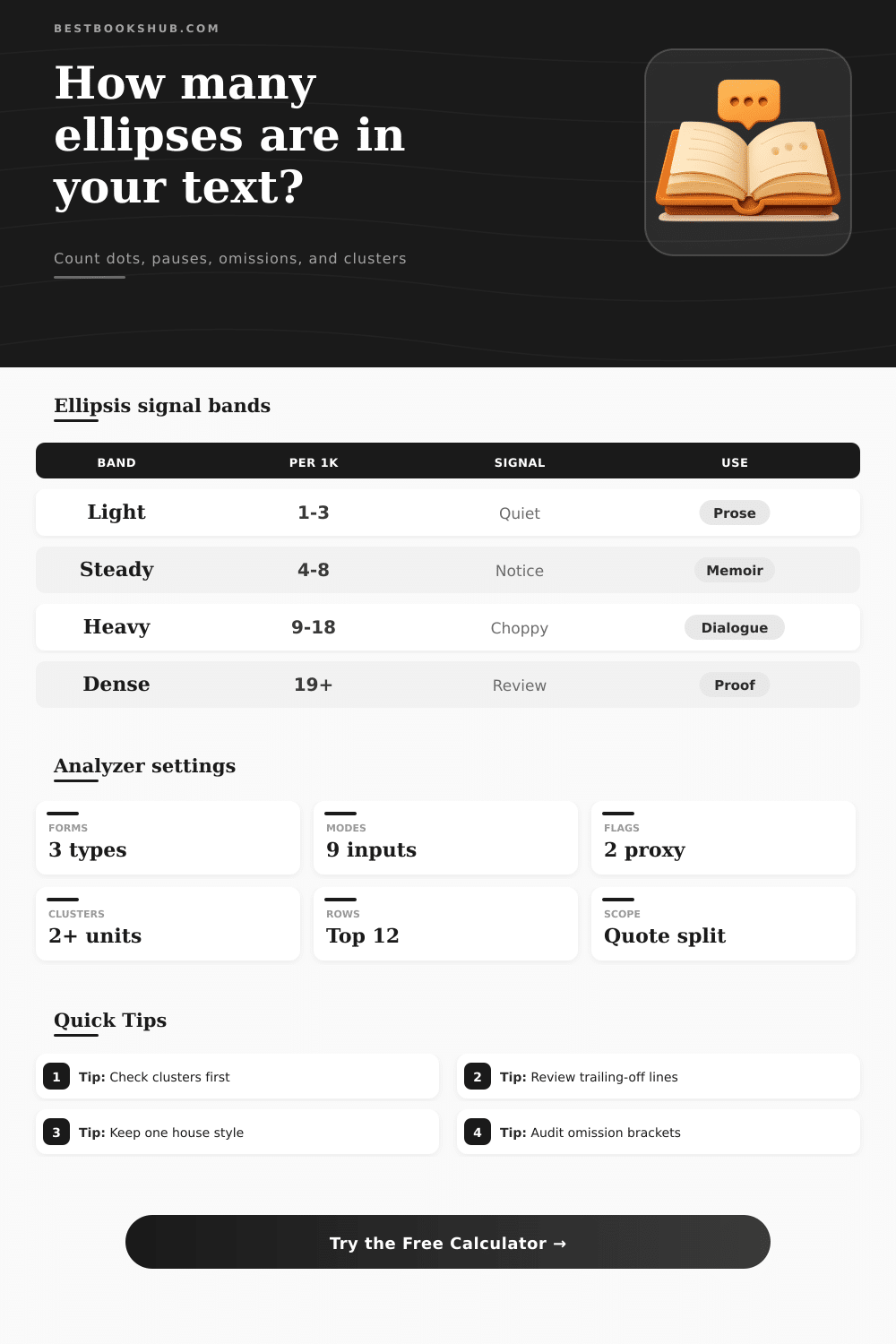
| Density band | Ellipses per 1k | Reader feel | Common use |
|---|---|---|---|
| Light | 1-3 | Occasional pause | General prose |
| Steady | 4-8 | Noticeable hesitation | Memoir or essay |
| Heavy | 9-18 | Fragmented rhythm | Dialogue-heavy pages |
| Dense | 19+ | Needs review | Proofreading pass |
There’s an ellipsis counter for counting all those spaced out ellipses, Unicode ellipses, and three-dot ellipses. You can check for clusters of ellipses and mark spots where the source might have left something out or trailed off.
On the page, ellipses seem easy; they’re nothing but three little dots. But anyone who has stared at a manuscript knows: These marks bear weight. A misplaced ellipsis, and your writing sounds tentative. Too few ellipses, and dialogue feels unnatural. The trick is noticing the pattern before it becomes a habit. This is why a quick tool for keeping count of every type soon prove helpful.
Why Counting Ellipses Helps Your Writing
Consider the way ellipses function in various forms of writing. Fiction use ellipses frequently to indicate a thought trailing off. It’s the dangling thought left hanging in the air as one character chooses her next phrase. Memoirs rely on ellipses to convey moments of emotional hesitation, they substitute for a sigh. Academics flip this script completely. For them, the ellipsis typically indicates something was left out on purpose. Quotations have words removed so the readers’ focus can land where it matters most: what’s left.
And the same symbol performs wildly different function. This split is the reason why classifying matters. If there are brackets around a quote with a mark at the end of the sentence, chances are good it’s an omission. If it follows a period after spoken dialogue and continues on the line in lower case, it’s likely to be a pause. But context is king here, and eye needs assistance spotting the pattern amid thousands of words.
The other issue is clusters: If there are four or five consecutive dots on your screen, it doesn’t look intentional anymore. That’s what happens when someone mashes the period key while debating what comes next. The calculator break those runs into reasonable units so you can decide which dramatic parts to keep or clean up into a single mark.
And most houses has a preference for sticking with one form across the work. Alternating between tight Unicode ellipses in narration and spaced dots in dialogue make unseen noise that readers detect without knowing how to describe it.
The story told by density: A light use, perhaps a handful per thousand words, feels like breath, like natural pauses in breathing. A heavy use break up the cadence and begins to make page itself choppy. Because spoken language is littered with trailing thoughts and false starts, dialogue-filled passages may hold higher numbers of ellipses than straight narrative. Nevertheless, whenever we cross the double-digit-per-thousand limit, it’s a good time to wonder whether something else isn’t amiss with the scene. Are the characters really pausing? Is it possible they’re doing so to avoid the tougher task of creating definitive dialogue?
But what’s the difference between an omission flag and a trailing-off flag? The answer will let you know when omission reflects editorial need, as opposed to creative choice. Omitting something is appropriate in a quotation when you need to stay faithful to the original material, but letting your thoughts trail off might better show the uncertainty of first-person narrator. Without realizing it, one could mix these and cause readers to wonder: Are those missing words, or was that just the thought trailing off? This is precisely the sort of thing careful writers try not to do.
The ellipse has been an issue of style guides for a long time. In some instances, Chicago argues for spaced periods; most publishers are happier using the single Unicode version because it’s cleaner. Consistency across your project matter more than which method you choose. After you establish your house approach, then comes the fun part: identifying moments when a pause is actualy warranted by emotion or evidence.
Finally, ellipses are more of a matter of breath different than they are grammar. Ultimately, when we use an ellipse, we’re controlling our readers’ time, holding it for a moment longer or just until the next thought begins. And with deliberate use, they can be elegant bridges. Without check, they thicken into word-filler. Usually it’s a question of looking at the whole picture before the draft has had a chance to set itself in ink. If you count them carefuly during revision, the picture will be easier to see.