— Dash style analyzer
Em dash counter
Paste fiction, essays, dialogue, copy, notes, or manuscripts to distinguish em dashes, en dashes, hyphens, double-hyphen stand-ins, dash density, and interruption flags.
Load a sample to test balanced fiction, dense voice, interrupted dialogue, ranges, hyphen-heavy copy, and formal text with different dash habits.
| Dash type | Mark | Count | Share | Main use | Review note |
|---|---|---|---|---|---|
| Load text to populate dash family counts. | |||||
| # | Sentence preview | Words | Em | En | Hyphen | Density | Flag |
|---|---|---|---|---|---|---|---|
| No sentence data yet. | |||||||
| # | Line | Pattern | Dash | Context | Suggested check |
|---|---|---|---|---|---|
| No dialogue flags found with the current settings. | |||||
| Target | Typical em dash density | Sentence pattern | Best use | Watch for |
|---|---|---|---|---|
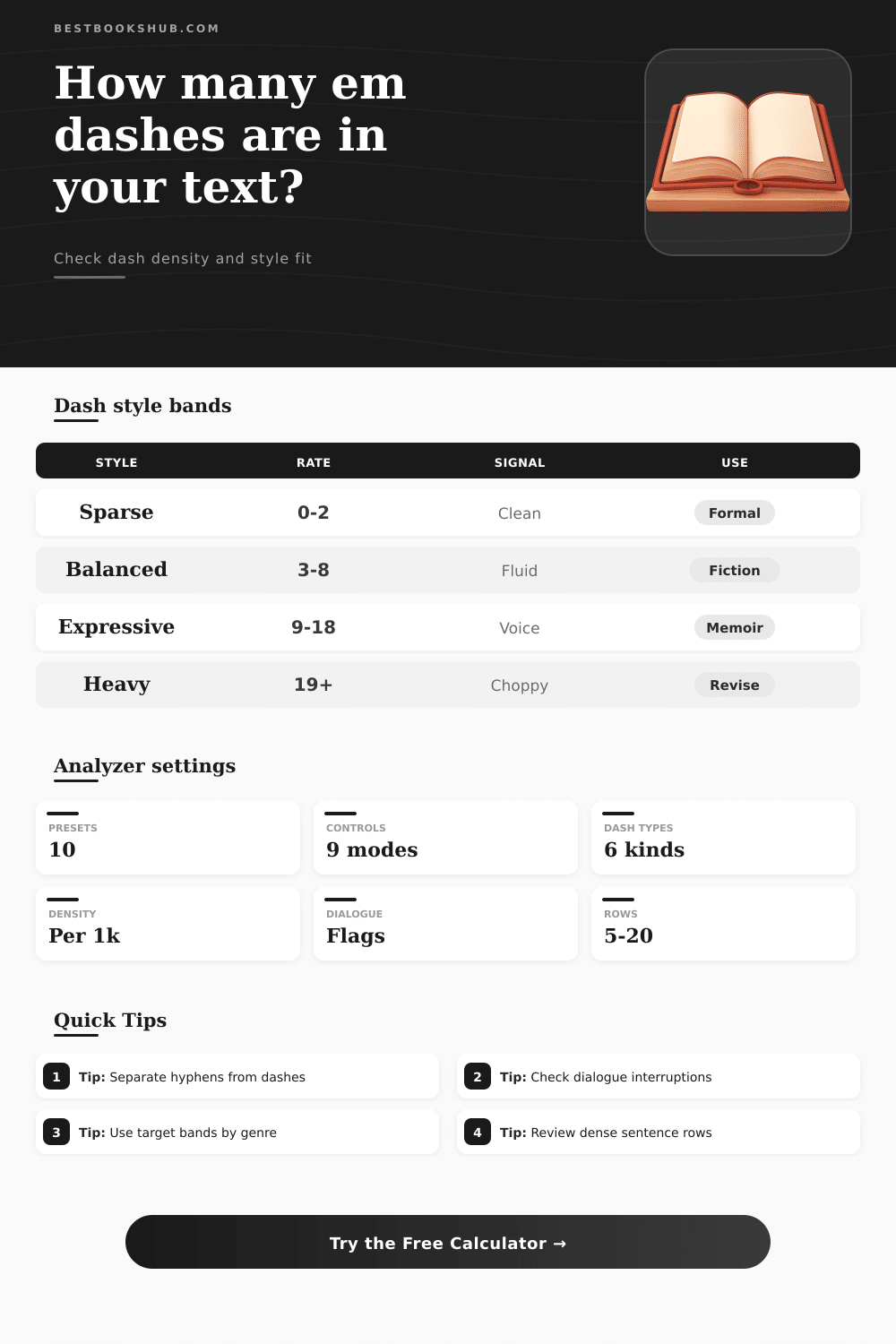
| Formal nonfiction | 0–3 per 1,000 words | Rare, controlled | Reports, academic prose, reference text | Using dashes where colons or commas are clearer |
| General prose | 2–8 per 1,000 words | Occasional aside | Essays, articles, accessible nonfiction | Dense paragraphs with repeated interruptions |
| Fiction | 4–14 per 1,000 words | Voice and pacing | Narrative asides and broken speech | Every sentence landing with the same rhythm |
| Memoir or voice-driven prose | 8–20 per 1,000 words | Expressive cadence | Reflective voice, interiority, quick turns | Losing sentence shape to constant pivots |
| Scripts or dialogue-heavy pages | 6–18 per 1,000 words | Interruptions and beats | Cutoffs, overlaps, unfinished speech | Confusing interruption marks with range dashes |
DISCLOSURE: This post may contain affiliate links, meaning when you click the links and make a purchase, I receive a commission. As an Amazon Associate I earn from qualifying purchases.
I remember an editor sending back my manuscript saying there were too many dashes. What was interesting about that comment was I didn’t know I’d been writing so many. And that’s when you start noticing a habit you didnt know existed.
How much do you really need these dashes? A tool for that would be a handy way to count them. You can use it to differentiate between real em dashes and others that crop up as you write, some are en dashes or double hyphens.
How to Count Your Dashes
So when you get down to the numbers, what starts to show is that your manuscript have patterns. Some chapters lean hard on interruptions while others stays surgically clean. Then you compare the chapters and notice how the voice works better in one than another.
Check the density of punctuation to see how many there are. Three em dashes per thousand words feels sparse, controlled. That’s good for formal or academic nonfiction in which each break should of warranted. Fourteen-plus per thousand feels breathless. It feels like you need a dramatic pause before every thought.
Fiction tend toward four through fourteen dashes per thousand. Voice-driven work and memoir may allow more. After all, the dashes becomes almost like breath marks on a musical score. Where does the narrator change direction? What we want here is to keep those changes intentional, not reflexive.
This gets complicated with dialogue. In well-constructed tight prose, an em dash cutting off a person’s speech can work well. Used too much, though, the em dash begin to resemble a underlined stage direction.
Good interruptions jump off the page. If there are too many, the reader won’t notice the interruptions. It’s worth flagging lines and checking them independently. You may discover that one character is interrupted after almost every line while another have a full sentence. That contrast can tell you where your voice is working and where it’s simply repeating itself.
This is why writers fear counting punctuation: It’ll mess up their flow. But typically it does the reverse, because once you count, you can make conscious choices rather than default to the reflexive ones. Once you know your base rhythm, you no longer fall into it automaticly. When you look at a densely written paragraph, maybe it looks choppier. Maybe a quieter page reveals some admirable restraint. The numbers aren’t about taste, they just disprove idea that all of this was made consciously.
There’s no way to know from the count whether any given dash makes the emotional impact more precise. That is for the ear to judge. But the tool does add context, revealing the pattern that has been created with less than whole-hearted attention. It makes this invisible habit visible and measurable, it then leaves you to choose whether to continue or not.
In the end, em dash is still a useful tool of prose. Used consciousy, rather than by default. When you intentionaly stretch toward it, as opposed to reaching for it reflexively. Know your own habits, know the tolerance of the genre. Trust yourself to be able to break those habits after you learn them. You will breathe better on page and have editors applaud the rhythm rather then wonder about it.