📖 Poem line-end analyzer
Enjambment Counter
Paste a poem to count enjambed lines, end-stopped lines, stanza breaks, line-end punctuation, pause strength, run-on density, and poem-form fit without scanning syllables.
These original short samples emphasize line-ending behavior, punctuation, stanza turns, and run-on movement. They are not syllable-count or free-verse line-length presets.
| Line | Ending mark | Class | Pause score | Next-line cue | Preview |
|---|---|---|---|---|---|
| Line data appears after calculation. | |||||
| Stanza | Lines | Enjambed | End-stopped | Avg pause | Ending profile |
|---|---|---|---|---|---|
| Stanza data appears after calculation. | |||||
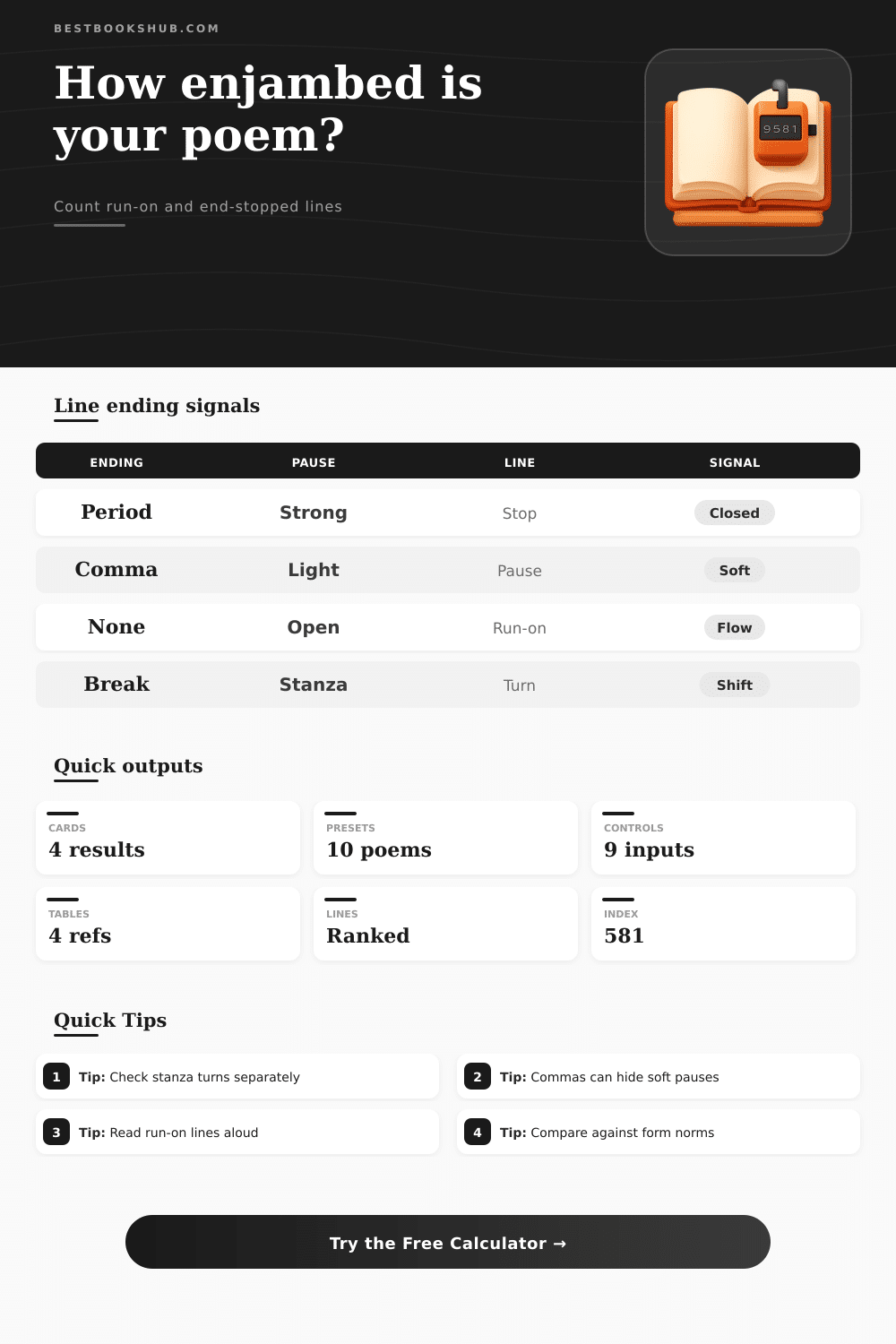
| Ending type | Default class | Pause signal | Revision question |
|---|---|---|---|
| No punctuation | Enjambed | Open carryover | Does the next line complete syntax or image? |
| Comma | Soft pause | Light suspension | Is the pause audible or mainly grammatical? |
| Semicolon / colon | Terminal in balanced mode | Structured hinge | Should the turn close harder or flow onward? |
| Period / question / exclamation | End-stopped | Strong closure | Does closure support stanza or argument? |
| Dash / ellipsis | Soft or terminal by mode | Interrupted hold | Is the line cut dramatic or over-signaled? |
| Form | Typical enjambment | Pause profile | Best comparison use |
|---|---|---|---|
| Lyric free verse | 35% to 65% | Variable, image-led | Check whether line breaks energize images. |
| Sonnet / blank verse | 20% to 45% | Medium closure | Compare argument turns and sentence pressure. |
| Ballad / narrative | 15% to 35% | Clear stanza beats | Watch story clarity at stanza ends. |
| Haiku / imagist | 10% to 30% | High cut value | Review whether breaks sharpen perception. |
| Spoken word | 45% to 75% | Breath-driven | Read aloud for breath and emphasis. |
| Prose poem draft | 60% to 90% | Low punctuation closure | Decide if lineation adds tension. |
DISCLOSURE: This post may contain affiliate links, meaning when you click the links and make a purchase, I receive a commission. As an Amazon Associate I earn from qualifying purchases.
This is an enjambment counter. How does this work? Select your poem’s form. Adjust the weight given to different marks and decide how stanzas should be detected. Record stanza breaks. Note runs on.
Use this enjambment counter to analyze poem line endings, run-on movement, terminal punctuation, stanza breaks, pause strength, and selected form fit. Analyze line endings. Enjambment can be an intimidating-sounding term; if you’ve heard it before, you’ll see that in fact it’s a very naturaly writing device used every day. It refers to the decision not to halt a sentence or image at the line-end but to allow them flow through to the next line. That simple decision make all the difference for reading and hearing a poem.
What Is Enjambment and How to Use It
One might use a lot of enjambment to make the poem feel like a stream of thoughts moving forward, or one might use lots of end stops so that it feels deliberate and structured. Much of the music lie right there in the tension. The impact of punctuation varies by context, which is what’s surprising to most writers. For example, did you know that when used on a line-end in free verse, a comma requests a brief pause from the reader? But when used at a stanza break, the comma have even greater meaning: White space magnifies its impact. The calculator accounts for this complexity, allowing you to modify emphasis of each mark. You’ll also be able to decide how stanzas themselves should be detected.
Why does this matter? What appears balanced on printed page might sound choppy when read aloud. Conversely, what looks messy in print may have a clear logic when you hear it spoken. To take an example: What’s the distinction between a “soft pause” and a piece of terminal punctuation? Generally speaking, a comma means a pause; it’s a period or a question mark that signals a hard stop. Even then, under pressure that rule bend. When performed, a poem may end its line with a dash that acts not as a close but as a dramatic breath.
You can play around with the limits like this, by adjusting different coefficients to see how they nudge the rhythm and observing the results. Chances are most poets will find they have some zone of habit, where they’ve settled into either closing up thoughts at stanza endings or allowing syntax to wander for several pages. Neither is better, realy. The skill is understanding what your ear has latched onto and if it’s suited to specific poem you’re attempting to write. The final proof is to read it aloud.
Your ear alone will tell you if the longest run-on stretch seems confusing or simply breathless. The calculator can list all those lines in order of pause strength and even give you the longest run-on stretch. But who knows how long a line should of be except for the sound of your own reading? This is why the page’s reference tables comes into play. It reminds you, as an example, that typical haiku sequences tend toward short bits and pieces, while prose-poem drafts allows for long runs of words. And yes, the numbers help, by making you ask the more important number: does this poem wish to linger or to race?
Early on, it becomes clear what not to do: Some new writers assume each line break automatically creates enjambment, regardless of other stanza placements or punctuation shifts that change pacing. Others obsess over achieving a certain percentage as if reaching some special number will automatically make it better. Here’s the simple truth: After you’re able to see your patterns clearly, then you can choose consciously when to break them. A different altered ending might completely change an otherwise-pretty stanza into something urgentaly real.
In the end, then, the tool on the page is not necessarily about producing ideal scores but rather making what cannot be heard audible. It turns what you instinctively feel into something that you can examine, modify and rely upon the next time around. Returning to the poem after running the analysis, we begin to hear the lines different. The breaks seem deliberate, not random. Then the craft take on a musical tone.