Serial Word Planner
Episode Word Budget Calculator
Build a balanced word budget for serialized chapters, newsletter fiction, bonus scenes, or long-form episodes by assigning words to scenes, beats, recap, revision drift, and release constraints.
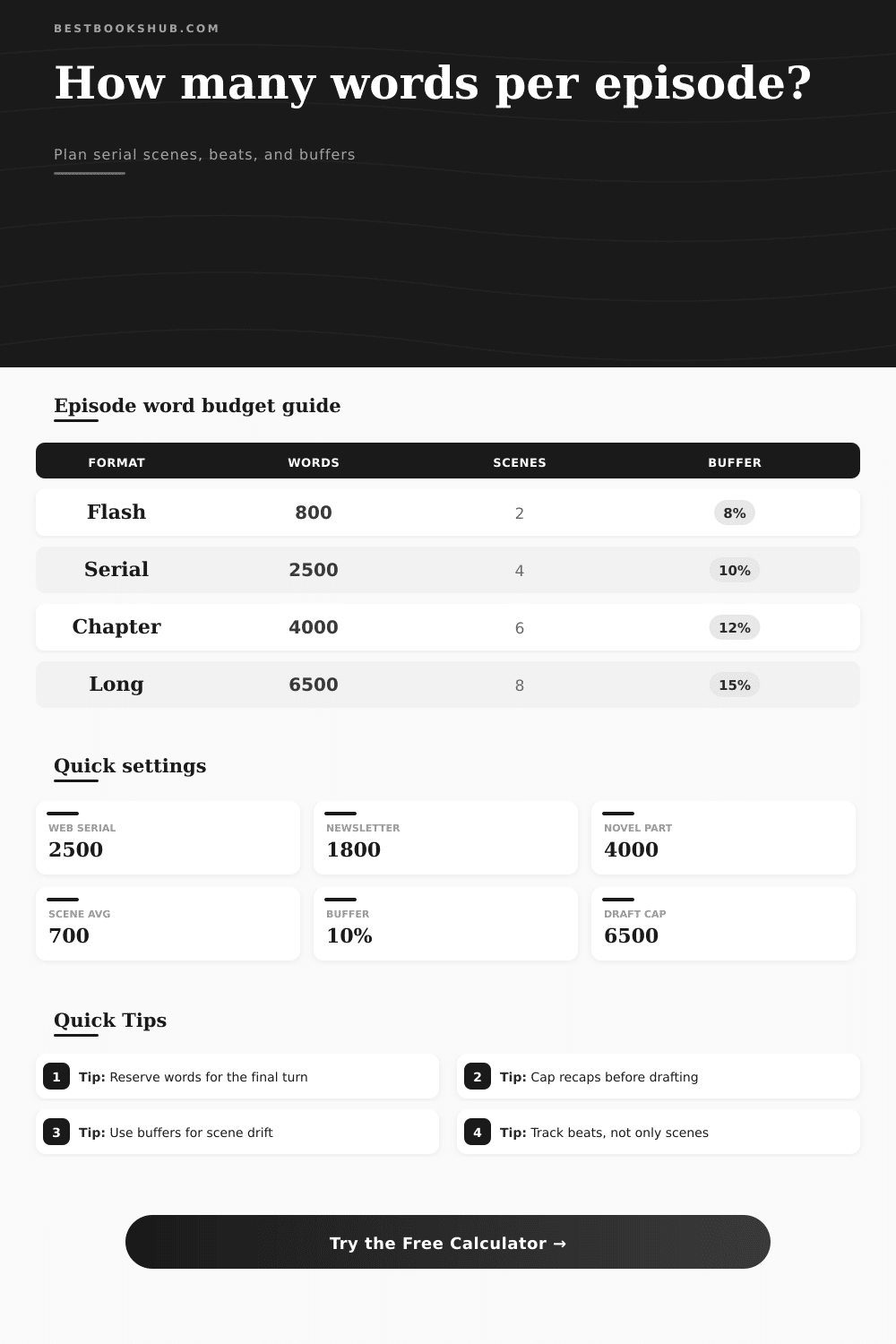
Load a realistic serial format, then adjust the target, scene count, and buffer for your draft.
| Release type | Typical words | Scene range | Best use |
|---|---|---|---|
| Flash fiction drop | 500 to 1,200 | 1 to 2 scenes | Single moment, quick reveal, bonus fragment, or social serial post. |
| Email newsletter installment | 1,200 to 2,200 | 2 to 4 scenes | Readable in one sitting while leaving space for recap and notes. |
| Web serial episode | 2,000 to 3,500 | 3 to 6 scenes | Balanced weekly release with hook, progression, and ending turn. |
| Novel chapter episode | 3,000 to 5,500 | 4 to 8 scenes | Chapter-like pacing for collected editions and longer reader sessions. |
| Finale or arc closer | 4,500 to 8,000 | 6 to 10 scenes | Useful when several threads need resolution without splitting the release. |
| Budget part | Typical share | When to increase | When to cap |
|---|---|---|---|
| Opening hook | 5% to 10% | New viewpoint, cold open, or delayed scene context. | When the episode must reach the inciting exchange quickly. |
| Scene bodies | 65% to 80% | More turns, more viewpoint texture, or action geography. | When scenes repeat the same emotional information. |
| Recap and continuity | 0% to 8% | Long gap between releases or dense plot memory load. | When the previous ending is already clear in the first beat. |
| Ending turn | 6% to 12% | Cliffhanger, reveal, question, or reversal needs space. | When the final beat is only a button line. |
| Author note | 0% to 5% | Newsletter or platform update needs a short note. | When the word budget refers only to story text. |
| Plan | Episodes | Words each | Arc total |
|---|---|---|---|
| Short side arc | 4 | 1,500 | 6,000 words |
| Monthly novella serial | 6 | 3,500 | 21,000 words |
| Weekly season block | 8 | 2,500 | 20,000 words |
| Long web arc | 12 | 3,000 | 36,000 words |
| Collected mini-season | 16 | 2,000 | 32,000 words |
DISCLOSURE: This post may contain affiliate links, meaning when you click the links and make a purchase, I receive a commission. As an Amazon Associate I earn from qualifying purchases.
And maybe you’re on the fourth scene of a serial episode, and you’ve already written half of what you planned to write. The editor want 5,000 words. The character wants to be quiet. The plot demands another turn. The story doesn’t feel finished yet. As you type the next sentence, you slide into red-ink land, where cuts will need to be made (but you keep typing anyway), because otherwise it won’t be done.
Budgeting words this way prevent that spiral from beginning. Managing an episode budget’s like working out a project timeline. Your constraints is limited. This means what you try to fit into a container, like a chapter or a newsletter slot, are finite. You don’t want to spill over, but you do want to pack the thing with something that moves story forward.
How to Plan Your Word Budget
To use the tool, first set your goal or your hard cap (i.e., what your platform will charge you for, or how much of people’s reading time you can command). That becomes your ceiling, which is non-negotiable for some platforms and help prevent cognitive fatigue in others.
Now flip the math: Allocate. Structural stuff take up a lot more real estate than most writers realize. Those little “Recap What Happened Last Episode” paragraphs may not feel like much. However, when spread out across a dozen episodes, they can total thousands of word. These are all words you didn’t use for new material. The calculator makes you factor in this overhead from the get-go. It demands that you saves words for the opening hook and the turn at the end, before doling any out for middle-of-the-episode moments. It helps you protect your most important story beat. Otherwise, the middle section of your episode balloon, leaving zero word space for a strong ending or a compelling cliffhanger.
Take, for example, scenes that gets the story moving versus those that serve no other purpose then getting characters from point A to point B. You want more bang for your buck on the first type. More money needs to be given to these scenes because they count. The second kind is there by necessity…they’re there because you felt like showing us how they got to point B.
Put in your desired episode lengths and scene/beat counts into this tool, and it will evenly split up the remaining words based on the number of scenes, so you can get an idea of whether each beat has enough space to breathe. Does the outputted number of words per beat seem insufficient? Well now you’ve got options: either make fewer scenes or make the entire episode longer. It’s a hard choice but it’ll force you out of laziness when making your plot.
The revision drift buffer is one of more subtle inputs. Serial writers have learned over time that their drafts always expand when they edit them. Add a comma here, expand a description there. Realize a dialogue tag requires clarification. Small additions add up to large word counts. When you add a ten or fifteen percent buffer to your base plan, you’re creating slack in the system. It is not waste space, but insurance against natural expansion of prose. Without it, each edit feels like a crisis because you’re already maxed out.
To put those numbers in perspective: What do they look like? For that, there are reference tables on the page. Long-form fantasy arcs are nothing like flash fiction drops; one needs to be given time and space to breathe and develop detail, whereas the other must lean heavily on implication and compression. Trying to fit a novel’s worth of plot into a newsletter is impossible. Matching your format with what the genre requires will help you avoid this mistake. It’s all about setting realistic expectations (for both you and your audience).
This all comes down to this: Planning out your word budget is not an exercise in limiting creativity. It’s an exercise in providing a secure structure that allows creativity to thrive without risk. Once you’ve set aside your exact number of words per beat, you lose track of the big number and instead worry about making the words count. You write to mean something, not to fill space. The math happens elsewhere; the story happens here. That distinction between what-you-do versus what-your-tool-does is key to keeping a serial sustainable for the long haul.
Build the walls first, paint them later.