📚 Exam reading planner
Exam Prep Reading Schedule Calculator
Turn a reading list, exam date, study speed, and review buffer into a daily pace, weekly target, and finish-by date.
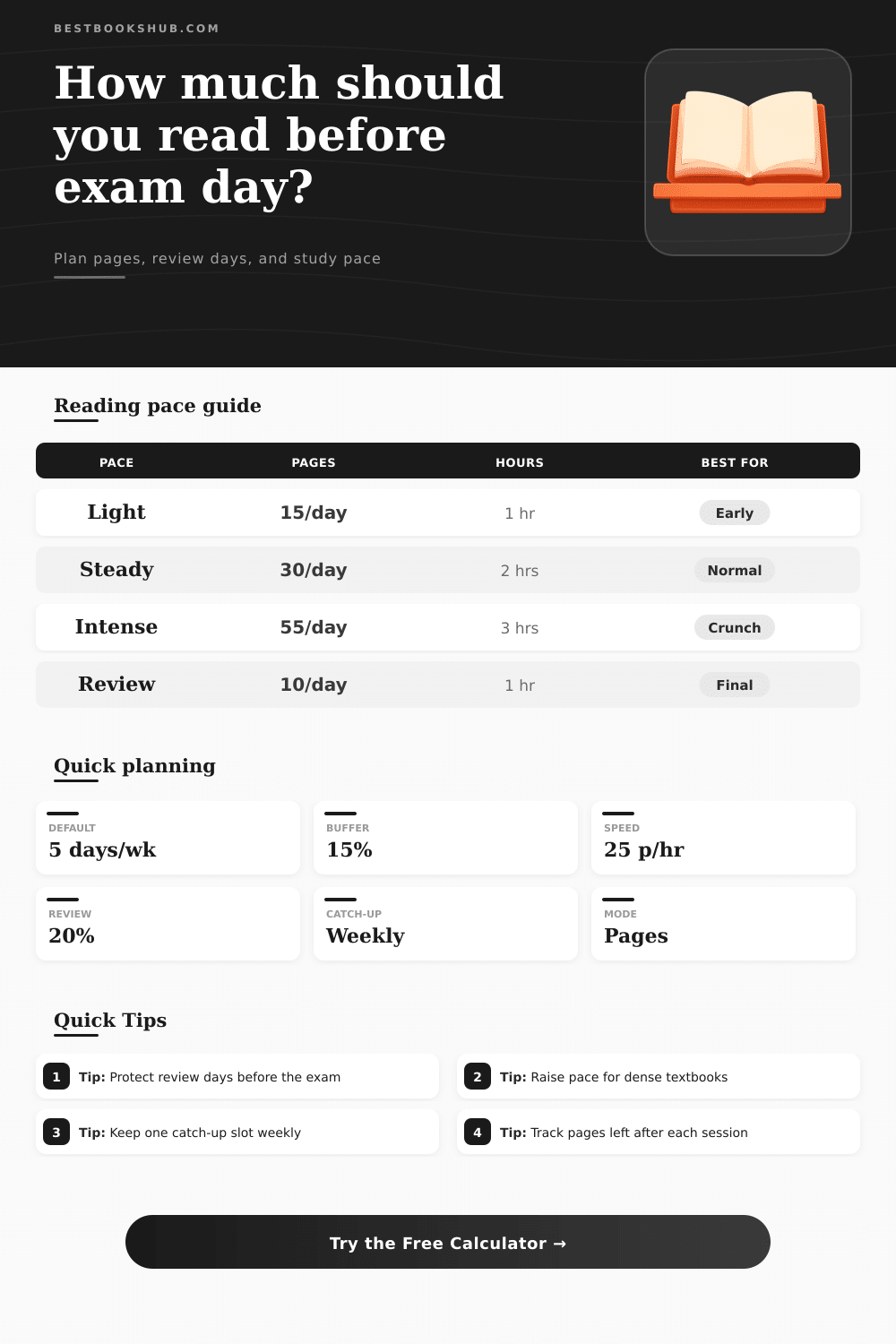
| Pace band | Pages per day | Typical study time | Best use |
|---|---|---|---|
| Light maintenance | 10 to 20 pages | 30 to 75 minutes | Long runway, familiar material, regular class reading. |
| Steady exam prep | 21 to 40 pages | 1.25 to 2.5 hours | Most textbook-heavy midterms and finals. |
| High-load review | 41 to 65 pages | 2.5 to 4 hours | Dense final push with notes taken while reading. |
| Crunch schedule | 66 or more pages | 4 or more hours | Short windows where review quality may suffer. |
| Material type | Speed adjustment | Useful review reserve | Planning note |
|---|---|---|---|
| Lecture notes | Faster than baseline | 10% to 15% | Skim once, mark weak topics, then revisit active recall prompts. |
| Standard textbook | Baseline | 15% to 20% | Leave time for end-of-chapter terms, figures, and summaries. |
| Casebook or primary source | 20% to 40% slower | 20% to 25% | Plan for briefs, issue spotting, and cross-reference notes. |
| Technical or medical text | 40% to 60% slower | 25% to 30% | Expect diagrams, terminology, and repeated recall cycles. |
| Exam window | Recommended reading share | Review share | Catch-up reserve |
|---|---|---|---|
| 7 days | 60% to 70% | 20% to 30% | Half day if possible |
| 14 days | 65% to 75% | 20% to 25% | One day total |
| 30 days | 70% to 80% | 15% to 25% | One day each week |
| 60 days | 75% to 85% | 15% to 20% | Flexible weekly slot |
| Plan style | Daily target | Weekly check | Best fit |
|---|---|---|---|
| Even pace | Same pages each reading day | Compare pages left every weekend | Students who keep consistent routines. |
| Front-loaded | More pages in the first half | Protect the final review block | Dense textbooks and uncertain exam scope. |
| Alternating heavy-light | Hard sections followed by lighter notes | Track fatigue and retention | Mixed chapters, papers, and class notes. |
| Review-first repair | Short reading blocks plus recall | Recalculate after each weak unit | Retakes, oral exams, or cumulative finals. |
DISCLOSURE: This post may contain affiliate links, meaning when you click the links and make a purchase, I receive a commission. As an Amazon Associate I earn from qualifying purchases.
You’re panicking three weeks out from finals, when you see that there is fewer days till the end of the semester than pages on your syllabus. You’re stuck on chapter two in your book, with your text open on chapter ten, wondering whether you should goes to sleep.
But it’s rarely a lack of discipline or knowledge! If only you knew the stuff! The issue isn’t typically one of discipline or unfamiliarity: it’s math. Specifically, you has been thinking about studying as a vague intention. You treat it as something you mean to do, rather than a practical task with set limits.
Why You Need a Study Plan
You must shift from thinking “I need to read more” to asking “How many pages a day can I finish? What’s my exact path to 100% before exam day?” you’ll find yourself far less anxious. Instead of praying, you have a plan. Here’s where this calculator comes in.
By entering your assigned reading load and the number of study days at your disposal, the calculator will do all the math for you. The calculator divides up what to read each day and builds in a buffer for review and practice exams. This prevents it from just spitting out an answer based off simple division, which would be inaccurate.
Most students aren’t failing because they don’t read the chapters; rather, they are failing because they have no time to absorbs that information into their long-term memories before test day. To solve this, the tool removes any mock exam sessions, catch-up slots and designated review days from overall calendar window. Next, it divides the leftover days (those with no new material) by the total number of days remaining to read new stuff.
That way, you’ll never forget to budget enough time to remember the material and end up trying to cram fifty thick-as-molasses legal case into the two days preceding your board exam. The problem with most plans is that the inputs aren’t right. Humans have a tendency towards over-optimism when it comes to their own reading speed: assuming that they can reads at peak performance for three hours straight every single day.
That’s why this planner includes a “difficulty” multiplier to help adjust for that optimism. What works for one type of text (e.g., a standard textbook) won’t work for another (e.g., a dense medical journal). What about a primary source casebook? That’s an entirely different amount of mental effort. You may be able to make your eyes move across the page as fast as before, but your brain isn’t processing as much information per minute, since it needs time to stop and decode the terminology.
Choosing the right difficulty level means you plan to understand what you read rather than just covering pages, which significantly changes your daily goal. And you have to be honest with yourself about how many hours per day you realisticly can dedicate to focusing deeply. Can you take a full course load and work twenty hours a week? Don’t say you have five hours of uninterrupted time each day, that’s a fast track to burnout.
Setting your weekly availability and daily caps in the planner ensures you create a reasonable schedule that won’t fall apart in reality. There’s also an option to add a buffer, because life happens. Sometimes you’ll get sick. Or you’ll have a family obligation. Or sometimes you just hit a wall of mental fatigue around day six.
Add a buffer of fifteen to twenty percent and don’t panic if you’re out one Tuesday. The schedule takes care of absorbing the shock without completely derailing your timeline. The page includes useful benchmarks. These are reference tables that show a good pace for different subjects, which is helpful because it is easy to get caught up in a book and lose track of how long you are reading.
So if you find out you’re supposed to read eighty pages of dense theoretical physics in one hour, that should of sent a flag up, it’s time to slow down and reassess rather than just powering through. Thirty pages with notes will go by quickly and steadily, and is doable. Sixty might be possible during an intensive sprint for a couple of days, but it is unlikely to be sustainable or maintain quality.
Protect your review block at the end. Do the math right now so that by test day, it will be about building confidence and reinforcing what you know, not desperately turning pages. Start from where you are (not where you wish you were) and that tiny change makes all the difference when test day rolls around.