❗ Exclamation intensity analyzer
Exclamation sentence counter
Paste fiction, dialogue, blurbs, comics, essays, or copy to count exclamation sentences, mark clusters, intensity score, dialogue versus narration split, and genre target bands.
Load a sample to test low-key prose, energetic dialogue, comic beats, launch copy, and chapter excerpts with different exclamation habits.
| # | Sentence preview | Marks | Cluster | Zone | Signal |
|---|---|---|---|---|---|
| Results appear after calculation. | |||||
| Cluster size | Count | Share | Likely effect | Review note |
|---|---|---|---|---|
| Cluster summary appears after calculation. | ||||
| Text zone | Sentences | Exclamation sentences | Share | Marks | Average force |
|---|---|---|---|---|---|
| Dialogue and narration split appears after calculation. | |||||
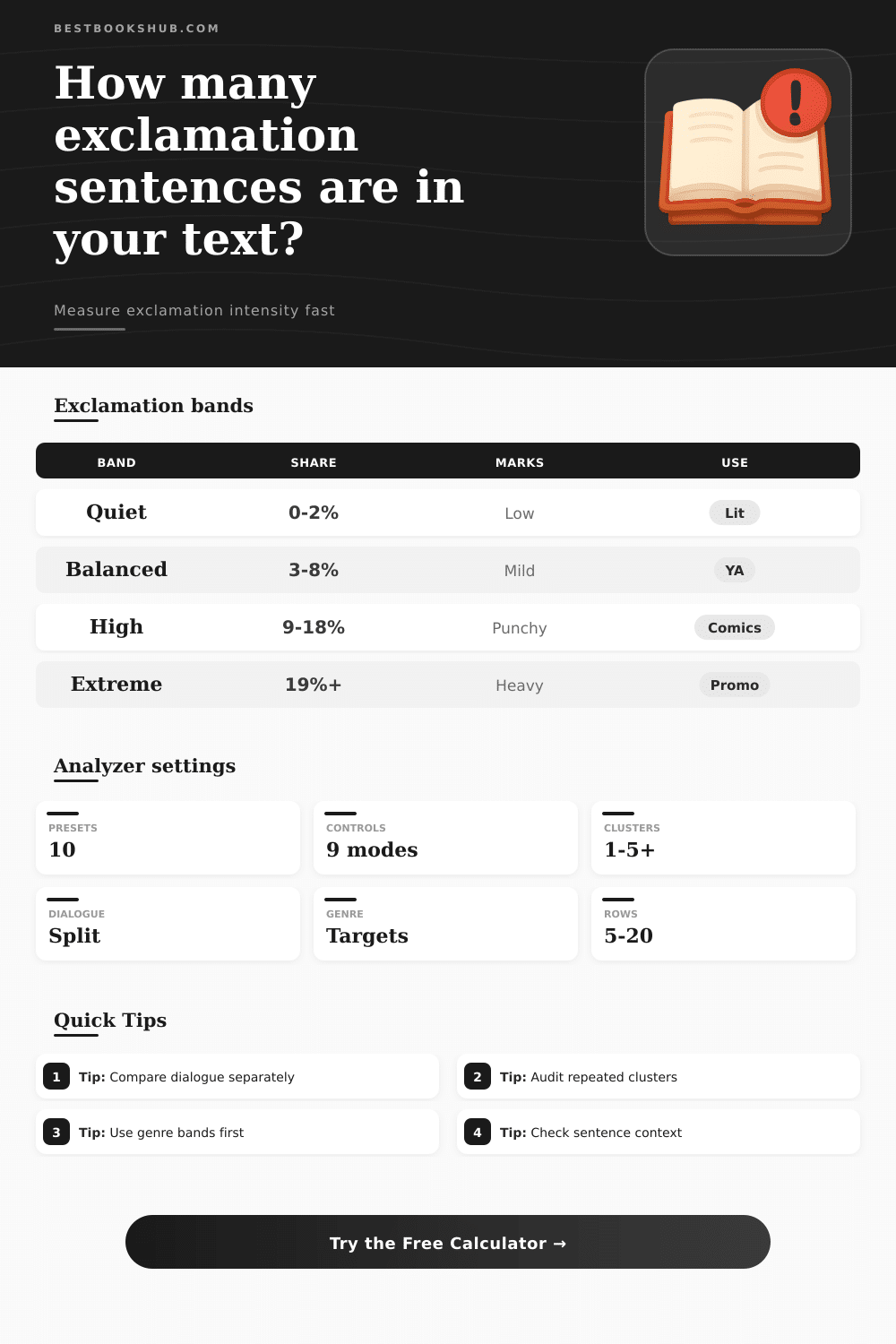
| Genre or use | Typical exclamation sentence share | Cluster tolerance | Best editing check |
|---|---|---|---|
| Literary or general prose | 0-3% | Very low | Use only where silence would flatten meaning. |
| Commercial fiction | 1-7% | Low to moderate | Keep most marks in dialogue or high-stakes beats. |
| YA and middle grade | 3-12% | Moderate | Separate character voice from narration habit. |
| Comics, scripts, or captions | 8-25% | Higher | Check whether clusters replace action clarity. |
| Promotional copy | 5-18% | Moderate to high | Limit repeated urgency in adjacent lines. |
| Academic or formal nonfiction | 0-2% | Nearly none | Replace emphasis with precise wording. |
DISCLOSURE: This post may contain affiliate links, meaning when you click the links and make a purchase, I receive a commission. As an Amazon Associate I earn from qualifying purchases.
The Punctuation Police will give you an idea about how many sentences ends in exclamation points. Clusters, intensity, genre fit.
Before revising your punctuation, try checking the dialogue for balance first. When characters is shouting on the page, without any dramatic cause, the whole scene sound too loud. A quiet novel might sound like a sales flyer. Usually it’s not the words. It’s the exclamation points that carry weight of tone. Until you see the numbers, most writers don’t realize just how reliant they are on them.
Why Too Many Exclamation Points Is Bad for Your Writing
This refers to whole sentences instead of treating each mark as its own part. Because one mark at the end of a sentence seem like a raised voice. Three does seems aggressive. And this matters, because the raw count can be deceptive. Narration which spikes with surprise every other paragraph is not the same thing than one character yelling. The calculator break this down automatically. You’ll know whether or not the excitement lies within dialogue (where it should). Whether or not the very intensity have spilled over into the telling itself.
Every genre has a tolerance for this kind of intensity. Serious literary fiction might be less tolerant then comics. The reader expects something from whatever kind of book she pick up. An adventure story for the middle grades can survives a higher share of exclamations because that audience is still learning how to feel big emotion on the page. Commercial fiction inhabits a tighter band. We want punch without exhaustion. Too much beyond that and it feels hysterical rather than urgent.
The diagnostic power come from cluster detection. When a writer’s repeating the same string of marks (e.g., a bunch of !s) that often means she’s leaning on the emphasis button instead of using a stronger verb. Those clusters is flagged by the calculator and highlighted where they occur. You may discover that even within a quiet excerpt you have three instances of triple exclamation in fewer than two hundred words. That pattern are the key to understanding what made beta readers feel the tone was off. Why couldn’t they say? It was just something they couldn’t pin down. But the data tells them.
Afterward, seeing the split between narrator and dialogue makes all the difference. Narrators typically shouldn’t be loud or messy. Characters can. You can breathe easier once you see that most of your exclamations sits inside quotation marks. When you reverse the split, you’ll know which sentence need a scalpel.
Similarly, intensity scoring works. It’s more about the trend across several drafts than the specific number. Observe where the score plummets after swapping vague verbs for those that hit the target. Punctuation begins feeling like a choice, not a necessity.
Exclamation point usage is a lot like seasoning. We write by sprinkling exclamation points around until it feels right. The problem is, we get used to it. What was invigorating in draft one becomes frenetic after the fifth. When you run your writing past this exercise, you break that habit. You become aware of how a solitary mark can have more punch than a string of five. You relearn to trust the quiet.
The best drafts rarely eliminate every exclamation; they simply make each one intentional. Readers stay tuned in to a story that understands when it needs to speak up and when to hush itself back down. And that’s not a result of hard and fast rules; it’s a result of being able to see the pattern so well you can choose consciously.
When something in a scene doesn’t feel right, let your data provide the answer. Odds are it would of be on the other side of the sentence.