Fanfic Planner
Fanfic Word Count Calculator
Estimate final fic length, chapter averages, arc word budgets, posting dates, remaining draft work, and revision-safe buffer for one-shots, chaptered fics, and longfics.
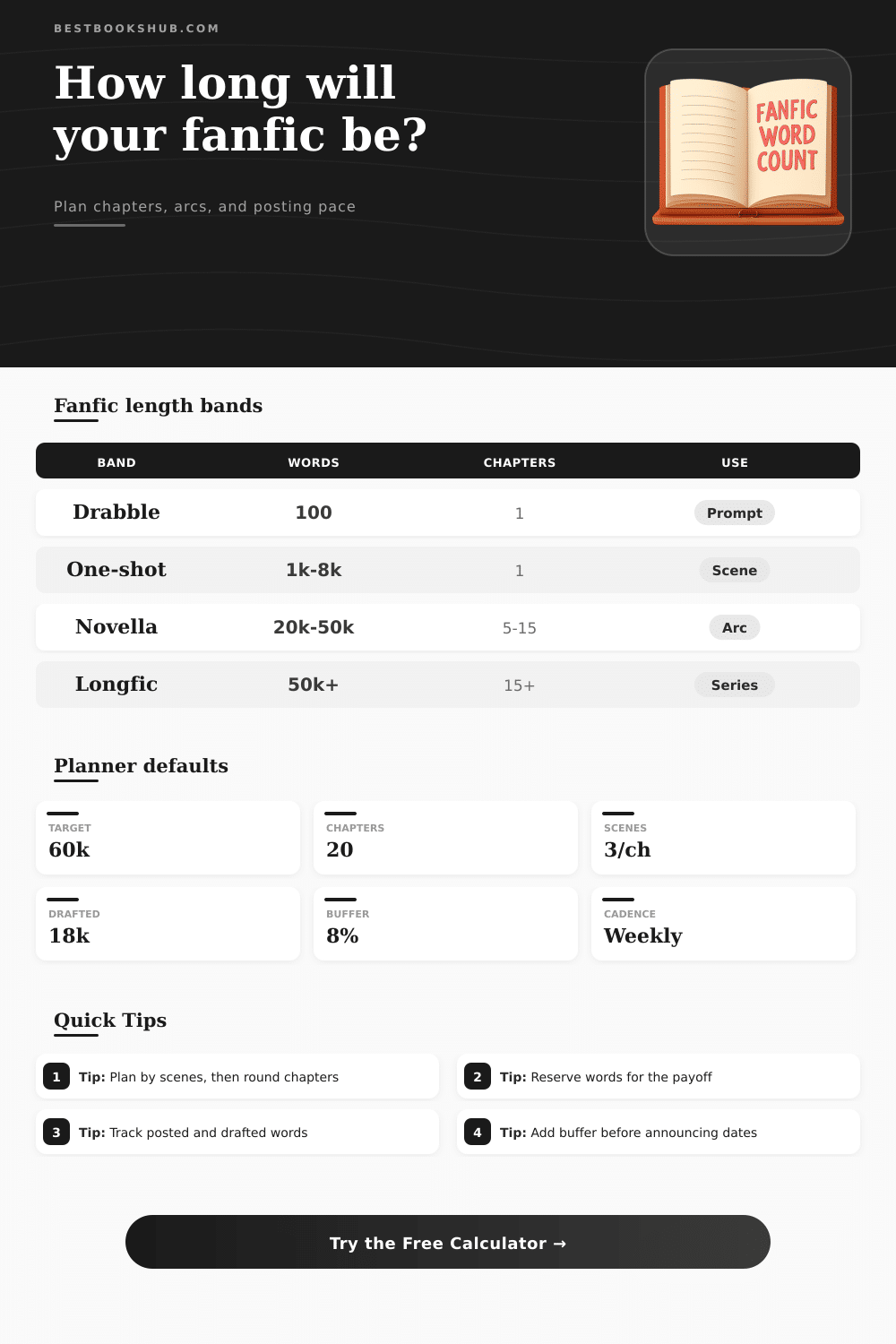
| Fic type | Typical words | Chapter shape | Planning note |
|---|---|---|---|
| Drabble set | 100 to 2,000 | 1 to 20 tiny entries | Count each prompt separately, then add intro or notes only if needed. |
| One-shot | 1,000 to 8,000 | Single chapter | Use scene count more than chapter math; one-shot pacing can stretch. |
| Mini arc | 8,000 to 20,000 | 3 to 8 chapters | Best planned around a turning point, reveal, and short payoff. |
| Novella fic | 20,000 to 50,000 | 6 to 16 chapters | Leave room for relationship beats or case steps between plot turns. |
| Longfic | 50,000 to 150,000 | 15 to 45 chapters | Track midpoint, darkest moment, and final sequence early. |
| Posting cadence | Best for | Buffer target | Risk check |
|---|---|---|---|
| Every 3 days | Short event fics | Finished draft | High pressure unless chapters are already complete. |
| Weekly | Most chaptered fics | 3 chapters ahead | Stable if your drafting pace matches one chapter per week. |
| Every 2 weeks | Dense chapters | 2 chapters ahead | Good for beta reads, art inserts, or heavy revision. |
| Monthly | Epic or research-heavy arcs | 1 to 3 chapters ahead | Readers can handle it if update notes stay consistent. |
| Chapter average | Reader feel | Scene count | Useful when |
|---|---|---|---|
| 800 to 1,500 | Fast updates | 1 short scene | Prompt fills, chatty slice-of-life, or event posting. |
| 1,500 to 3,000 | Light chapter | 1 to 2 scenes | Romance beats, comedy, recovery scenes, or short cases. |
| 3,000 to 5,000 | Full episode | 2 to 4 scenes | Common longfic chapter size with room for B plots. |
| 5,000 to 8,000 | Dense update | 3 to 6 scenes | Action arcs, crossover logistics, or finale chapters. |
DISCLOSURE: This post may contain affiliate links, meaning when you click the links and make a purchase, I receive a commission. As an Amazon Associate I earn from qualifying purchases.
You’ve got a couple thousand words down on a chapter and all of a sudden you can’t think where to take your character for another dozen pages. That’s what panic looks like: at first, it’s more of a feeling of losing steam; later it becomes a sense of desperation, a desperate attempt at drama, which turns out to be no more than an act of writer surrender.
Word count is the skeletal structure of your story. It isn’t just something that shows up on a writers profile page. If you don’t have a word-count goal, you’re writing in the dark and praying the story will come through the fog. When you do, you’ll know exactly how much space there is for things you want. You will have room for subplots, character growth, and moment to let the reader breathe. You don’t have to guess at pacing either: put in your goals, and let the calculator up top take care of math.
Why Word Count Helps Writers
Most of us start with a feel, we have some dynamic or picture of a scene, but no idea what to contain it within. That’s where you begin: do I want something that can absorbs within a single breath (vignette) or something that demands a full set of lungs (a saga)? Think in terms of scenes instead of chapters when doing something like a quick confession/missing scene. Tighter pacing mean no wasted energy, and each paragraph earns its spot.
Stretch that energy across a longfic, however, and the rules shift: now there’s room to breathe, but also room to drift. This is bad news if you’re a serial writer, since now any drift while writing could leave you twenty chapters in before realizing there’s no end in sight. This is where monitoring your average chapter length matter. If your gut tells you each chapter should of run five thousand words, but you know from experience they tend to clock in around three, believe the past. Use the tool to set your total goal and then calculate what the required average would be to hit that number. And yes, it even factors in the fact that drafts gets ugly. You’ll trim scenes. You’ll stretch others. Eight percent wiggle room ensures you can adjust without the whole thing crashing down. This helps if you finally realize chapter four was really just two scene glued together with duct tape and hope.
Another aspect that goes beyond mere word count is scheduling. Writing a fic and posting a fic are two very distinct disciplines. The calculator treats posted chapters as separate from drafted words to save your sanity. Having extra chapters ready gives you the freedom to hit a creative wall or take a sick day without skipping an update. Consistency matters much more to readers than volume does. To be consistent, shoot for being three chapters ahead if you plan on posting weekly. That cushion can absorb lifes interruptions. Otherwise, you’re on a tightrope with no net: just you and one chapter, which means the pressure will shine through in the prose.
For reference, here’s a chart of what various lengths generally look like, from the page: Different lengths feel different in terms of volume, and they also has different architectural requirements. Series are structured; novellas are all about momentum. Recognizing the distinction can tell you whether or not you should stop. All too often I see writers padding their work because they assume bigger is always better. It’s not. Every time, a tightly written eight-thousand word story will trump a meandering thirty-thousand word story.
You want your narrative to get to its emotional payoff without overwhelming readers with detail, but with enough detail to make them feel something. Your Word Budget is Limited You’re only given so much narrative budget… How many lines of dialogue, description, and action can fit into the draft? Spend it all in Act One, and by the time the climax arrives, you’ll be broke. The Arc Map visualization makes that clear: you have to allocate words to the resolution just as carefully as the setup. Starting quickly isn’t nearly as important than ending well. When you view your draft as a finite resource instead of an endless scroll, you gain control over the pace. You build. Instead of guessing. This removes that panicked feeling, knowing precisely how many steps are left to the exit. #4