🔧 FE readiness model
FE Exam Score Calculator
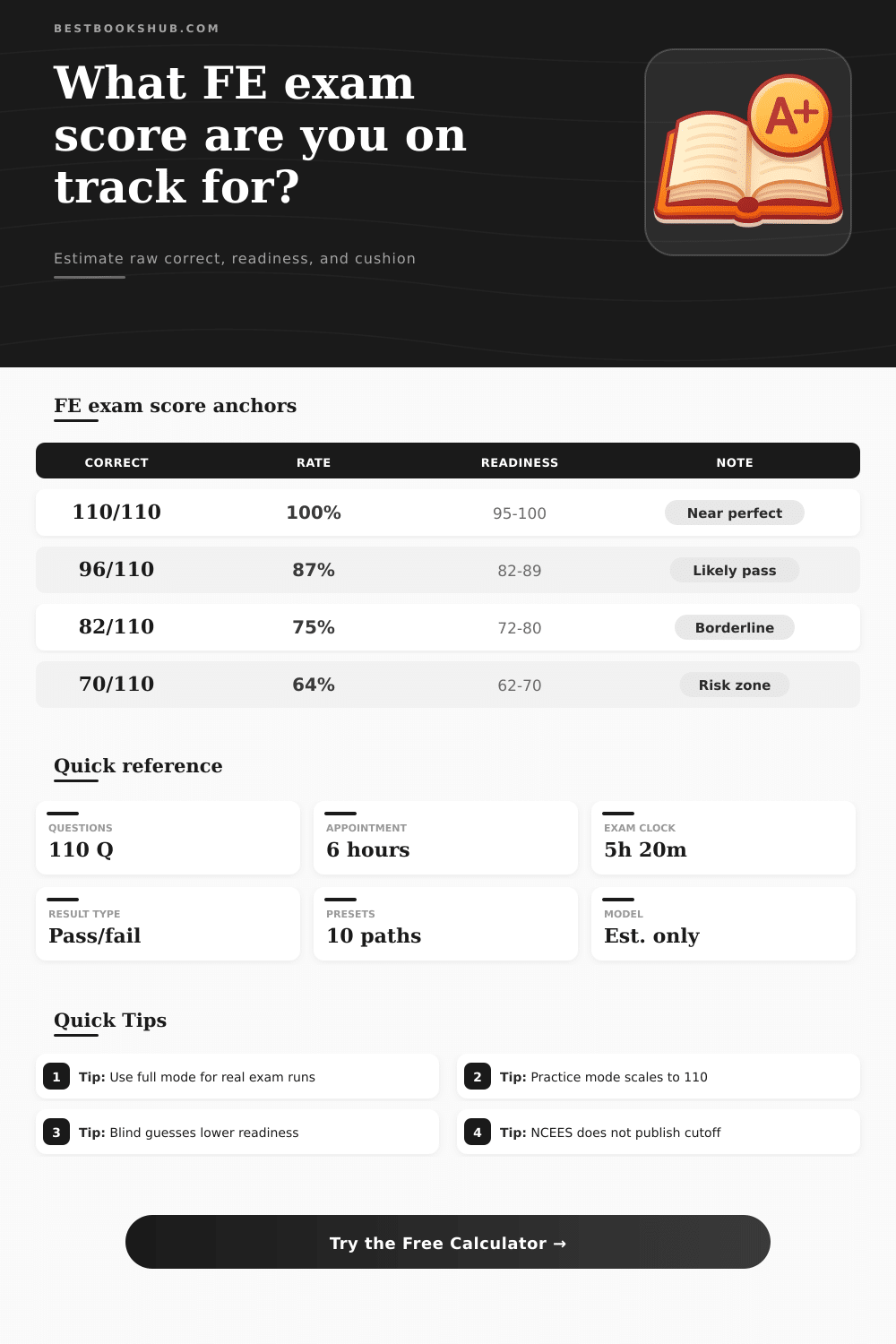
Estimate FE readiness from correct answers, practice-set size, pacing reserve, and weak-topic flags. This is a model, not the official cut score.
These tables turn the published FE structure into a quick planning view. The readiness ladder is a model, while the exam facts come from NCEES.
DISCLOSURE: This post may contain affiliate links, meaning when you click the links and make a purchase, I receive a commission. As an Amazon Associate I earn from qualifying purchases.
The FE exam is simply pass or fail. NCEES, the organization that runs the test do not issue passing score. It is a computer exam that you can do any time during the year.
The test lasts five hours and twenty minutes, with 110 questions covering an engineering degree.
How the FE Exam Is Scored
Results of all FE exam results point only pass or fail. They do not carry a number score. NCEES does not share passing points because those range according to the difficulty.
The exams use a scaled system, so the raw score adjusts. Raw score is only the amount of right answers. You then convert it to a scaled score, that considers little differences of difficulty between various versions of the test.
There are no points reduced for wrong answers, so everything depends on the total of right.
What percentage you require to pass stays something mysterious. Most ratings say that around 50 to 60 percent of right answers suffice. Widely you consider that 50 percent of the questions well done already answer, although it can adjust according to the whole difficulty of the exam.
Some opinions go higher, for instance one calculation shows around 67.4 percent as the necessary score. A professor that helps students prepare for the FE Civil said that around 77 right answers, so 70 percent, is what must.
The belief about 70 percent comes from the times of paper and pencil tests. Then you set every raw score to 70 scaled, so that results of different dates be comparable. That 70 percent figure stayed almost as an urban legend.
NCEES scales the minimum raw score to 70 in its system.
Various branches maybe have a bit different limit scores. For the FE Civil, a diagnosis with 60 percent and failure happens rare. But for chemical, electrical and mechanical, the threshold can reach 65 percent.
The diagnostic report warns that you can not exactly count the number of right answers, because each exam is another.
Not all of the 110 questions affect the final score. Around 10 of them are pilot questions without points. 20 to 30 questions are purely conceptual, and some answers are not even present in the reference manual.
Newcomers occasionally succeed more than repeaters. NCEES mixes psychometrics, expert opinions and scaling methods to set results. Practical attempts of NCEES have questions and solutions that imitate the real computer exam format and experience.