📖 Spanish readability lab
Fernandez-Huerta readability calculator
Paste Spanish text to calculate the Fernandez-Huerta score from syllables per 100 words and sentences per 100 words, then map the result to Spanish education bands.
Load a sample in Spanish, then adjust the sample window, sentence rules, syllable method, target education band, and output precision.
| Variable | Current value | Formula role | Editing signal |
|---|---|---|---|
| Load a preset to see Fernandez-Huerta formula terms. | |||
| FH score | Readability band | Spanish education signal | Typical action |
|---|---|---|---|
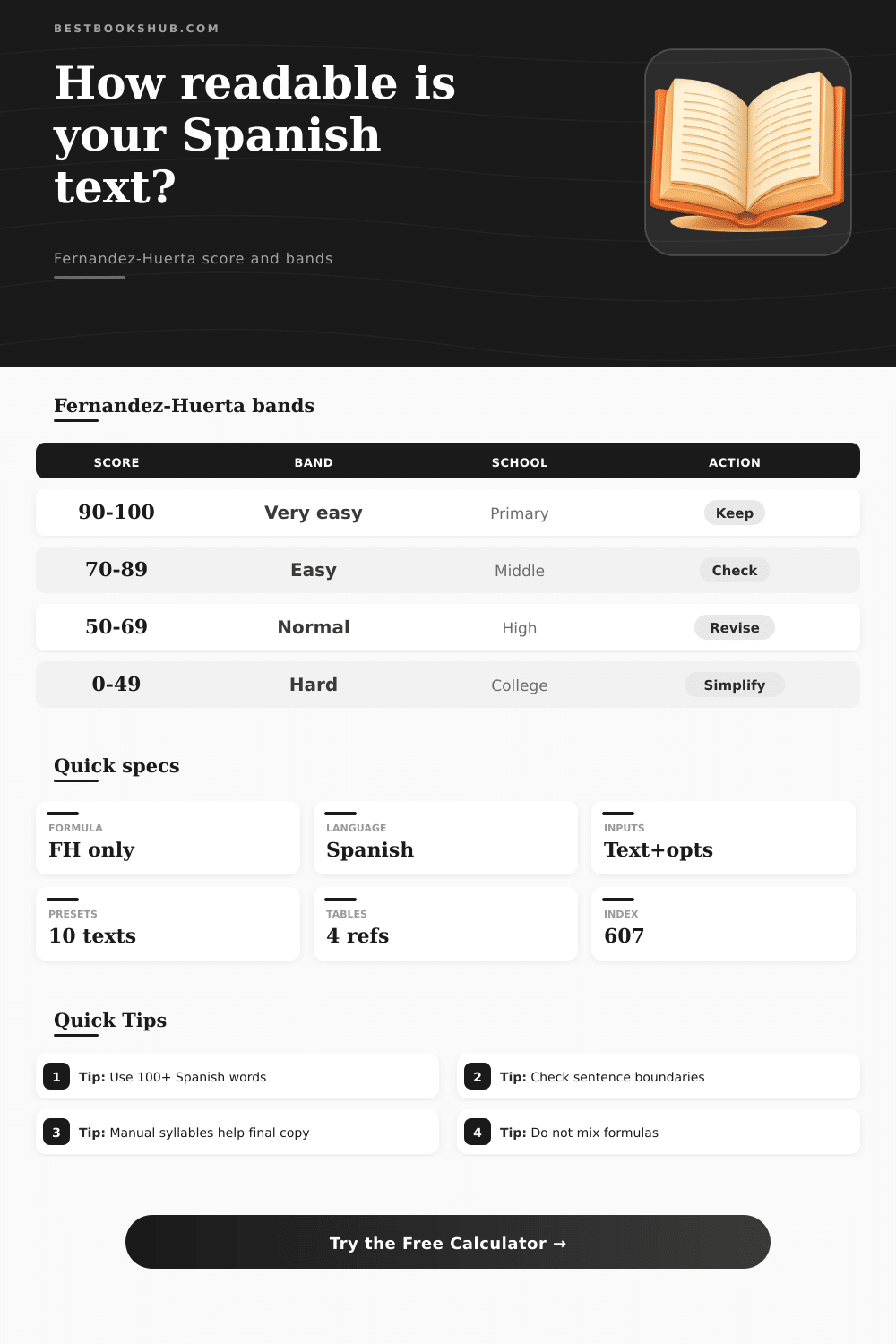
| 90-100 | Muy facil | Primaria inicial | Keep short sentences and familiar words. |
| 80-89 | Facil | Primaria superior | Usually clear for broad school use. |
| 70-79 | Bastante facil | Secundaria inicial | Check long sentence clusters. |
| 60-69 | Normal | Secundaria / Bachillerato | Suitable for many general readers. |
| 50-59 | Algo dificil | Bachillerato avanzado | Revise if the audience is broad. |
| 30-49 | Dificil | Universidad | Simplify for public-facing copy. |
| 0-29 | Muy dificil | Posgrado o especialista | Use only for expert audiences. |
| Sample size | Reliability | Why it matters | Best use |
|---|---|---|---|
| 0-49 words | Very low | One sentence or one long word can swing the score. | Only quick experimentation. |
| 50-99 words | Low | Counts begin to stabilize but still move quickly. | Draft-level checks. |
| 100-249 words | Fair | Classic readability samples often start here. | Paragraph or page review. |
| 250-599 words | Good | Sentence and syllable averages are steadier. | Section-level editing. |
| 600+ words | Strong | Several sentence patterns are represented. | Chapter, article, or policy review. |
| Formula | Language focus | Variables used | This calculator output |
|---|---|---|---|
| Fernandez-Huerta | Spanish | Syllables per 100 words and sentences per 100 words | Calculated as the main score. |
| Flesch-Szigriszt | Spanish adaptation | Related syllable and sentence variables with different constants | Not calculated here to avoid mixed formulas. |
| Szigriszt-Pazos INFLESZ | Spanish public text | Words, syllables, and phrases in its own expression | Not duplicated in this tool. |
| Gulpease | Italian | Letters, words, and sentences | Reference only, not a Spanish FH score. |
DISCLOSURE: This post may contain affiliate links, meaning when you click the links and make a purchase, I receive a commission. As an Amazon Associate I earn from qualifying purchases.
This is a handy little tool for scoring text in Spanish. Enter some Spanish text. You will get a score on readability, the number of sentence per 100 words, the number of syllables per 100 words, education levels, formula steps, and sample warnings.
If the words on the page create barriers or provide opportunities, then you’re writing for Spanish speakers. A teenager reading a chapter of history, a parent reading a notice from the school, an older adult following public health guidance, all comes with their own set of limitations and expectations. The Fernandez-Huerta formula takes into account both sentence frequency (how much breathing room are you providing the reader?) and syllable density (what’s complexity of language itself?). It measures how well your text meet those limits.
How to Use the Spanish Readability Tool
It’s easy to figure out. Take 206.84, subtract some points because of how many syllables there is in each word, then deduct more points based off how often it has a complete sentence, and there you have it: a number from zero to a hundred that represents ease of readability. The higher the number, the easier it reads.
For Spanish, this makes sense since Romance languages tend to be written with lots of multisyllabic word (a long noun can convey the same as three short English words). However, as the number of syllables increases, it can become harder to read, especially if you are stressed or young. But cutting all your sentences short also tire the reader out. So the calculator resolve these competing stresses.
The raw score is translated into education bands that provide practical guidance. If the score is above ninety then it’s probably good for an early primary year (it builds confidence from short, familiar phrases). Drop down into seventies and you’re in early secondary territory. Below fifty and you’ll be needing the sustained attention of most college students when it comes to assigned reading.
The bands are a practical signal rather than a rigid exam. They informs you if your community newsletter runs the risk of losing its readers or if your instructional manual gets followed.
Most writers don’t think much about sample size. That’s why they might write off a paragraph as being representative when the calculator tells them it’s enough to change everything because of just one compound word. Or maybe you want to test the middle passage of your document? Open up a section? Test out a whole document. With the tool, you could ask various different questions, such as finding where complexity increases or checking overall tone of an entire report.
Because of the subtlety of Spanish syllable counting, we’ve built in special handling of diphthongs and hiatus that greatly affect the number of syllables. Often the ear hears them as a single sound, but strong vowels next to each other often split. In some cases this is smoothed by algorithm but when an experienced editor catches a pattern the calculator missed, there’s a chance to adjust manualy. This also applies to sentence detection because periods are used for abbreviations. If left unmanaged, your count will increase and your score drop for no stylistic reason at all.
The point is not to chase one magic number, though, and you shouldn’t do that. The value comes when you revise, rerun the calculation, and see the number go up even though the meaning stay the same. You could of seen it earlier. You’ll learn to distinguish between the long sentence that earns its length and the long sentence that’s showing off. You’ll also find cases where two simple words replace three heavy ones, raising the readability level without losing quality.
The main point is that even with a high Fernandez-Huerta score, the reader is still influenced by layout, background knowledge, and cultural context. Factors that can make a piece work. But if you don’t understand the concept or are confused about the organization, no amount of smooth writing will save it. If the intention matches the score, though, readers glide through and take in the ideas without even noticing they’re reading.
Next time you complete a draft of something in Spanish, fight the temptation to rely only on how it sounds to you. Copy/paste it. Observe as the words play off each other. See where the formula takes you and how readers will respond. Those two simple averages can hide whether your writing is just clear enough or truly clear; adjust them carefully, and suddenly the text flow on its own. You should of seen it sooner.