📖 Prose cleanup analyzer
Filler Word Counter
Paste prose, dialogue, essays, or book copy to count filler word categories, add a custom filler list, compare dialogue versus narration, measure density per 1,000 words, and rank revision priority by sentence.
| Rank | Filler term | Category | Hits | Density | Revision signal |
|---|---|---|---|---|---|
| Run the analyzer to list filler terms. | |||||
| Category | Hits | Share | Dialogue hits | Narration hits | Priority |
|---|---|---|---|---|---|
| Category totals appear after analysis. | |||||
| Sentence | Scope | Words | Filler hits | Density | Revision priority |
|---|---|---|---|---|---|
| High-impact sentences appear after analysis. | |||||
| Category | Common examples | Why it matters | Best first edit |
|---|---|---|---|
| Hedges | maybe, perhaps, somewhat, probably | Softens claims or emotion before the reader feels it. | Keep uncertainty only when it changes meaning. |
| Intensifiers | very, really, so, extremely | Often props up a weak verb or adjective. | Replace the nearby word with a sharper one. |
| Qualifiers | just, almost, kind of, sort of | Creates hesitation and weakens direct action. | Cut unless the shade of meaning matters. |
| Transitions | actually, basically, anyway, therefore | Can make prose sound like throat clearing. | Use only when logic or voice needs the cue. |
| Redundancies | in order to, due to the fact that | Adds length without adding information. | Compress to a single clear word or phrase. |
| Dialogue crutches | you know, I mean, well, like | Can build voice but quickly becomes repetitive. | Keep a few for character rhythm, not every line. |
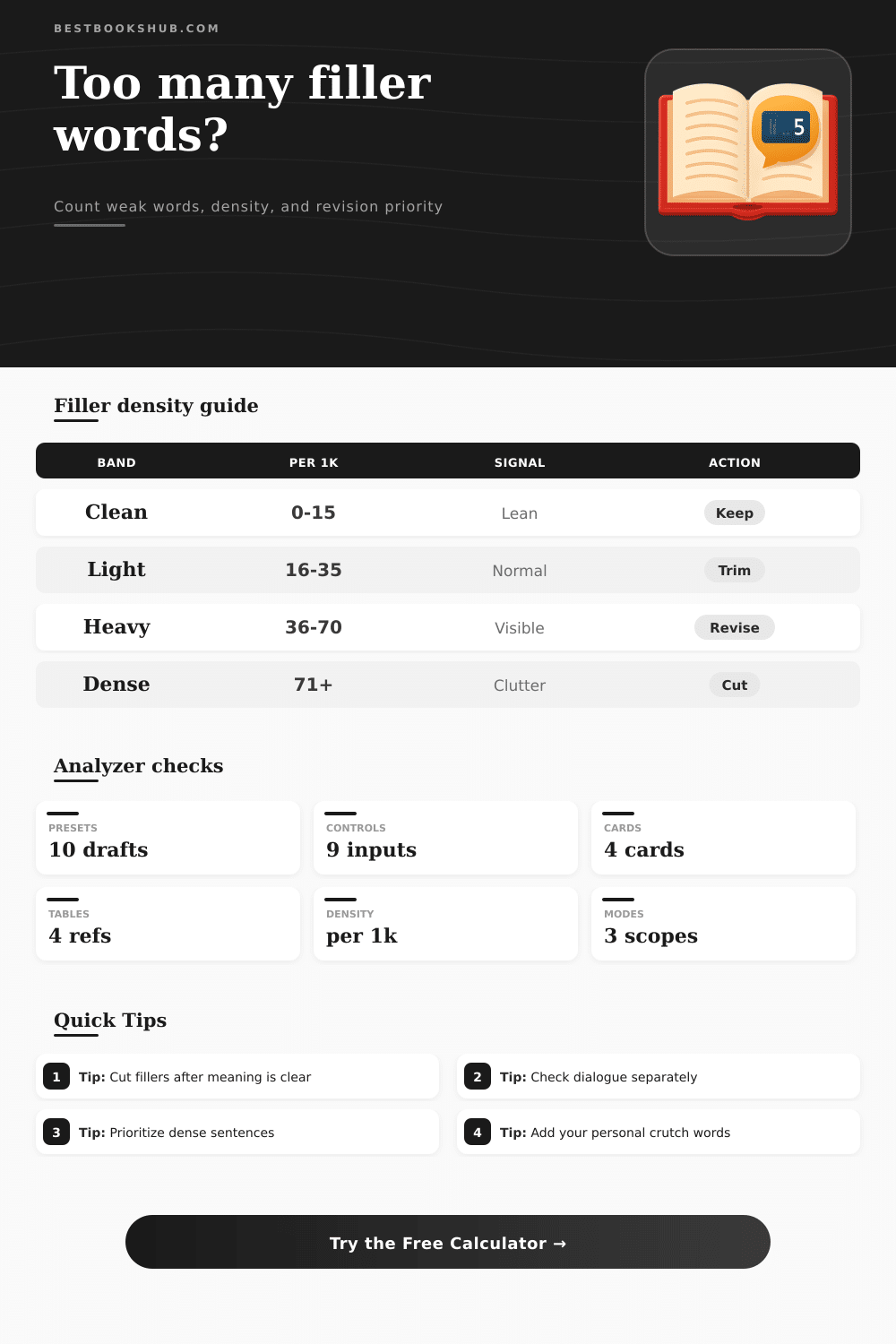
| Density per 1,000 words | Typical reading effect | Revision priority | Suggested next pass |
|---|---|---|---|
| 0-15 | Very lean or heavily edited prose | Low | Review only for voice-sensitive dialogue. |
| 16-35 | Normal draft texture | Low to medium | Trim repeated favorites and dense sentences. |
| 36-70 | Noticeable hesitation or clutter | Medium | Revise top terms, then reread for rhythm. |
| 71-100 | Heavy filler load | High | Prioritize sentence rewrites before line polish. |
| 101+ | Draft may feel padded or uncertain | Critical | Cut repeated phrases and rebuild weak lines. |
Dialogue
Fillers can sound natural when they reveal hesitation, class, age, rhythm, or relationship pressure. Review repetition before removing all voice.
Narration
DISCLOSURE: This post may contain affiliate links, meaning when you click the links and make a purchase, I receive a commission. As an Amazon Associate I earn from qualifying purchases.
Narrative filler usually slows movement and weakens description. If a sentence survives without the filler, cut it first.
Exposition
Hedges and redundancies make explanation feel less confident. Compress phrases that repeat obvious logic or delay the point.
Revision Order
Start with high-density sentences, then repeated terms, then custom crutch words. This protects voice while removing clutter.
| Phrase | Lean substitute | Usually cut? | Watch for |
|---|---|---|---|
| in order to | to | Often | Formal padding |
| due to the fact that | because | Often | Academic clutter |
| kind of / sort of | specific verb | Sometimes | Voice versus vagueness |
| at this point in time | now | Usually | Slow transitions |
| for the most part | mostly | Sometimes | Hedged claims |
| as a matter of fact | actually | Usually | Throat clearing |
A writer may feel that the draft isnt quite correct, even though the sentence within the draft are correct and the story within the draft is present. Often, a writer feels that the draft is not quite correct because the writer has used many word that do not provide much weight to the story being told. A writer may use these weightless words when they are thinking on the page or to create a certain rhythm to the story, but these weightless words may cause the reader to feel hesitation while reading the story.
The density of weightless word within a story can determine whether a writers draft will move the reader or drag the reader along with the story. Using only a few weightless word within a story is typically not an issue, but using ten or twenty weightless words can significanty impact the storys flow. A writer must consider the density of the weightless words, rather than just the total number of weightless words that the writer uses in a piece of writing.
Cut Weak Words to Improve Your Story
The density of the weightless words can change based on where the weightless words are used in the story, such as in dialogue versus narration. The calculator will provide result to a writer once the writer has selected both a scope and a list of terms to evaluate. The calculator separates word within quotation marks from word outside of quotation marks, as words within quotation marks may have a different purpose within a story than word outside of quotation marks.
In narration, the writer may use many weightless word to convey uncertainty, but within dialogue the writer may use many weightless word to convey the age of the character or the amount of pressure that they are under. Using the calculator, a writer can also input the target density for their story so that they can determine how far their story is from their target density, allowing the writer to make certain that they are deleting the correct word from their story. Many writer have certain word or phrases that they use within their stories often, and many of those word may not have much weight.
For instance, one writer may use intensifiers within their story, but another writer may use transition within their story. A writer can create a custom list within the calculator so that the calculator ranks both common and weightless words. A writer should begin with the word that appear the most within their story, and then check to see if those word tend to cluster in certain sentences that the tool has ranked as high-impact.
The sentences that the tool flags as high-impact are important within a story, even if the overall density of the story is good. For example, a manuscript may have an even density of weightless words throughout, but contain a few clogged sentences that may distract from the story and the writers ability to tell the story. Fixing these sentences first will significantly improve the story more then focusing on editing every instance of each individual weightless word.
The reference tables shows what density within a story indicates, and they assist an author in determining if their story requires some light editing or more extensive editing. These tables are not a replacement for the writers judgment of their own story, but they do provide a means of discussing the density of their words within a story. Dialogue and narration will not follow the same rule, as using the same weightless word in dialogue may indicate that a character is young, but using the same word in narration may indicate that the narrator is unsure of their thoughts.
The order in which a writer edits their word is also important. A writer should begin with the sentences that are the most important to the story. Cleaning those sentences first will allow the writer to better focus on the individual word that remain within the story.
Some word will be recognized as important to the writer and the story, while others will be deleted due to their lack of importance to the story. A writer does not have to delete all weightless word from their story, but having control over which weightless word are included in the story will result in a better story. Having control over the weightless word that appear in a story will result in a better writing overall.
The scene that was previously padded will move at the speed of the story, and dialogue will only reveal hesitation when the character within that dialogue is indeed exhibiting that behavior. While the improvement in one page may not be dramatic, the difference in each page will be noticeable when the writer complete the manuscript.