🌙 Night reading planner
Finish before bed calculator
Estimate whether tonight's remaining pages fit before bedtime after breaks, wind-down time, chapter rounding, and a realistic reading-speed adjustment.
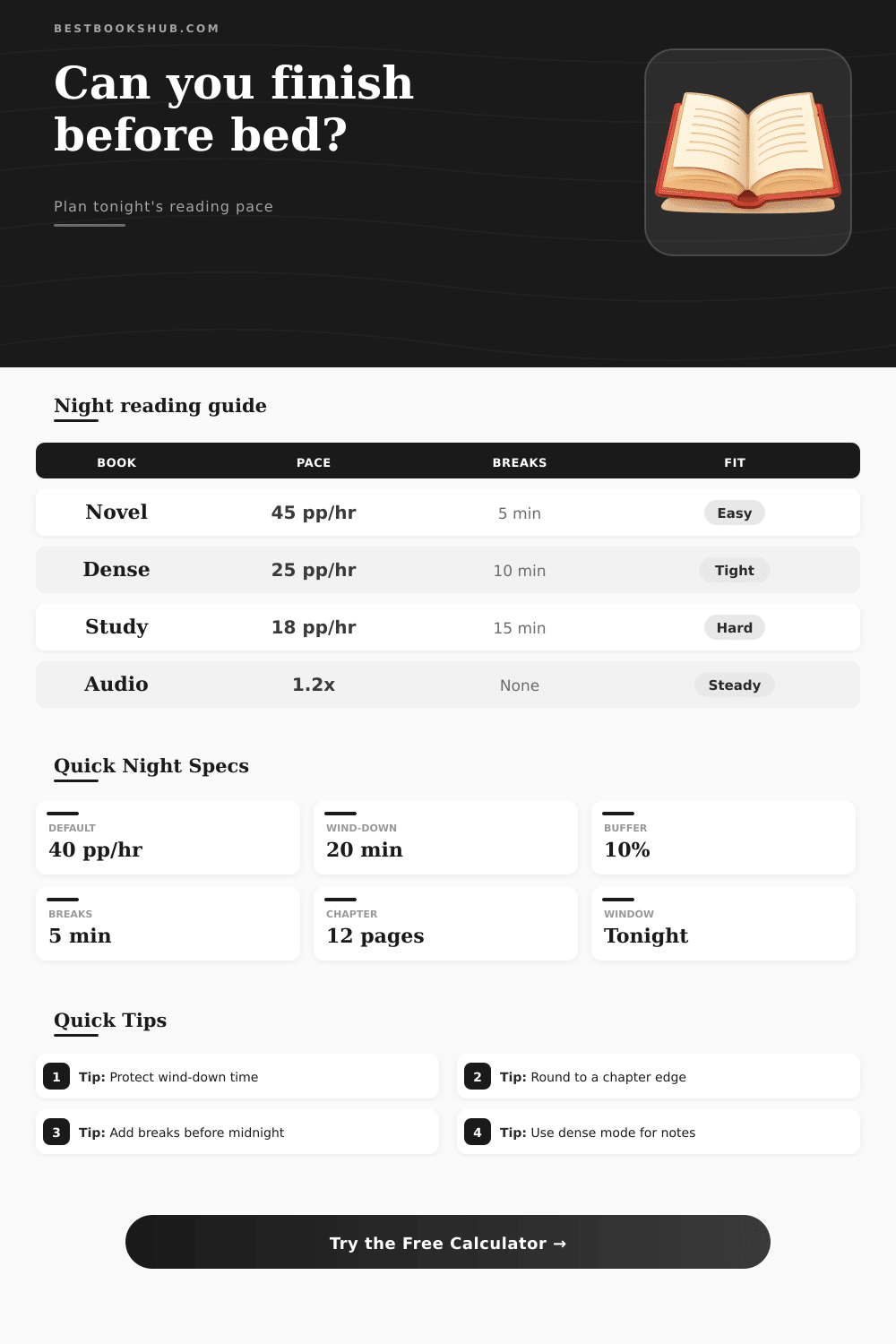
| Reading profile | Speed multiplier | Best use | Night warning |
|---|---|---|---|
| Light fiction | 1.15x | Romance, thrillers, familiar series | Easy to overread past wind-down time |
| Standard book | 1.00x | Most novels, memoirs, narrative nonfiction | Use a small buffer for chapter endings |
| Dense nonfiction | 0.72x | Idea-heavy nonfiction and slow prose | Breaks matter more than page count |
| Academic reading | 0.55x | Textbooks, research, technical chapters | Notes and review can double the time |
| Annotated reading | 0.48x | Marginalia, highlighting, close reading | Set a chapter target instead of full finish |
| Audiobook or read-along | 0.95x | Syncing audio with pages or ebook percent | Use known runtime if available |
| Available reading window | Comfortable pages | Sprint pages | Better target |
|---|---|---|---|
| 30 minutes | 10 to 22 pages | 25 to 35 pages | One scene or a short chapter |
| 60 minutes | 22 to 45 pages | 50 to 70 pages | Two average chapters |
| 90 minutes | 35 to 70 pages | 75 to 100 pages | Book club catch-up |
| 120 minutes | 50 to 95 pages | 100 to 135 pages | Final act of a novel |
| 150 minutes | 65 to 120 pages | 130 to 170 pages | Only if sleep can stay protected |
| Stopping rule | How it changes target | When it helps | Tradeoff |
|---|---|---|---|
| Exact target | No extra pages | Strict page goals or homework | May stop mid-scene |
| Chapter edge | Rounds up to chapter size | Fiction, memoir, book club reading | Adds pages near the end of a chapter |
| Scene cushion | Adds about 3 pages | Serials and fast-paced chapters | Small extra time cost |
| Notes review | Adds review minutes | Study, nonfiction, annotated books | Finish time moves later |
DISCLOSURE: This post may contain affiliate links, meaning when you click the links and make a purchase, I receive a commission. As an Amazon Associate I earn from qualifying purchases.
Here’s what happens: You’re about to attend a book club and realize there is still dozens of pages remaining on the book. And it’s getting late, you need to go to bed soon. Panic sets in. “I don’t know if I’m going to finish this thing!”
There’s a solution to remove this worry, a calculator tool that give you a concrete plan and proves that just because there’s time doesn’t mean it’s usable time. As the day moves into night-time, your effective reading window gets smaller. Because it’s important that you rest your mind before bed, the tool distinguish between times when you are actively reading and when you’re winding down.
How to Read Without Losing Sleep
Reading right up to bedtime can lead you to either doze off while holding book (bad!) or struggle to fully absorb what you’ve read. Setting a 20-minute gap around your bedtime give you a reasonable cut-off point both for your body clock and your curiosity.
It sounds like a steady reading speed that flexes with content: You fly through light thrillers while parsing academic text slow you down. To make up for it, a reference table map out multipliers for various types of books. Enter in your base rate and the system will dial it back when you’re tired or when reading something really dense (non-fiction).
The whole point is not to make same mistake everyone does: assuming that what works during the day also work at night. The structure of the reading session change with scheduled breaks. Reading continuously appears efficient. Until your eyes glaze over and you reread sentences. A brief break every 45 minutes reset your focus without costing much time.
It prevents you from thinking you are making progress when you is actualy just skimming because you are tired. The ten percent safety buffer add insurance for complex ideas that need to be thought through. These additions transform a difficult sprint into a manageable jog.
Knowing whether or not I can finish isn’t enough. Knowing where to stop matters too. Instead of choosing a random number of pages, which would mean stopping in the middle of a scene, use stopping rules that end at edge of a chapter. It adds extra pages but maintains the story’s flow. Instead of being interrupted abruptley when closing the book, you feel like you finished something.
You close it with a sense of completion, honoring the story’s structure while respecting your sleep schedule. It’s easy to get late at night, thinking you’re more focused than you really are. When there’s little distraction, you tend to think you’re taking in more. But no matter what kind of vibe you’ve got going on, your brain eventually gets tired.
To compensate for that, the calculator includes a focus slider which adjust estimates downward when you confess to feeling fatigued. Be honest: save time. Don’t read slowly only to backtrack. Make it a habit that you can keep, and value understanding more then quantity.
Tonight’s read is less about willpower and more about logistics. What time do you start? What are your physical limitations? How dense is this material? Your objective: get through it while maintaining energy for tomorrow. Better sleep results from a well-organized stopping point, one clean chapter mark, plus a well-wind down routine.
You’ll still turn the page. You’ll still keep your sanity. And you’ll still keep your sleep. It would of been better to plan ahead.