📖 Current page finish predictor
Finish date from current page calculator
Project the day you will finish a book from your current page, pace, reading schedule, skipped days, rereading load, and buffer.
Enter the page you are on now. The calculator treats the current page as already reached and forecasts the remaining workload from tomorrow if today's reading block is not included.
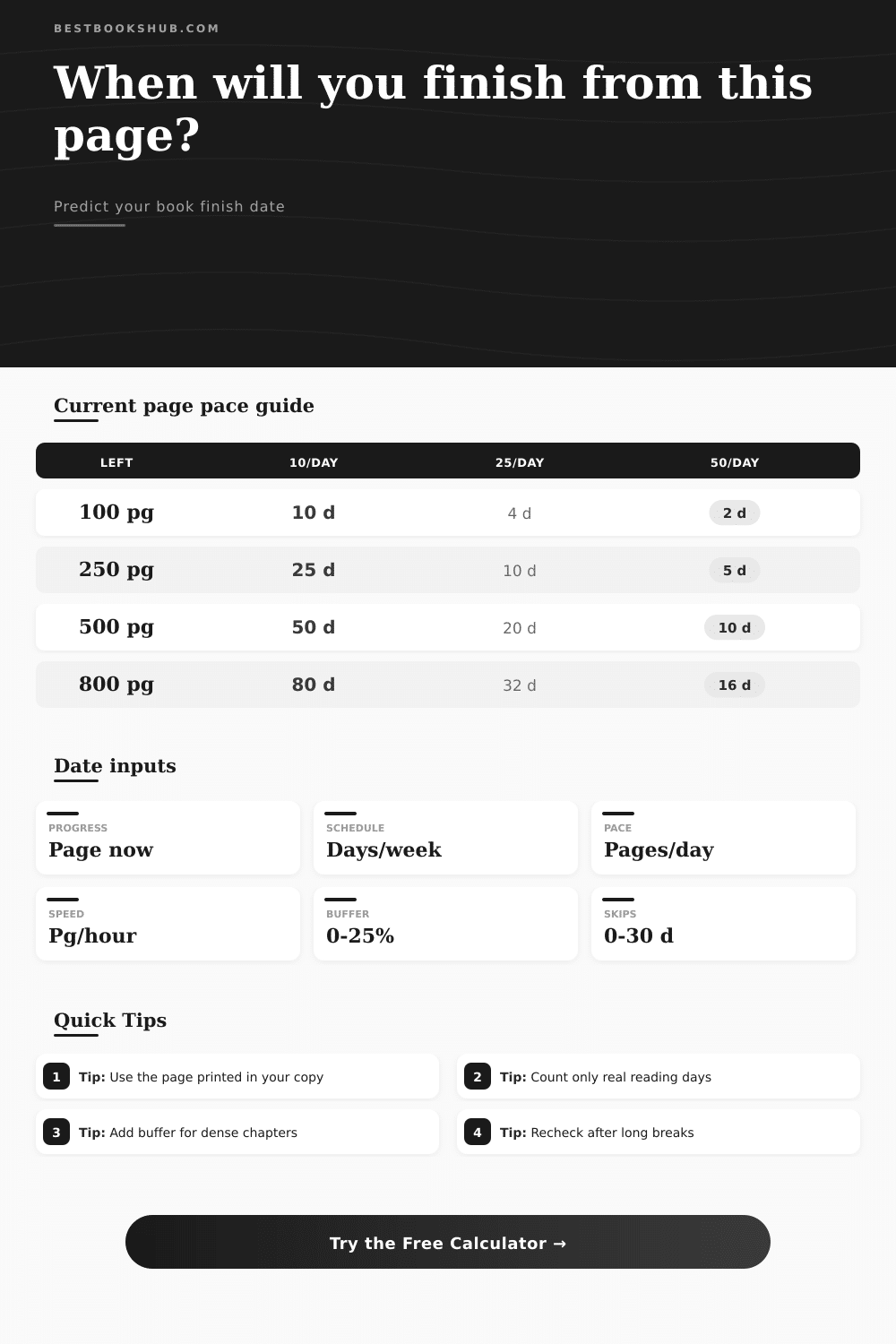
| Pages left | 10 pages/day | 25 pages/day | 50 pages/day | What it means |
|---|---|---|---|---|
| 100 pages | 10 reading days | 4 reading days | 2 reading days | Short finish or final section |
| 250 pages | 25 reading days | 10 reading days | 5 reading days | Typical half-novel workload |
| 500 pages | 50 reading days | 20 reading days | 10 reading days | Long book or large course block |
| 800 pages | 80 reading days | 32 reading days | 16 reading days | Major volume or multi-part project |
| 1,200 pages | 120 reading days | 48 reading days | 24 reading days | Very long classic or series plan |
| Session length | At 25 pages/hour | At 40 pages/hour | At 60 pages/hour | Good fit |
|---|---|---|---|---|
| 20 minutes | 8 pages | 13 pages | 20 pages | Short commute or bedtime reading |
| 45 minutes | 19 pages | 30 pages | 45 pages | Standard daily reading block |
| 60 minutes | 25 pages | 40 pages | 60 pages | Focused evening or study block |
| 90 minutes | 38 pages | 60 pages | 90 pages | Weekend or deadline push |
| 120 minutes | 50 pages | 80 pages | 120 pages | Reading sprint with breaks |
| Schedule | Reading days/week | Calendar effect | Best use |
|---|---|---|---|
| Every day | 7 | Fastest calendar finish | Daily habit, short deadlines, or steady novels |
| Weekdays only | 5 | Weekends stretch the date | School, work lunch, or commute reading |
| Weekends only | 2 | Slowest calendar finish | Long sessions with busy weekdays |
| Custom days | 1 to 7 | Uses a repeating weekly pattern | Flexible readers with changing free nights |
| Skipped days | Added separately | Pushes finish date later | Travel, exams, holidays, or planned breaks |
| Adjustment | Typical value | Effect on finish date | When to use it |
|---|---|---|---|
| Reread load | 5% to 20% | Adds page-equivalent work | Complex plots, citations, or close analysis |
| Difficulty factor | 1.10x to 1.70x | Slows the effective page plan | Dense prose, textbooks, annotation, or proofing |
| Planning buffer | 10% standard | Adds cushion before the date | Useful when missing one session would matter |
| Review pages | 0 to 100+ | Adds explicit extra pages | Appendixes, notes, glossary, or final review pass |
| Skipped days | 0 to 30+ | Moves calendar date only | Known non-reading days before the finish |
DISCLOSURE: This post may contain affiliate links, meaning when you click the links and make a purchase, I receive a commission. As an Amazon Associate I earn from qualifying purchases.
It’s not that you won’t read this book; it’s that you’re on page forty-two of a four hundred page novel, and you haven’t decided yet when you’ll stop making excuses and get serious about future.
Most people come to reading with unclear good intentions. They know they want to read more. They mean to catch up by summertime. Intentions without a date? That’s just wishing. Wishing doesn’t survive contact with the realitie of weekends and work schedules. Plug in your current position and daily capacity and let the calculator do the math. Avoid having to do the math in your head, because that’s where you’d be trying to figure out the coefficient!
How to Plan Your Reading Time
This brings us to the second rule: Your current page is more important than cover date. Sure, you purchased the book six months ago, but if you’re stuck on chapter two, you can’t pretend like you’re halfway through. Your current page represents a hard limit for the tool. Anything up to this point is finish. Anything beyond this point is debt.
This sounds obvious until you attempt to estimate how long a textbook chapter will take you. Perhaps you flip open a 50-page section and think that it’ll go quick; the font is big! Then you read the first paragraph and notice that it takes three minutes to unpack all the new vocabulary. That’s where most people mess up. Time isn’t equal to page count. Instead, its a measure of raw material that must be chewed on by your specific attention span. That’s why those inputs around pace are important. By specifying hours/sessions/pages per day, you can define your speed as well. When you do the math, I read forty pages an hour but only have fifteen minutes before bed, you are forced to face an uncomfortable truth. Context switching kills momentum, and you are moving slower then you think. The table of references on the page make this clear: Here’s where speed and session length interact. The results of a two-hour weekend sprint differ vastly from a twenty-minute commute block, even at the same reading speed.
But then there’s the reality of friction: On any given day, you don’t get to read at full potential. Sometimes you’re sick. Sometimes you’re traveling. Sometimes it’s just an evening when you turn the lights out and look at the ceiling. That’s why we built these buffer settings to soak up real-life chaos. Your default should be a ten percent cushion. But depending on deadlines (like a book club meeting) or class schedules (like a syllabus), you may want as much as twenty-five percent. This isn’t about being pessimistic. It’s about being accurate. If you explicitly mark off days you know you’ll skip, the system knows those dates are black holes in terms of your reading progress. It keeps your work separate from your time. Sure, you may have three-hundred more pages left. But half of ’em might land on a workday when you literal cannot read. And that’s OK; because even with blazing speed, the calendar date will stretch anyway.
There is also some detail in how difficulty is adjusted. A classic with archaic sentence structures isn’t going to flow like a technical manual or light fiction. You can use this feature to apply a multiplier to slow down your effective pace so that you don’t promise yourself 30 pages a day on something that realistically only gives you 10. Plan for the slower pace, get ahead, then be done rather than burning out at week two and not finishing the book altogether.
Not only does it give you a projected date (which we’ve already talked about), but it also shows you the difference between days on the calendar and days you’d have to actualy read. That’s where your habit lies. Because if you have ten weeks left to reach your goal and the calculator tells you it’ll take thirty reading days, you immediately know that you need to read every damn day. No exceptions. No wiggle-room.
The tension is visible in the way it breaks down visually. With just a few clicks, you can adjust the daily page number and/or the buffer, then observe how even minor adjustments spreads throughout the timeline. Adding five extra pages per day may not sound like much, but over the course of a month, it saves you almost two weeks of calendar time.
This isn’t about micromanaging every minute of your evening. This is about setting an end-date for yourself, a way to focus your attention to ensure you don’t just passively own the book. Knowing exactly when you’ll turn the last page makes the abstract task of ‘reading’ into a concrete list of daily steps. No more worrying about whether you’re going to finish; now you’re focused on showing up for each of your scheduled blocks. The date is no longer a looming threat; just another landmark along the way. When you reach that projected finish line, you get to close the book with the satisfying certainty you got by planning it out in the first place.
You should of tried this sooner!