📖 opening paragraph lab
First paragraph word count calculator
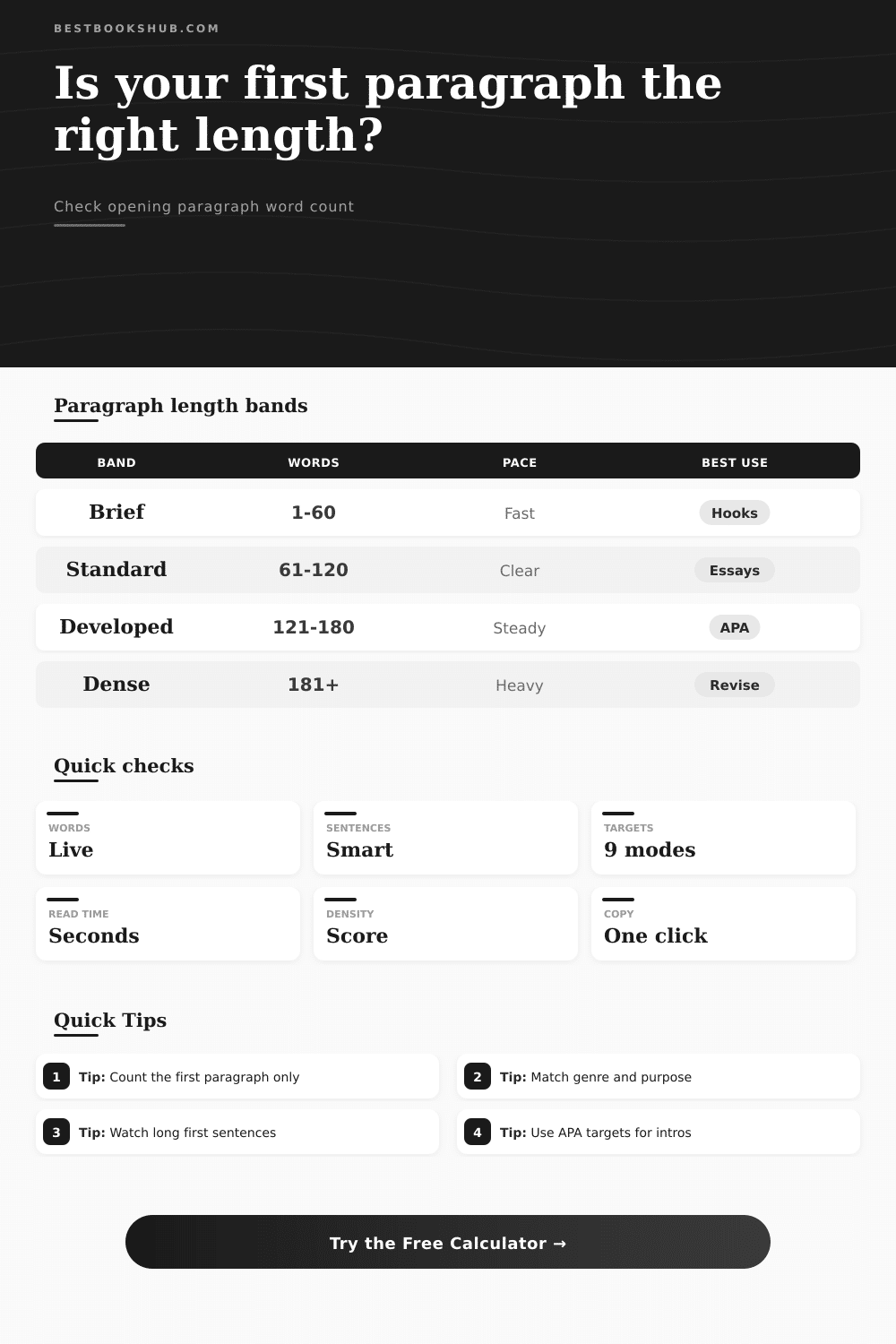
Paste a draft and measure the first paragraph for word count, sentence balance, reading time, opening pressure, and target fit across fiction, nonfiction, reviews, and APA introductions.
📌First paragraph presets
✍Text and target settings
📊Paragraph count bands
📖Reference targets
| Paragraph type | Target words | Sentence target | Best use |
|---|---|---|---|
| Commercial fiction opening | 45-115 | 2-5 | Scene entry with quick orientation and a clear turn. |
| Thriller or suspense | 35-95 | 2-4 | Urgency, danger, contradiction, or immediate question. |
| Middle grade opening | 30-85 | 2-4 | Direct action, visible character, and low syntax load. |
| Literary fiction opening | 70-170 | 2-6 | Voice, image, memory, and controlled complexity. |
| Memoir opening | 55-135 | 2-5 | Scene, stance, memory frame, or confession. |
| Book review lead | 45-120 | 2-5 | Book premise, evaluative stance, and reader orientation. |
| General nonfiction intro | 60-140 | 2-5 | Problem framing with enough clarity to move forward. |
| APA academic intro | 85-180 | 3-6 | Research context, construct, scope, and study rationale. |
| Query or pitch paragraph | 40-110 | 2-4 | Compact premise, stakes, and protagonist pressure. |
🧭Revision signals
| Signal | Often means | Check first | Possible edit |
|---|---|---|---|
| First sentence over 45 percent | The opener carries too much load | First verb and first comma | Move one detail to sentence two. |
| Average sentence over 28 words | Dense syntax | Clause chains | Split after a turn or contrast. |
| Paragraph under target | Thin setup | Orientation | Add subject, setting, claim, or scope. |
| Paragraph over target | Delayed transition | Final sentence | Start paragraph two at the next move. |
| Many abstract nouns | Low concrete pressure | Main subject | Add actor, object, source, or scene. |
| No end punctuation | Draft fragment | Boundary setting | Finish the paragraph before judging. |
📝Opening paragraph patterns
| Pattern | Typical range | Strength | Risk |
|---|---|---|---|
| Scene-action start | 35-100 words | Momentum and character presence | Context can arrive too late. |
| Image-to-meaning start | 70-160 words | Voice and atmosphere | Can delay the governing idea. |
| Research-frame start | 85-180 words | Scope and scholarly context | Can become noun-heavy. |
| Review stance start | 45-120 words | Fast evaluative clarity | May summarize before judging. |
| Pitch premise start | 40-110 words | Stakes and compression | Can overload names and world terms. |
✔Practical notes
DISCLOSURE: This post may contain affiliate links, meaning when you click the links and make a purchase, I receive a commission. As an Amazon Associate I earn from qualifying purchases.
How long should an intro be? A common mistake among writers is spend too much time refining sentence structure and vocabulary without accounting for length. How long does it need to be to fulfill its purpose without tiring the reader? There are many great plots and theses out there, but when the first paragraph hit them in the face like a brick wall rather then a door, we’ve lost our footing by the time we get to meat of the material.
How long should an intro be? Counting words strategicaly is a strategic task. Word count isn’t a bore. Word count is a strategy. Once you drop your draft into calculator (above), it’ll do the math for you. So there’s no more guessing if you’re being too verbose or too brief. And it doesn’t just give you overall words; it also breaks it down to reading time and sentence balance. One hundred words of dense academic prose can be quite different from one hundred words of short sentences. The tool help you see that.
How Long Should Your Introduction Be?
Think about the genre you’re writing for. Do you need urgency, such as in a thriller opener? Or do you need to provide exposition, like a APA academic intro that must define key terms and explain the gap in research? If your first paragraph stretches past ninety-five words, chances are you’re smothering your hook with context. An academic intro, however, may appear thin or underdeveloped if only sixty word fill up the paragraph. As the reference table at the bottom of page shows, what counts as a standard length varies based off the expectations of your audience.
Another error is thinking only about overall word count and not paying attention to where words go. For example, you could have exactly one hundred words, but then seventy of them are stuffed into one run-on opening sentence. The result? Writing feels off-pace. A lot rides on that first sentence: It has to set the scene without overloading the reader’s brain. So when that first sentence is working too hard everything else in the paragraph feel comparatively weak. You can take the pressure off by unpacking long clauses and moving supporting information to next sentence.
Another helpful measure is to check the “reading time” for online content in particular. If it says most folks can read your opener in ten seconds, that’s great, you’re aware of how much respect you’re paying to the reader’s time and attention. But if it’s taking them thirty seconds to even reach end of your first paragraph, you’ve got a retention issue.
Most of the time, revising isn’t about putting more words in. It’s about taking out ones that aren’t necessary. If the tool tells you that a paragraph is dense, the likely cause are over-explanation. Eliminate any adjectives that don’t advance new information; look for abstract nouns which could be replaced by something more concrete. Delete phrases like “it is important to note”; just say what it is and let the reader infer its importance. You should of have faith that they’ll get the point.
Word counts aren’t the answer. They’re a diagnostic measure. What do they tell you? Your text has friction. The word count shows where that friction comes from. You might have undeveloped elements like stakes. Or, you might be too long because you are afraid to let go of background information. Let the numbers inform your cutting process, but then cut with your ear as well.
Even though a great beginning is thoughtfully crafted, it’s easy on the ears. Hold on tight to that beginning, one that’s clear, strong, and inviting. Invite the reader along and she’ll go anywhere you want her to go next.