📝 Sentence starter extractor
First word of each sentence extractor
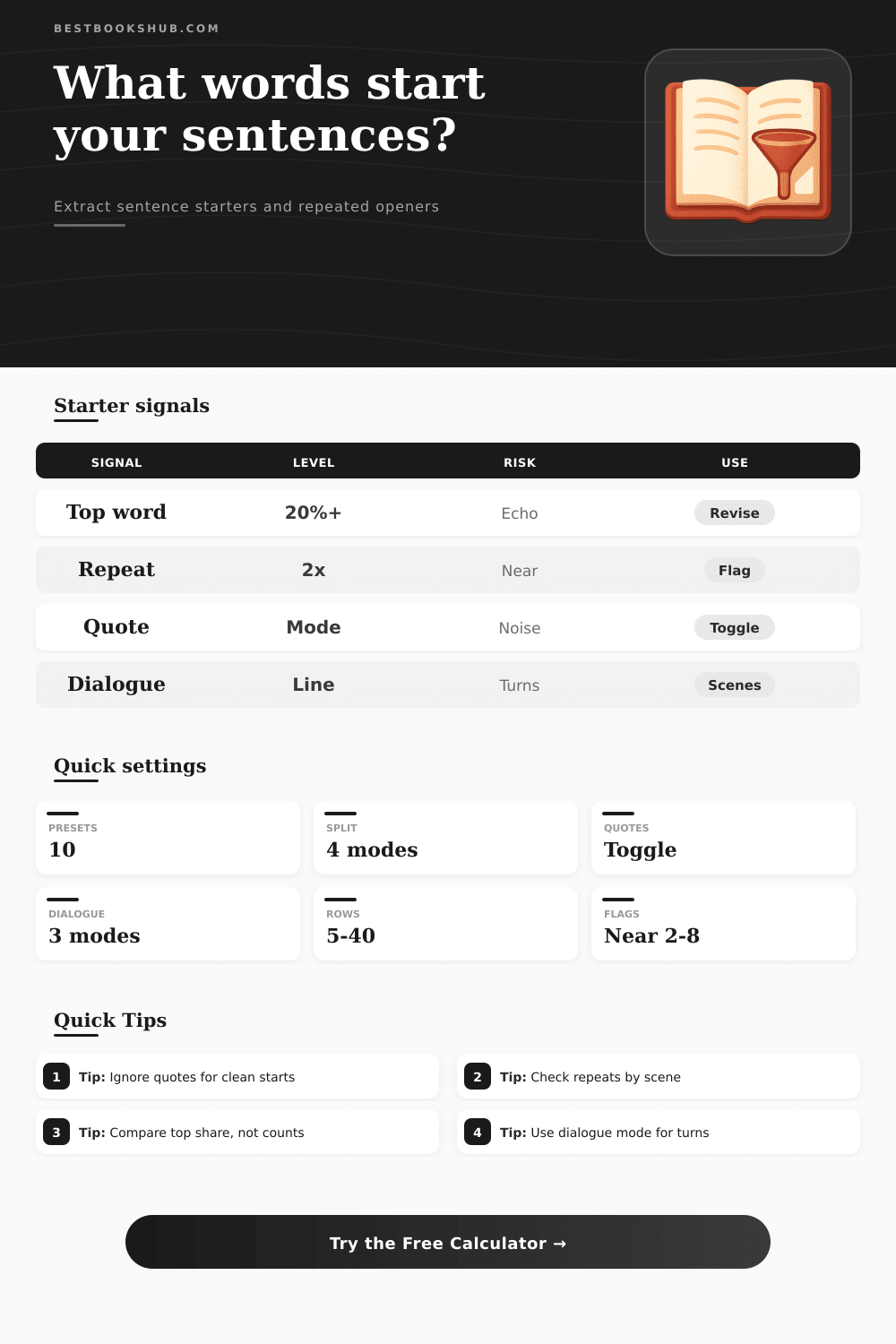
Paste prose, dialogue, notes, or study copy to split sentences, extract every first word, rank sentence opener frequency, and flag repeated openers that may sound mechanical.
Load a sample with a different opening pattern, then tune quote handling, dialogue mode, and repeat sensitivity.
DISCLOSURE: This post may contain affiliate links, meaning when you click the links and make a purchase, I receive a commission. As an Amazon Associate I earn from qualifying purchases.
The extractor protects common abbreviations and decimals before splitting, then reads the first visible or significant word from each sentence.
The first table lists each sentence and first word. The frequency table ranks openers. The repeat table flags repeated starters near each other.
| # | First word | Sentence preview | Words | Flag |
|---|---|---|---|---|
| Load a preset or paste text to see first words. | ||||
| Rank | Starter | Count | Share | Sentence numbers | Signal |
|---|---|---|---|---|---|
| Starter frequency will appear after analysis. | |||||
| Sentence | Starter | Matched earlier | Distance | Why flagged |
|---|---|---|---|---|
| Repeated opener flags will appear after analysis. | ||||
| Mode | What it reads | Best use | Watch for |
|---|---|---|---|
| First visible word | Earliest word token | Exact rhythm check | The and I may dominate |
| First content word | Skips small function words | Theme and emphasis | Can hide natural flow |
| Dialogue aware | Quoted sentence turns | Scenes and interviews | Speaker tags need cleanup |
| Speaker labels | Line turns after colon | Transcripts | Labels are not starters |
To check out the beginning of your sentences, I suggest using this sentence starter extractor. This will help you notice what your dialogue sounds like, where you repeat same opener, etc. And it will give you an idea for how to shift rhythm before you go back in and edit.
Rhythm is one thing writers strives for and don’t always realize when it goes astray. You write a paragraph, then you run your eyes over it again, and something just isn’t right. But what? All the sentence start with the same opener. They step along in sync. Your eye sweeps across and your ear registers but too late.
Why Starting Words Matter in Writing
How we start our sentences is more important than many bits of craft advice let on. It’s the invisible backbone that drives pace. Paste in a scene or paragraph here and the tool will make visible what your ear cannot hear: patterns. It chop up the text, extracts the first word of each sentence, and counts their frequencies. Suddenly there are pattern that you didn’t know were hiding in plain sight.
When a page is loaded with “Then,” or “She” or “The” it doesn’t feel like style anymore; it feels like a rut. And now you notice. The calculator highlights those clusters wherever you want. In a two-sentence window? In an eight? That count of proximity matter. A word appearing five times over thirty sentences lands different than one that appears every fourth line.
Here, words tell us their truths: Dialogue starts with “You,” “But,” “That,” “I”, short openers that writers love in speech. Turn on dialogue-aware mode and watch extractor skip past the speaker tags; judge for yourself how it sound spoken. Otherwise, you risk thinking “said” is a stylistic decision rather than a structural one.
Quotes are similar. The lead-in quotation mark may hide true starting point. This is why there is quote handling options. Ignore them if you want analysis without distraction; leave them alone if you prefer to know precisely what the reader sees.
Repetition works different in various styles of writing: Precision may require repeating “The” in academic prose, but fiction hardly ever does. Memoir needs “I remember” and also wants to get away from its own echo chamber. For kids’ stories, repetition bring comfort as long as it’s done intentionaly.
None of this matter to the extractor; it just tells you how words is distributed raw, and lets you make decisions deliberately rather than by accident. Not all repeated openers are bad. They can show character voice, drive a point home, and create rhythm. Starting half of your sentences with “Maybe,” like a detective does, conveys something about his uncertainty. Starting every other sentence with “Look,” like a child does, communicates excitement you may wish to preserve. Knowing there’s a pattern gives you the option to vary it or not; it’s the key to changing editing from guesswork to surgery.
But also, context is everything with the numbers. Twenty percent of your sentences starting with a top opener sounds like a lot, but then you see that dialogue use too many pronoun. Look at shares instead of raw counts. Six spread out through a chapter might sound better then two right next to each other. Change the repeat window to see what makes it pop. You get to play with the flags and see when that unease becomes something you can measure and fix.
Experienced writers pick up on their own internal ear over time. Novices don’t get that same benefit. That’s where the extractor could of help smooth the learning curve. You put your query letter through it and you see that every single paragraph start off with some variation of “The” or “This.” That dulls the sharpness of your original angle.
You put a thriller beat through it and you find that there are now three consecutive “He” sentence at precisely the moment you want things to heat up. They are not rules. They are signals. And it’s not about being varied to the nth degree. As a reader, no one counts how many different kinds of beginnings they’ve encountered. It’s about control.
You learn what you are doing in your sentences, and then you choose to change it. You stop seeing the page as a mystery, and start seeing it as something you mold with your eyes wide open. And that little adjustment takes you from an accidental rhythm to a chosen one. And that’s where craft actualy starts.