Flash Fiction Counter
Flash Fiction Word Count Calculator
Paste a compact story, choose a flash fiction target, and measure word count, market fit, ending room, compression pressure, and revision cuts in one pass.
Load samples for microfiction, classic flash, contest caps, title handling, hyphen rules, and late-draft trimming before checking your own story.
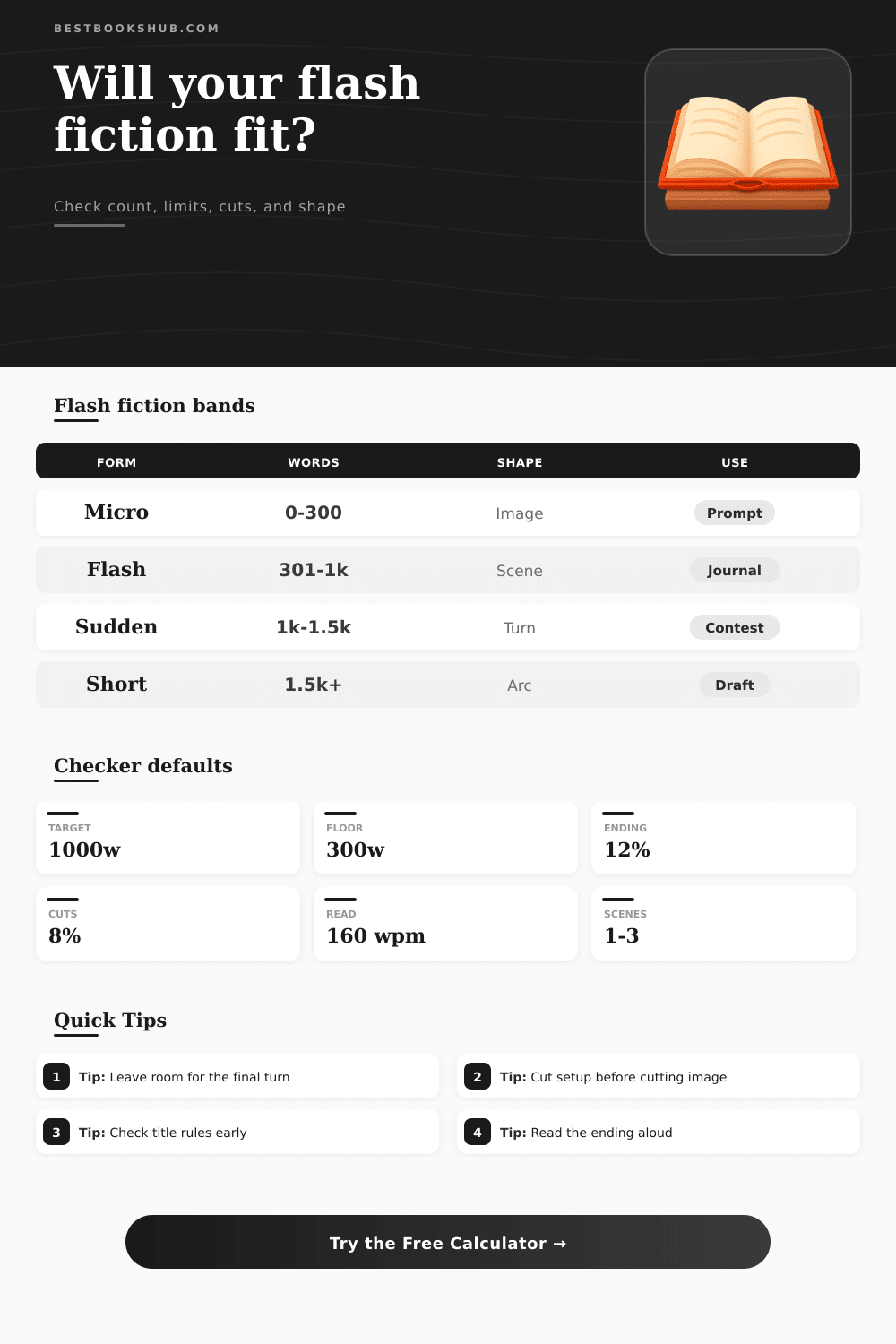
| Form | Typical word range | Best structural use | Count risk |
|---|---|---|---|
| Microfiction | 1 to 300 words | One image, reversal, or charged implication | Every extra modifier is visible. |
| Classic flash fiction | 301 to 1000 words | One compressed scene with a clear turn | Setup can quietly consume the ending. |
| Sudden fiction | 1001 to 1500 words | Small arc, braided memory, or scene plus aftermath | May read like a short story opening if unresolved. |
| One-page flash | 400 to 750 words | Print-friendly page with tight paragraph rhythm | Line breaks and title rules can affect fit. |
| Target maximum | Recommended ending reserve | Opening allowance | Middle pressure |
|---|---|---|---|
| 300 words | 25 to 45 words | 30 to 55 words | Use implication instead of backstory. |
| 750 words | 70 to 110 words | 90 to 140 words | Keep one causally important scene. |
| 1000 words | 100 to 150 words | 120 to 190 words | Let image, choice, and turn share space. |
| 1500 words | 150 to 225 words | 180 to 275 words | Use movement without expanding cast. |
| Diagnostic | Strong signal | Warning signal | Revision move |
|---|---|---|---|
| Title handling | Rules checked before final count | Title could push draft over the cap | Save two counts: with and without title. |
| Hyphen handling | Market rule chosen consistently | Compound-heavy prose shifts the total | Run strict and split-hyphen counts. |
| Paragraph shape | Paragraphs carry clear turns or images | Many tiny fragments hide word bloat | Merge fragments or cut repeated beats. |
| Ending space | Final turn has room to land | Last line has to explain too much | Cut setup, not the payoff image. |
| Cut pass | Typical reduction | What to remove first | What to protect |
|---|---|---|---|
| Light polish | 3% to 5% | Repeated tags, filler transitions, weak intensifiers | Voice and exact sensory nouns |
| Normal flash trim | 6% to 10% | Backstory, throat clearing, doubled reactions | The turn and emotional hinge |
| Contest compression | 10% to 15% | Secondary characters, extra setting logic | Cause, consequence, final image |
| Micro conversion | 20% or more | Most explanation and connective tissue | One decisive change in pressure |
DISCLOSURE: This post may contain affiliate links, meaning when you click the links and make a purchase, I receive a commission. As an Amazon Associate I earn from qualifying purchases.
It’s that moment when you’re staring at your blinking cursor: There are only three hundred words until it’s due. For those of us who writes under strict rules, it generates a certain kind of writerly panic. It’s like you’re constructing a house in a shoe box, and you want to make sure there’s enough space for someone to stand upright, but also enough space so the roof doesn’t bump against ceiling.
By displaying how many words you can fit between here and the end of word count, the word count tool turns guesswork into strategy. Word count isn’t simply a number to most writers; it’s a measure of tension. Paste your draft into the calculator, and it tells you whether you’re under or over the limit, but it also considers form of words themselves.
How to Write Good Flash Fiction
A classic flash story fall between three hundred and a thousand words, which means each sentence needs to earns its spot. You can’t afford a sentence explaining character’s backstory when their action will speak for them. Can the emotional turn be placed here, or does this take away from it?
Learn how each market counts words in your short work: Will they count a hyphenated word as one or two? What about title? Some will include it in their word count. Others won’t. That could be the difference between accepted and rejected if you’re one word over (nine hundred and ninety-five versus a thousand). Using right setting on the calculator ensures you don’t make that mistake. Hit submit knowing exactly where your words fall.
You should of also consider pacing. While reading silently, we naturaly speed-read to an extent; there’s no pause for breath or emphasis on beats. How long will this remain in someone else’s mind if they’re reading it out loud? The read-aloud guess provides a clue as to whether the work may be too rushed, even if it only take two minutes to read through. Is it possible that adding some white space or breaking up longer sentence could help?
Paragraph shape is very important in flash fiction. While a dense block of text might seem right for short stories or essays, flash fiction should be quick and light. In this form such paragraphs can be suffocating.
Also take a glance at the reserve metric. Amount of story left over at the end. Try to save roughly one-twelfth of your word count for the final turn, so there’s room for the conclusion to land without feeling rushed and tacked on. The last twelve percent can feel like an afterthought if you’ve spent all your words up until the 88 percent mark. It’s often more difficult to cut the setup than write it, as you’re trusting the reader to fill in what you don’t include. But the payoff is in the words you cut up front to buy you space for image that will stay with them long after they close the book.
The page breaks these bands down into usable advice with reference tables. Sudden fiction allow braided memory or a small arc; Microfiction depends upon one charged image. If you know your band, then you will know what to cut first. Start by shaving off adjectives and get rid of filler transitions. If over the limit, then shave away repeated tags next. Sensory nouns and voice protect the story. They are what make the story feel real, even if the plot has been pared down to its barest bones.
It’s an act of restraint. Flash fiction forces you to be both writer and curator. You create something that isn’t just a story told, but an experience curated where every element have more than one function. The calculator does the math for you, allowing you to focus on the craft of taking away. It will tell you how many words to subtract in order to make the frame work, but it won’t tell you which ones means the most. To do that, you must rely on instinct and let go of sentences you cherish to make room for the ones that has the greatest impact.
Always. Clarity and impact. Not a number. Begin big and narrow down until you get to the bare necessities. Tally your words early. Pad your savings account for the end. Believe that less is more. What’s left should be powerful enough to hold up on its own if there’s nothing else but it. Then, when that last word falls into place, you’ll find out the shoebox holds the house just right.