📖 Flesch-Kincaid Reading Level Calculator
Paste your text or enter stats manually to instantly get readability scores and grade level
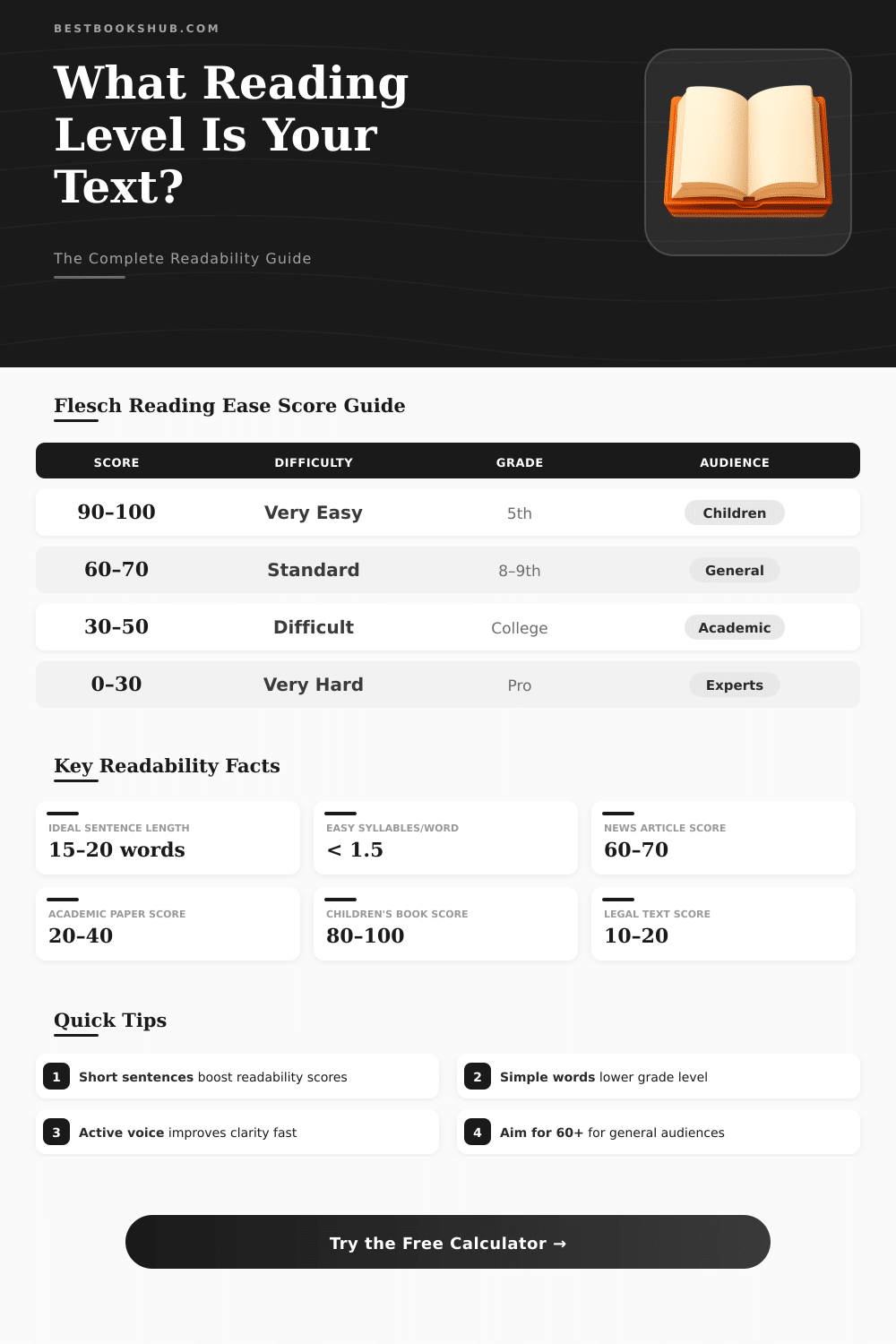
| Score Range | Difficulty | Grade Level | Typical Audience | Examples |
|---|---|---|---|---|
| 90 – 100 | Very Easy | 5th Grade | Children | Children's books, comics |
| 80 – 90 | Easy | 6th Grade | Young readers | YA fiction, simple blogs |
| 70 – 80 | Fairly Easy | 7th Grade | General public | Popular magazines |
| 60 – 70 | Standard | 8th–9th Grade | Average adult | News articles, emails |
| 50 – 60 | Fairly Difficult | 10th–12th Grade | High school+ | Trade publications |
| 30 – 50 | Difficult | College | College educated | Academic journals |
| 0 – 30 | Very Difficult | College+ | Professionals | Legal, medical texts |
| FK Grade Level | School Year | Avg. Reader Age | Approx. FK Score |
|---|---|---|---|
| Grade 1 | 1st Grade | 6–7 years | ~95 |
| Grade 3 | 3rd Grade | 8–9 years | ~85 |
| Grade 5 | 5th Grade | 10–11 years | ~75 |
| Grade 7 | 7th Grade | 12–13 years | ~65 |
| Grade 9 | 9th Grade | 14–15 years | ~55 |
| Grade 12 | 12th Grade | 17–18 years | ~45 |
| College | Undergraduate | 18–22 years | ~30 |
| Professional | Graduate+ | 22+ years | <20 |
| Content Type | Avg. Sentence Length | Avg. Syllables/Word | Typical FK Score | Typical Grade |
|---|---|---|---|---|
| Children's Books | 8–10 words | 1.2–1.4 | 80–100 | 1st–5th |
| News Articles | 15–20 words | 1.4–1.6 | 60–70 | 8th–9th |
| Blog Posts | 14–18 words | 1.4–1.5 | 60–75 | 7th–9th |
| Business Emails | 16–22 words | 1.5–1.6 | 55–65 | 8th–10th |
| Academic Papers | 22–30 words | 1.8–2.1 | 20–40 | College+ |
| Legal Documents | 28–40 words | 1.9–2.3 | 10–25 | Professional |
| Technical Manuals | 18–25 words | 1.7–2.0 | 30–50 | College |
| Marketing Copy | 12–16 words | 1.3–1.5 | 65–80 | 7th–9th |
Sentence length has the largest impact on both FK formulas. Aim for an average of 15–20 words per sentence for general audiences. Break long sentences into two where possible.
For accurate Flesch-Kincaid results, use at least 100 words. Short samples (under 30 words) can produce wildly inaccurate scores. The more text you analyze, the more reliable your score.
The reading level helps to estimate how difficult or easy a text is to read. One uses it also to estimate the skills of a reader. By definition, it shows the reading skill of a typical person at a particular age.
DISCLOSURE: This post may contain affiliate links, meaning when you click the links and make a purchase, I receive a commission. As an Amazon Associate I earn from qualifying purchases.
Usually one ties the word with a grade level for example “reading level of the 5th grade“, and that points to the ability of people to read materials at that grade.
How Reading Levels Help You Choose Books
Various systems exist for reading levels. The levels of AR books base on the ATOS formula about readability and are shown by means of a decimal number, as 4.5. Level 4.5 shows that a student with equal skills probably can read the text alone.
Lexile measures are much bigger, for instance 720. Levels of guided reading, that one also calls Fountas and Pinnell, mark by means of a letter, as R. Understanding the differences betwen those methods simplifies the search for fitting books.
Tools like the Accelerated Reader Bookfinder allow students, teachers, parents and librarians to find books by criteria like ATOS book level or Lexile measure, interest level or title. The Book Finder is another aid, that fits a classroom library, prepares a list of books and helps to choose volumes at the right reading level. The Chart of Reading Levels from Booksource shows how commonly those systems match between themselves.
There are also free websites for checking readability, that immediately point out the grade of a text and notice common phrases, that are hard too read.
A simple way to estimate whether a book fits a reader is the placing of fingers. During the reading, raise a finger for every unknown word. If two to three fingers stay up for a whole book, that is the ideal.
When four or even five fingers rise, the book probably is too hard.
Current knowledge shows that students require clear and sorted teaching about phoneme awareness, phonics and firm links between letters and sounds, together with exercises using decodable texts. Leveled texts do not intend to be decodable, which is a key point to recall.
Automatic scales for reading levels sometimes give confused results for fiction books. One program can estimate a chapter at the level of the 6th grade, while another estimates it at the 11th or 12th grade for the same bit. So they do not always deserve trust for stories.
The reading levels matter mostly for those that still learn to read. When a reader reaches enough skill, the choice of books varies a lot. At a reading level of the 4th grade, the choices spread widely, and most common market texts sit around the level of the 6th grade.
Here the level matters less. The best way is to simply read, stay calm and pause when one feels tired. Reading a bitdaily makes troubles in texts easier over time.