📖 Spanish readability lab
Flesch-Szigriszt index calculator
Paste Spanish text to count words, sentences, and syllables, calculate the Flesch-Szigriszt index, map difficulty bands, and compare related Spanish readability formulas.
Load a realistic Spanish passage, then adjust sample scope, sentence detection, syllable style, hyphen handling, abbreviation treatment, target band, and precision.
| Step | Current value | Formula part | Effect on score |
|---|---|---|---|
| Base | 206.835 | Starting constant | Anchor value |
| Syllable load | 0 | 62.3 x syllables / words | Lowers score |
| Sentence load | 0 | words / sentences | Lowers score |
| Final | 0 | 206.835 - syllable term - sentence term | Flesch-Szigriszt index |
| Score range | Band | Typical reader fit | Revision signal |
|---|---|---|---|
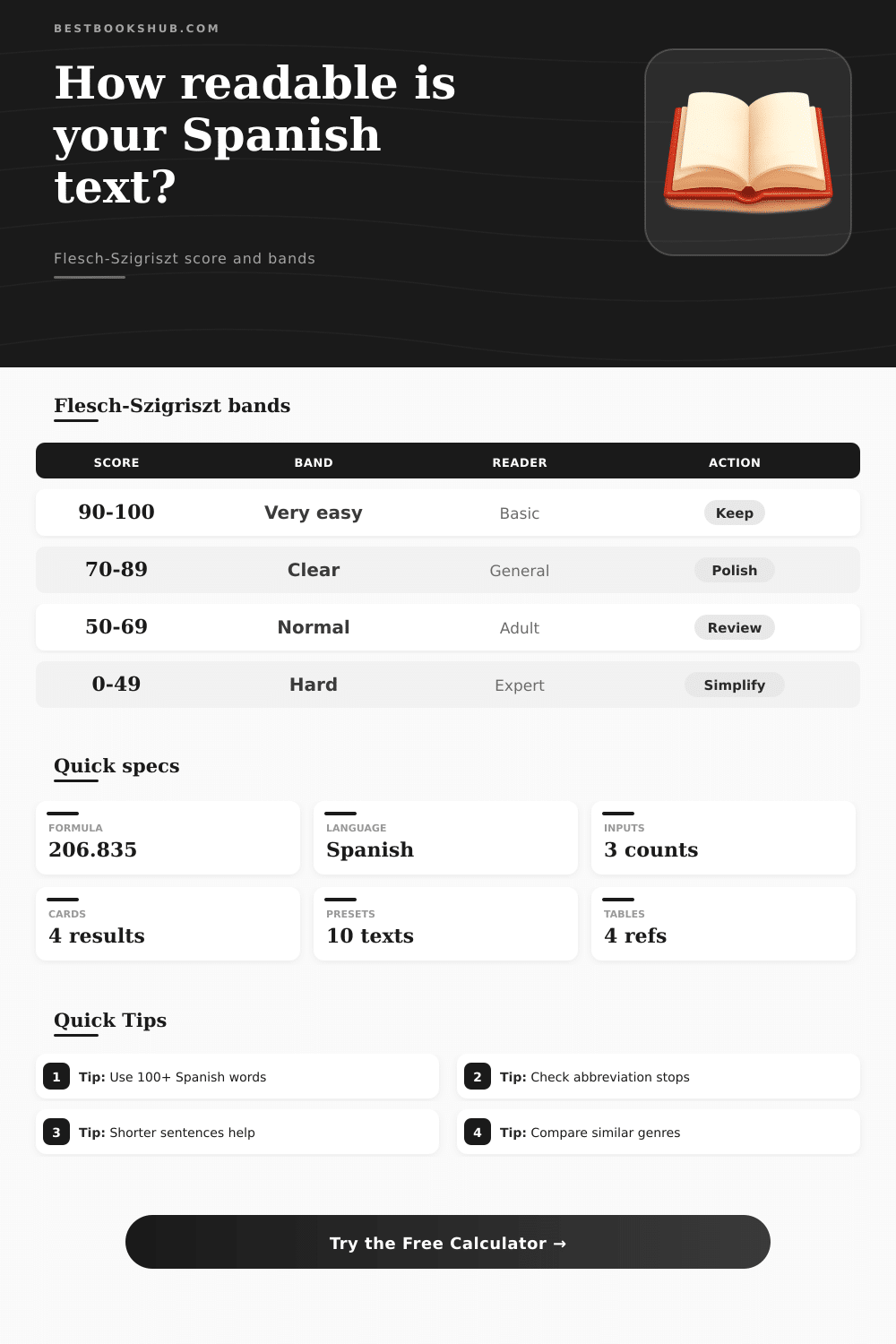
| 90-100 | Very easy | Simple public text, young or quick scanning readers | Keep sentence rhythm natural; avoid over-simplifying. |
| 80-89 | Easy | General public text, clear instructions, basic web copy | Good target for service pages and patient handouts. |
| 65-79 | Quite easy | Comfortable adult reading with moderate vocabulary | Check long paragraphs and dense noun phrases. |
| 50-64 | Normal | Average adult reader, newspaper or article style | Review if the audience needs fast comprehension. |
| 30-49 | Difficult | Specialized, academic, legal, or administrative readers | Break sentences and define technical terms. |
| 0-29 | Very difficult | Expert or highly motivated readers | Revise heavily for public-facing communication. |
| Formula | Displayed equation | Main inputs | How this calculator uses it |
|---|---|---|---|
| Flesch-Szigriszt | 206.835 - 62.3 x S/P - P/F | Words, sentences, syllables | Primary score and band. |
| Fernandez-Huerta | 206.84 - 0.60 x syllables per 100 words - 1.02 x words per sentence | Spanish syllable density and sentence length | Side-by-side Spanish Flesch adaptation. |
| Szigriszt-Pazos | 206.835 - 62.35 x S/P - P/F | Perspicuity with Spanish coefficients | Reference neighbor shown for transparency. |
| Difference row | Primary minus comparison | Same counts, different coefficients or label | Highlights whether the formulas agree. |
| Text feature | Default handling | Optional control | Why it matters |
|---|---|---|---|
| Sentence endings | Period, question mark, exclamation mark, and Spanish closing marks | Guard abbreviations or use manual count | Sentence length directly subtracts from the score. |
| Spanish vowels | Vowel-nucleus syllable estimate with accents and diaeresis recognized | Simple or accent-sensitive mode | Syllable load has the largest coefficient. |
| Hyphenated terms | Split terms such as tecnico-administrativo | Keep as one token | Compound treatment changes both words and syllables. |
| Acronyms and numbers | Count compactly as one spoken unit | Count letters or exclude | Official and technical texts often include many codes. |
| Sample size | Confidence | Best practice | Common issue |
|---|---|---|---|
| Under 50 words | Low | Use for a quick preview only | One long sentence can dominate the score. |
| 50 to 99 words | Moderate-low | Compare only with similar short snippets | Headings and fragments distort sentence count. |
| 100 to 249 words | Good | Strong for pages, notices, and short articles | Lists may need manual sentence review. |
| 250+ words | Strong | Best for chapters, reports, and public documents | Long samples can hide one difficult section. |
DISCLOSURE: This post may contain affiliate links, meaning when you click the links and make a purchase, I receive a commission. As an Amazon Associate I earn from qualifying purchases.
For example: The Flesch-Szigriszt index calculator measure syllables, sentences and words to estimate Spanish readability. Then it compares similar formulas to help editors know what to aim for as they revise. Whether you’re writing a city hall notice, a school textbook or a patient leaflet in Spanish, the distance between your desired meaning and readers’ understanding can span far. The index measure that distance without guessing.
It counts the number of words within a given sentence then the number of syllables within each word. Combined, these two factors drag the score downward from its initial 206.835. The closer the final number are to zero, the lightest the text will feel when reading. It’s designed for Spanish.
How to Make Your Text Easy to Read
The Romance languages can be tricky for English-based formulas; Szigriszt adjusted coefficients to approximate actualy flow in Spanish. Sentences containing abstract nouns and other stuff quickly sinks the score into dangerous waters. Everyday words, short and to the point, lift it.
This is one reason the calculator allows users to tinker with how it counts sentences. You can decide whether to treat hyphenated compounds as separate or not, and what to do with acronyms. These choices correspond to actual editorial decisions you’re likely making during revision.
Here’s an example: Imagine a piece of health literature that score in the low thirties. Clarity means no errors, so what happens if most people has to read the same paragraph more than once? Perhaps by replacing technical words with plain equivalents and splitting a long twenty-five word sentence into two slightly shorter ones, the passage land squarely in the sixties. You’ll notice the impact when you view the writing mapped against bands indicating how easy or harder a piece is to understand.
That’s not the entire story. For instance, numbers don’t account for the fact that a piece of writing might have a seemingly perfect score on paper. It might still trip readers’ tongues because its vocabulary are strange, or the ideas come in the wrong order. Familiarity with the culture. Someone who never deals with bureaucracy will be confused by a legal notice written at a normal difficulty level; another person will find a novel at the same level to be welcome and brisk. Your judgement determines whether this place on the scale matches your audience, even though the calculator tells you what that place is.
Longer words are not necessarily more difficult. But writers tend to think they is. In fact, Spanish uses a lot of long words that hold a bunch of meaning and which native speakers zip right through. The actual difficulty lie in piling up multiple such words within sentences that do not seem to end. The rhythm becomes heavy when you find yourself watching the number of words per sentence edge closer to twenty-five with the syllables per word inching past 2.2.
Either reduce the word count or shorten your sentences to see improvement; shortening sentences is usually the quickest way. It also shows how these formulas compares with each other. Here’s where Fernandez-Huerta will tweak weightings and occasionally offer a slightly rosier opinion about the same passage. Szigriszt-Pazos stays closer but alters her constants by just enough to push that final band in another direction. That’s what it’s like seeing them side by side: You don’t treat any number as gospel. You get a feel for the range in which your document should of fall.
The beauty of readability scoring is that it’s most effective when the reader has a dialogue with the text. Paste in your draft, let the numbers fall into place and consider if your readers will flow from one sentence to the next. No? Then it won’t take much. Use some concrete verbs over there and a couple of shorter sentences here. Same ideas but they now have room to breathe.
The readability scorer doesn’t give you a Spanish ear. But it acts as an objective mirror for a Spanish ear, ensuring the final result is exactly as it should be.