📝 Free verse line lab
Free Verse Line Analyzer
Paste a poem to measure line length distribution, enjambment marks, stanza density, repeated line openings or endings, line-break rhythm, short/long balance, and visual shape.
Length spread
Paste text to compare short, medium, and long lines.
Enjambment marks
DISCLOSURE: This post may contain affiliate links, meaning when you click the links and make a purchase, I receive a commission. As an Amazon Associate I earn from qualifying purchases.
Open-ended lines are measured by selected punctuation rules.
Repetition rhythm
Repeated openings and endings show line-break echo.
Visual shape score
Width shifts show whether the poem forms a block, wave, or jagged field.
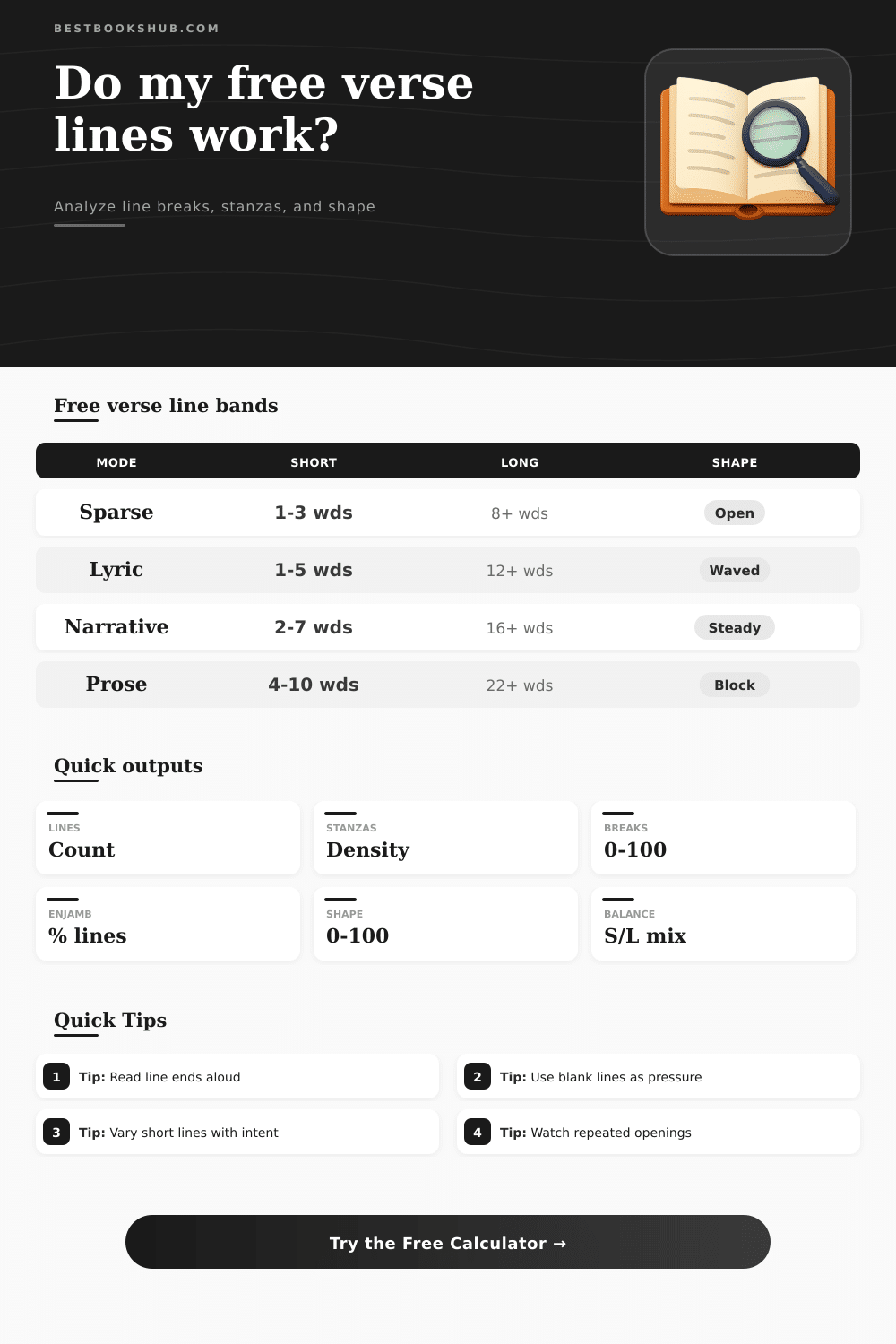
These reference bands are editing guides, not rules. Free verse can deliberately break any range when the line break earns its pressure.
| Lineation mode | Typical short line | Typical long line | Common effect |
|---|---|---|---|
| Sparse lyric | 1-3 words | 8+ words | Silence and white space |
| Contemporary lyric | 1-5 words | 12+ words | Image and turn balance |
| Narrative free verse | 2-7 words | 16+ words | Story movement |
| Prose-poem leaning | 4-10 words | 22+ words | Block pressure |
| Enjambment share | Reading feel | Line-end pressure | Revision cue |
|---|---|---|---|
| 0-25% | End-stopped | Firm closure | Check if pauses feel too final |
| 26-50% | Balanced | Mixed pressure | Good range for many drafts |
| 51-75% | Flowing | Forward pull | Make sure line ends still matter |
| 76%+ | Highly open | Continuous rush | Add stops if breath disappears |
| Stanza density | Visual pace | Reader breath | Possible use |
|---|---|---|---|
| 1-2 lines | Fragmented | Frequent stops | Turns, flashes, emphasis |
| 3-5 lines | Open | Flexible breath | Lyric and image clusters |
| 6-9 lines | Medium block | Slower intake | Narrative development |
| 10+ lines | Dense block | Long pressure | Prose-poem or argument |
| Visual shape | Length pattern | Shape signal | Line-break risk |
|---|---|---|---|
| Block | Similar widths | Stable field | May flatten visually |
| Wave | Gradual shifts | Musical movement | May feel too decorative |
| Stair-step | Directional shifts | Acceleration or descent | Can over-signal meaning |
| Jagged | Sharp contrasts | High disruption | Can distract from image |
Line breaks in free verse poetry is important because line breaks carry pressures and line breaks influence teh meaning of a poem. Line breaks can stop a thought or they can push the reader to the next line of the poem. Line breaks can isolate a single word or they can keep a sentence going through the stanza of a poem.
Therefore, line breaks are never neutral in their influence on a poem. Some writers uses instinct when they create line breaks and some use the revision of a poem to create there line breaks. Using instinct may allow writers to create line breaks that are habitually placed in ways that the writer no longer even notice.
Line breaks matter and a calculator can help
The calculator are used to determine the mathematical measurement of a poem. A person can paste a poem into the calculator to determine the number of line and stanzas in the poem. Additionally, the calculator can determine the number of lines that end without punctuation, the variation of lengths of line within a poem, and the repetition of the beginning and ending word of the lines in a poem.
Line length impact the way readers process a poem. Short lines allows space for words within a line and slow the reader down to read them. Long lines contain more information and require the readers eyes to move back to the left margin of the page more slow.
The combination of short and long lines within the same poem can impact the meaning that the poem makes for the reader. The calculator help to determine these shifts in line lengths within a poem. Stanza break can have an impact upon a poem.
However, their impact is upon a larger scale than line breaks impact upon the poem. A stanza that consists of three lines read differently than one that contains seven line of poetry. A stanza break allow the reader to absorb the information that was just presented in the stanza and prepare the reader for the stanza that follows it.
Additionally, if each stanza in a poem have the same number of lines, this create a sense of pressure within the poem. Such pressure can work for the poet or against them, depending upon the poem that is being write. Enjambment is the use of lines that does not end in punctuation.
When a poem utilize enjambment, the reader carry the sentence into the next line. If there is too much enjambment in a poem, line break lose their power. However, if there is too little enjambment because there is too many commas and periods, the poem can feel as if it is boxed in the readers mind.
The percentage that the line break calculator determine for enjambment can help poets to better understand this element of free verse poetry. Additionally, the repetition of the beginnings of lines and the repetition of the ending words of lines within a poem can impact the poem. The calculator help determine how often these types of word begin or end lines within a poem.
Therefore, calculators provides numbers that allow the poet to make decision regarding these repeated words and lines. For instance, if the short-line percentage is high, the poet can utilize short lines in the poem. Additionally, if the poet decide that there should be more enjambment in the poem, the poet can adjust the poem according to the percentage of enjambment that the calculator provide.
The calculator does not allow the poet to make decisions about the poem, but it does allow them to become aware of what is happening in their poem to inform their decisions regarding revisions to the poem.