📖 Front matter layout lab
Front Matter Page Calculator
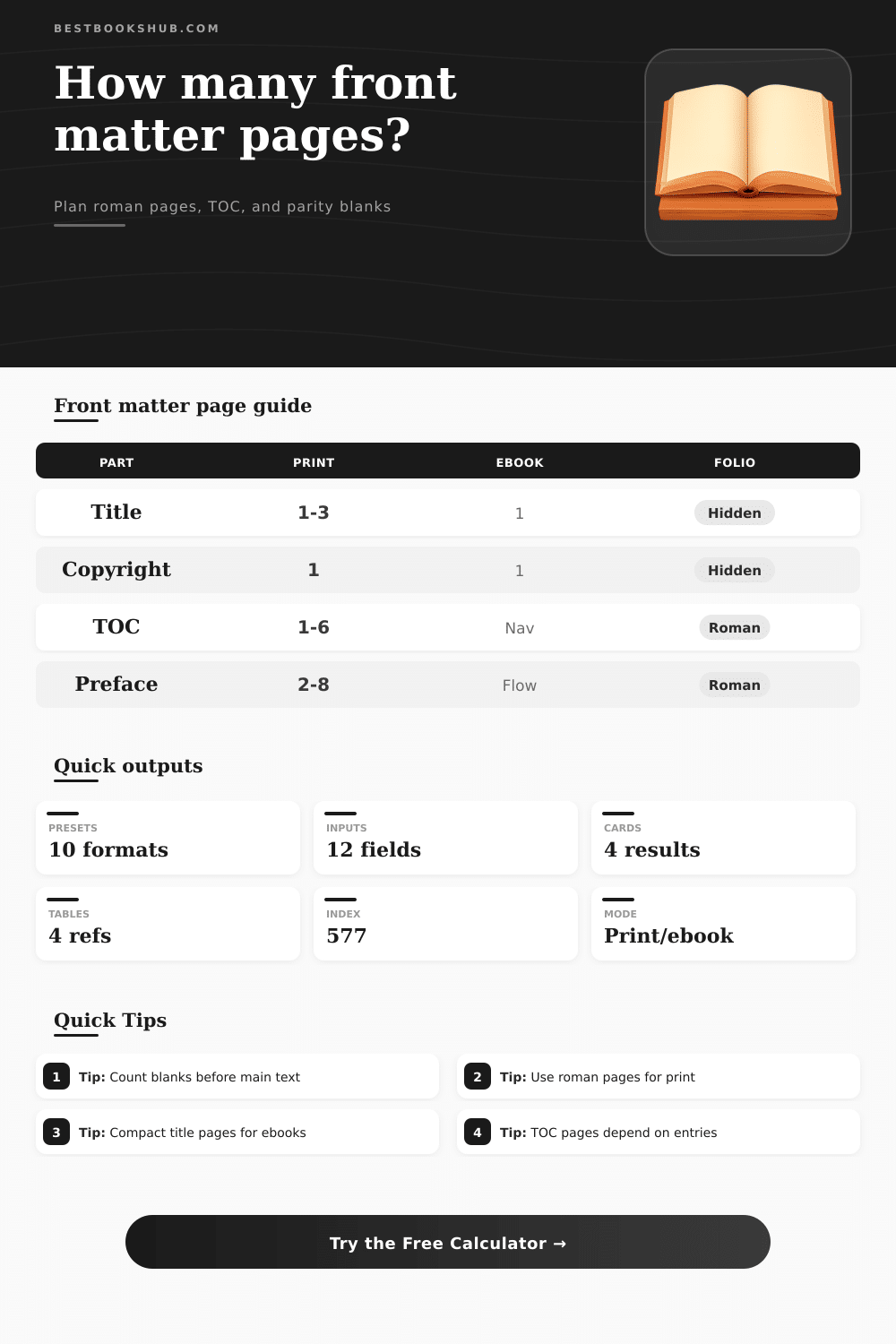
Estimate title, copyright, dedication, table of contents, foreword, and preface pages with roman numeral tracking, blank-page parity, and separate print or ebook handling.
Load a realistic front matter plan, then adjust any control. These presets only model preliminary pages before the main text.
DISCLOSURE: This post may contain affiliate links, meaning when you click the links and make a purchase, I receive a commission. As an Amazon Associate I earn from qualifying purchases.
Use these references to sanity-check the live estimate. Exact front matter may vary by imprint style and ebook export settings.
| Front matter part | Typical print pages | Calculator input | Layout note |
|---|---|---|---|
| Half title and title | 1-4 pages | Title page layout | Deluxe print editions often add extra preliminary display pages. |
| Copyright page | 0-2 pages | Copyright pages | Usually placed on the verso after the title page in print. |
| Dedication | 0-2 pages | Dedication pages | Short dedications often receive a standalone recto page. |
| Table of contents | 1-6 pages | Entries and entries per page | Long nonfiction and textbooks can need several TOC pages. |
| Foreword and preface | 2-16 pages | Words and WPP | These are calculated from text length, not a fixed allowance. |
| Roman numeral choice | Print behavior | Ebook behavior | Best use |
|---|---|---|---|
| Lowercase roman | i, ii, iii through the front matter total | Usually hidden or replaced by navigation | Standard trade and nonfiction print interiors. |
| Uppercase roman | I, II, III for formal preliminary pages | Rare in ebook display pages | Academic, legal, or highly formal layouts. |
| No roman display | Pages still count, folios are suppressed | Navigation landmarks replace page folios | Minimal print layouts or digital-first books. |
| Hidden title folios | Title and copyright count but may not print a number | Often merged with metadata screens | Common for title pages and copyright pages. |
| Parity rule | What it checks | Possible blanks | When to choose it |
|---|---|---|---|
| Main text starts right | Only the page before chapter one | 0-1 page | Most novels and standard nonfiction print layouts. |
| Major sections start right | TOC, foreword, and preface starts | 0-4 pages | Formal nonfiction where front sections open on recto pages. |
| Every front section starts right | Dedication, TOC, foreword, and preface starts | 0-5 pages | Deluxe or highly structured print interiors. |
| No parity blanks | Nothing is forced to recto | 0 pages | Ebooks, proofs, PDFs, and compact print workflows. |
| Book format | Typical front matter | Common TOC depth | Page planning signal |
|---|---|---|---|
| Novel | Title, copyright, dedication | None or short TOC | Usually compact unless a foreword is present. |
| Trade nonfiction | Title, copyright, TOC, foreword, preface | Chapters and major parts | Often needs roman numerals and recto starts. |
| Academic monograph | Expanded title block, TOC, foreword, preface | Parts, chapters, tables | Long TOC and formal roman pages are common. |
| Workbook or textbook | Title, copyright, TOC, preface | Units and lessons | TOC pages often dominate preliminary count. |
| Ebook edition | Title, copyright, navigation landmarks | Linked nav rather than printed pages | Suppress print-only blanks and compact display pages. |
This front matter page calculator can be used to estimate preliminary book pages and roman numeral range. It also calculates print parity blanks and how to treat ebook page prior to chapter one.
Look closely at a printed piece of work and you might notice that the story doesn’t actualy start until page fifteen. The initial few pages aren’t filler; they’re structural. They communicate to the reader what type of experience awaits them. Get your front matter right and the jump from title to chapter one is seamless, if you get it wrong, your book reads as abrupt and bloated.
How to Calculate Your Book’s Front Matter Pages
Most new authors don’t realize the numbers is significant. What begins as a single clean page of a title block might stretch to four when you add a series page, half-title, and full title with epigraph. Every selection alters the next roman numerals. After selections are made, the calculator will performs the calculations for you. It demonstrates what happens when you mix different parity rules, word counts within foreword, and title styles.
Six pages appear before Arabic numbers start, which can be easily added or lost based off a small preference on layout. And what about the table of contents? Fiction has a one-page TOC if we’re lucky, or sometimes no TOC at all. Nonfiction has a long column of titles, five or six spreads long, that readers treat like a road map. That’s why the TOC length vary depending on your genre.
It is not for decoration. Because it determines whether the foreword falls onto a right-hand page, which means you may have to add a blank page to ensure proper parity. And those blank pages aren’t mistakes. They represent a way to keep physical book balanced so that big sections fall open on the right side, where Western readers expect them to.
The ebooks muddle things even more. A beautiful title in print appears as an awkward expanse of blank Kindle screen. Using a compact or flow treatment merge the title, copyright, and dedication into fewer screens. At the same time, that same tool cause the number at the bottom to drop as if by magic. Inflating your sample, the fancy four-page title block you adored in print suddenly look like a liability. It’s all visual, it’s all immediately understandable.
Writers often learn one of many lessons too late: there is no set length for either a preface or a foreword. Depending on the typeface, a 1,200-word guest-expert foreword could easily occupy three pages when led comfortabley; make it large, and it require four. Double that for the preface, and you’ve just swallowed an additional eight pages of roman numerals in silence. Before you lay out, the calculator shows you this reality. You can trim your prose or revise your expectations while there’s still time.
And then there’s all of the subtle signaling of the roman numeral system itself. Lowercase suggests trade publishing conventions; uppercase feels more academic or formal. Folios are often hidden on early pages even though those pages is still counted to decide where Arabic page one begins. It is a small thing, but it matters.
Books are still physical things first, so there are some parity rules. Many people find it strange when a main text start on a left-hand page. How strict do you want the “every section opens on the right” rule? The stricter you get, the more blank pages. Some publishers love ‘em. Other publishers view them as wasted real estate and will only have one at the end of chapter one (or whatever). It all depends on your production budget, the expectations of the genre, and how traditional you want the finished book to be.
Front matter provide more orientation than decoration. It tells the reader whether to take this seriously or lightly; whether it’s intimate or scholarly. A preface and dedication are something the calculator won’t help you write, won’t help you polish up. But it will give you an exact count of how many pages it will cost you before getting to the story. Sometimes, knowing the true cost of our intentions is the most helpful thing a tool could of done for us.