📖 Grammar signal analyzer
Function word counter
Measure articles, prepositions, pronouns, conjunctions, auxiliaries, and custom function-word lists without turning the report into a generic stopword or content-word count.
Load a genre profile, then change category focus, custom words, token rules, and rate mode to compare function-word density.
DISCLOSURE: This post may contain affiliate links, meaning when you click the links and make a purchase, I receive a commission. As an Amazon Associate I earn from qualifying purchases.
The tables separate family distribution from individual words and rate spikes, so the tool stays focused on grammar function rather than broad stopword removal.
| Rank | Function word | Category | Count | Share of functions | Per 100 words |
|---|---|---|---|---|---|
| Load a preset to begin. | |||||
| Category | Count | Share of functions | Per sentence | Per paragraph | Typical signal |
|---|---|---|---|---|---|
| Category distribution appears after analysis. | |||||
| Segment | Type | Words | Functions | Density | Preview |
|---|---|---|---|---|---|
| Sentence and paragraph rates appear after analysis. | |||||
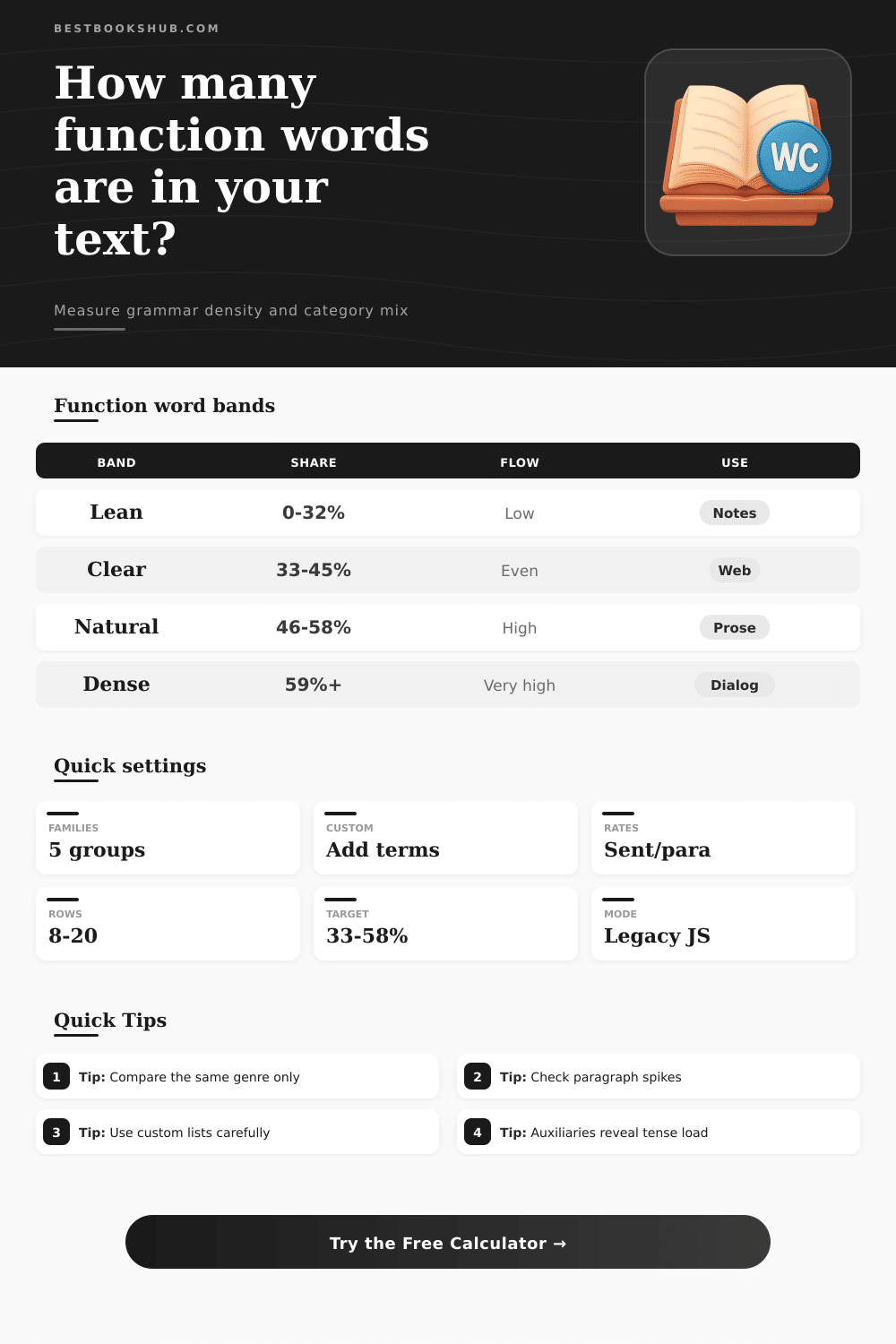
| Profile | Density band | Common driver | Watch point |
|---|---|---|---|
| Lean notes | 22-40% | Nouns | Choppy links |
| Web prose | 32-48% | Direct verbs | Thin flow |
| General prose | 38-56% | Balanced glue | Normal range |
| Dialogue | 44-62% | Pronouns | Voice load |
| Academic | 40-58% | Prepositions | Long clauses |
The function word counter is a tool for measuring how much grammar is in your writing. It also compares amount of different parts of speech… Like prepositions, pronouns, articles, conjunctions, and auxiliaries, plus any spikes you find at the sentence level. Because these words are largely in the background, and they don’t get our attention like nouns and verbs do, they’re called “function” words: They make things happen, but we rarely notice them.
But when their number goes up or down, the feel of something shifts entireley. What used to sound chatty now sounds stiff, or vice versa; and the writer can’t tell you why. That’s where a function word counter comes in showing you that invisible structure. It really matters when we see how these language assistants forms voice and rhythm.
Why Function Words Matter in Your Writing
How concretely does someone talk about something? Is it with definite article, i.e., “the”? Or the indefinite: “a”? The support provided by prepositions indicates where ideas fall in relationship to other ideas. Pronouns holds viewpoint. Conjunctions show us how tightly related two (or more) clauses is.
Watch out for patterns, because if there’s too much of any given family, the prose will begin to lean. Piling on prepositions can feel confusing; watch out for that. A wave of pronouns are a good clue that we’re entering dialogue or personal narrative. The deeper point is that function words is not inherently bad.
Writers often mistake having more of them for being better. In fiction, that’s just fine. We use them a lot in conversation, and readers follow. In academic writing, it fall into a slightly tighter range. Prepositions bear much of the burden, but too many can make writing feel like a labyrinth. Your notes remains sparse enough to see what matters most, the information itself.
The math is left up to the calculator, and you get to interpret. What appears ideal for fiction might seem gaseous in an online tutorial, which prevents revision from pursuing wrong metric. Look at your spikes at the paragraph and sentence level. One subtle lesson becomes clear: one dense chunk will show where you explained too much or where your viewpoint slip.
Auxiliaries is kind of a stress test of tense load. When “might be” and “had been” begin piling up, chances are the writer is either hedging, or flashing back. Catching that pattern soon allows you to determine if this complexity confuses or advances the story.
The other dimension it opens up is custom lists, where you can keep tabs on terms that you wish to remove (or perhaps add), such as discipline-specific connectors. Again, the ability to fold them into more general families of grammar and to pull out those terms remains, so long as you use the tool carefuly, as otherwise it will drown in a mess of custom elements rather than highlight any signals.
Experienced editors do this intuitively; they can sense when a manuscript sounds or feels too gluey. This just makes that an objective, repeatable check. What used to be intuitive discomfort becomes data you can work with, bringing you back to the words themselves with sharper vision.
But in the end: Consistency within genre matters most. Judge a dialogue page by a dialogue page; don’t judge it by a research abstract. Learn its naturaly range. And then the numbers will no longer feel abstract at all. They’ll be like a compass pointing toward your voice’s on-track direction, as well as where it veered off again.
And the thing that holds the most weight in style isn’t anything so big as a single word. It’s the littlest ones. Getting good at reading their secret density doesn’t take away the art of writing. It just provides you with better tools to shape it.