📖 BestBooksHub reading tools
Reading time by genre calculator
Estimate how long a book will take to read by genre, page density, and pace. Compare fiction, nonfiction, and study text before you commit the time.
Genre changes the pace signal, but your own reading speed and the edition's density still steer the estimate.
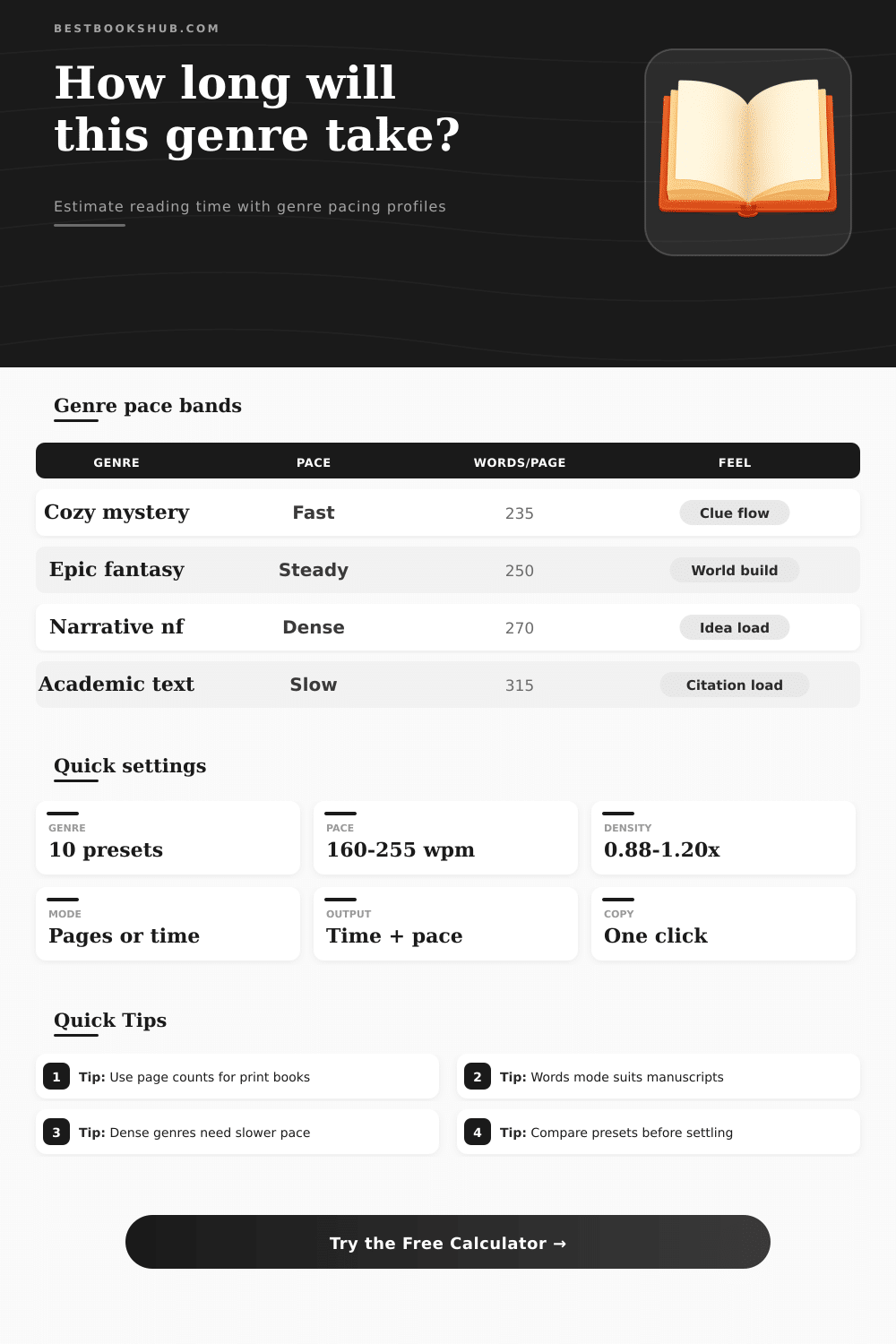
| Genre band | Pace factor | Words / page | Reading feel |
|---|---|---|---|
| Cozy mystery | 1.04x | 235 | Clue-driven |
| Epic fantasy | 0.94x | 250 | Lore-rich |
| Nonfiction | 0.88x | 270 | Idea-heavy |
| Academic text | 0.74x | 315 | Citation-dense |
| Reader pace | WPM | Pages / hour | Best fit |
|---|---|---|---|
| Slow review | 160-180 | 12-15 | Deep notes |
| Steady read | 200-225 | 15-18 | Most fiction |
| Brisk flow | 230-255 | 18-22 | Page-turners |
| Study mode | 140-170 | 10-13 | Complex text |
| Reading time | Pages | Words | Typical book |
|---|---|---|---|
| 3-5 hours | 80-140 | 20k-35k | Quick pick |
| 6-8 hours | 150-220 | 40k-55k | Compact read |
| 9-12 hours | 240-340 | 60k-90k | Standard book |
| 13+ hours | 360+ | 95k+ | Long haul |
DISCLOSURE: This post may contain affiliate links, meaning when you click the links and make a purchase, I receive a commission. As an Amazon Associate I earn from qualifying purchases.
The number of pages that a book have is an specific number. However, the number of pages does not always provide informations about how long it will take for an individual to finish reading that book. For example, a 300 page novel can be finished in a weekend, but the same number of pages in a nonfiction book might take several week to finish.
The reason for this difference are that different book genres have different levels of difficulty to read and different amount of text on each page of the book. The reading calculator makes it possible to calculate the difference between these book genres. The reading calculator contain presets for different genres of books because books of different genres contain a different amount of information on each page.
What Affects Reading Time
For example, mystery books contains alot of dialogue, which allows readers to turn the pages quick. In contrast, books such as epic fantasy books contain a lot of information for readers to learn, such as names of characters, maps, and rules for the world in the book. Academic writing also contain a lot of citations and cross references in the text that slow the reading speed of the reader.
These variables allows for some book genres to read quickly and others slow. The reason for this difference is because some book genres has more words on each page than other book genres. Another reason why the reading calculator ask for the readers reading speed is because an individuals reading speed can change depending on the book that they are reading.
For example, an individual might be able to read 250 word per minute when reading a thriller but can only read 180 words per minute when reading a business book. Business books requires the reader to remember information that the text presented earlier. The words per minute that an individual can read will change depending on the book being read.
Therefore, it is essential to adjust this setting in the reading calculator. The different densities in the reading calculator will differ depending on the different print edition of the book. For example, a mass market paperback will contain more words on a page than a trade paperback.
Textbooks will contain even more words on each page than a mass-market paperback. The density of the book allow the reader to specify whether the book is of light, balanced, or heavy density. This will have a considerable effect on the time estimate for the reader because it can change the time estimate by more than one hour for a long book.
Another reason why a buffer percentage is include in the reading calculator is to make allowances for the time that a reader might take breaks during reading and to review the text that was just read. When reading a long book, the reader might take a break at the end of each chapter. The review time that a reader might take to go back to a previous page to review a specific name or fact will also be included in the reading time for the book.
The buffer percentage for the reading calculator will allow for this time to be included in the estimate that is provide for the reader. The reference tables on the page will provide information regarding the different book genres and how fast individuals of different reading speeds can read. These tables shows the different categories of books and how many pages per hour individuals of different reading speeds can read.
These references will allow readers to determine whether their chosen reading speed for the book is realistic or whether the books settings need to be changed before calculating how long it will take for them to finish reading the book. The reader can use the reading calculator to make decision regarding a reading schedule for the reader. For example, if the reading calculator determines that it will take the reader fourteen hour to finish the book, the reader can decide that they should choose a shorter book to read instead.
If the reading calculator determines that it will take a business book six hour to finish reading, the reader can decide whether they would like to read the book in two session or whether they would like to read the book over the course of a week. By knowing the number of hours that will be required to finish reading the book, readers can make decisions regarding their schedule. Another helpful habit for readers is to run the reading calculator twice with two different set of assumptions.
For example, the reader can enter the number of words per minute that they can read comfortabley and then use the reading calculator to determine how many words per minute they would need to read to finish the book in a specific amount of time. Knowing this information will help them to choose books that will take up the actual hours available to them during the week. The reading calculator makes the differences between the book genres visible to the individual reader.
Some books will require more attention to be paid to each page than others. These difference in reading attention will impact the amount of time that an individual can plan to read the book. By making visible the difference between book genres with the reading calculator, individuals can choose a book that will take up the amount of time that they actualy have available.