📊 GMAT Focus planning
GMAT Section Score Calculator
Estimate Quant, Verbal, or Data Insights on the official 60 to 90 section scale using accuracy, blanks, pacing, and difficulty pressure.
This planner uses the official GMAT Focus section range of 60 to 90, plus section question counts and a 45 minute clock for each section.
DISCLOSURE: This post may contain affiliate links, meaning when you click the links and make a purchase, I receive a commission. As an Amazon Associate I earn from qualifying purchases.
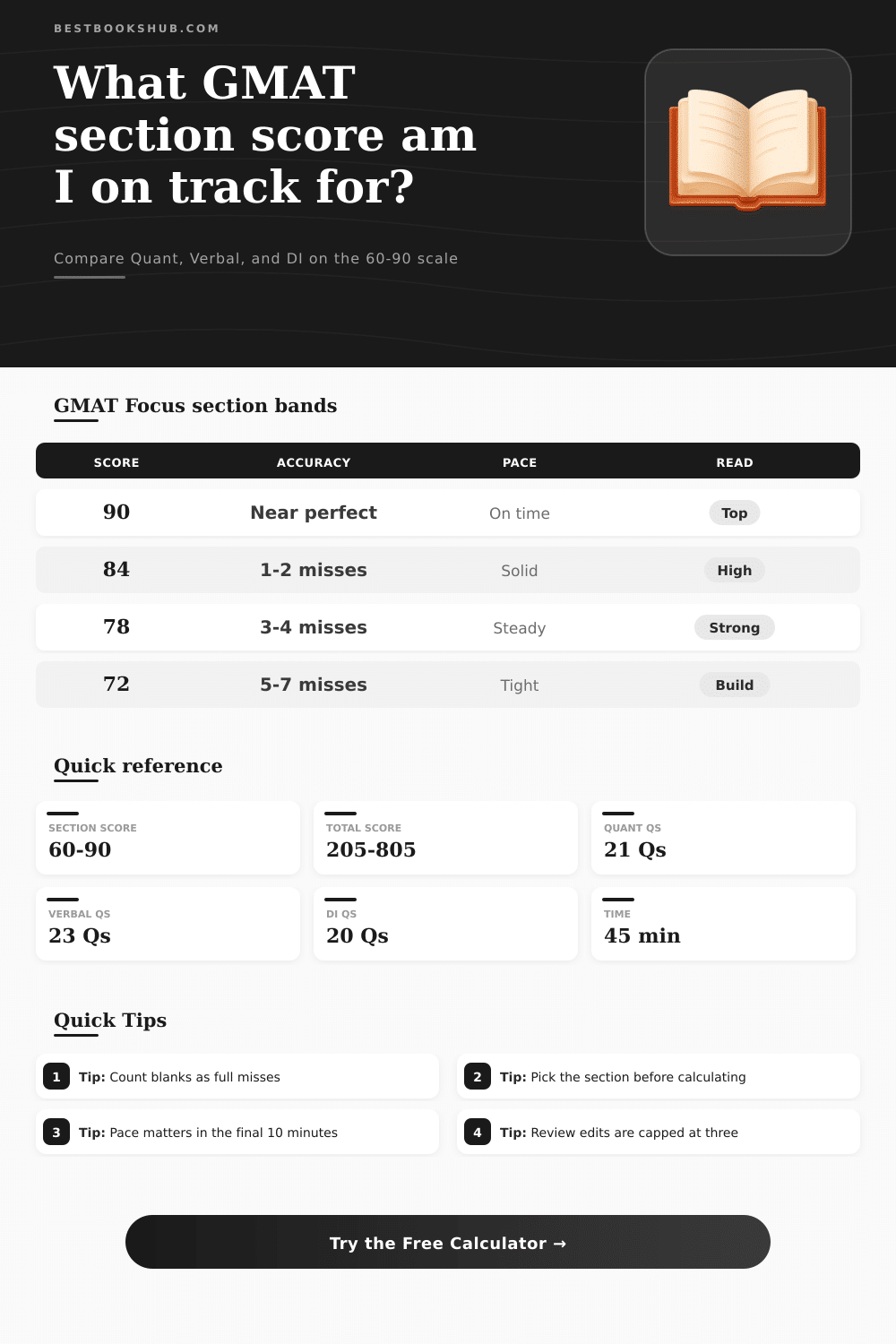
These tables summarize the official GMAT Focus structure and the planning signals that shape an estimated section score.
| Section | Questions | Time | Skill focus |
|---|---|---|---|
| Quantitative Reasoning | 21 | 45 min | Problem Solving |
| Verbal Reasoning | 23 | 45 min | Reading and arguments |
| Data Insights | 20 | 45 min | Data, logic, calculator |
| GMAT Focus total | 64 | 2h 15m | Equal section weight |
| Score band | Typical reads | Miss pattern | Pace read |
|---|---|---|---|
| 88-90 | Elite | Almost none | Very controlled |
| 84-87 | High | One or two slips | Steady |
| 79-83 | Strong | Small clusters | Normal pressure |
| 60-78 | Build | Frequent misses | Tight or late |
| Input signal | Effect | Best use | Why it matters |
|---|---|---|---|
| Wrong answers | Medium drag | Watch hard misses | Difficulty matters in scoring |
| Skipped answers | Largest drag | Protect guesses | Unanswered items penalize most |
| Hard questions correct | Score lift | Lean into tougher sets | Harder correct answers help more |
| Review edits | Small lift | Use carefully | Second-pass control stabilizes runs |
| Pace profile | Clock read | Signal | Risk note |
|---|---|---|---|
| Smooth pace | Under 45 | Helpful | Leaves room to review |
| Standard pace | About 45 | Neutral | Clean baseline run |
| Tight pace | Over 45 | Pressured | Small penalty zone |
| Late rescue | Overrun | Choppy | Blank risk rises fast |
The GMAT-points measure skills settle problems, think critically and read data. They help commercial schools estimate academic readiness. The current version, called GMAT Focal Publication, have total points of 205 until 805.
Before it was the GMAT 10th Publication. For count the whole you enters divisional values in formula that gives result between 205 and 805.
How GMAT Scores Work
Are three sections: Quant, Verbal and Data Insights. Each from them receives points of 60 until 90. The sections contribute equally to the total score.
For find it, enter the expecting points for Quant, Verbal and Data Insights in calculator. It then shows probable whole for that combination. Note that every spot in divisional score matches in 20 total spots.
Because the GMAT Focal Publication is adapta test, points do not depend only of the number of right answers. It uses Item Response Theory for set points. That considers the trouble of questions together with right and wrong answers.
For instance, two folks with same number of right questions can have different points in Verbal section if the trouble of their answers differs. Even same raw numbers give different knowledges according to computer. So the total score comes from amount of divisional points, and the best section most a lot helps.
GMAT-poentaraj leagues show as far as highly you require to reach in Quant and Verbal sections for wake target score. Points above 600 are good because they surpass the centre. Many estimate good score between 645 and 705 with 675 until 685 as ideal.
For brilliant programs as Stanford, Booth or HBS, intend 715 or more. Widely wonder at least 30 spots above the median of intended schools. Points also become percentiles for understand competitveness.