📚 GMAT verbal reasoning
GMAT Verbal Score Calculator
Estimate your GMAT verbal score on the current 60-90 scale using correct answers, pacing, question mix, and target planning.
GMAT Focus verbal uses 23 questions in 45 minutes. This calculator blends accuracy, timing, and question mix so the estimate reacts like an adaptive test rather than a flat percentage line.
DISCLOSURE: This post may contain affiliate links, meaning when you click the links and make a purchase, I receive a commission. As an Amazon Associate I earn from qualifying purchases.
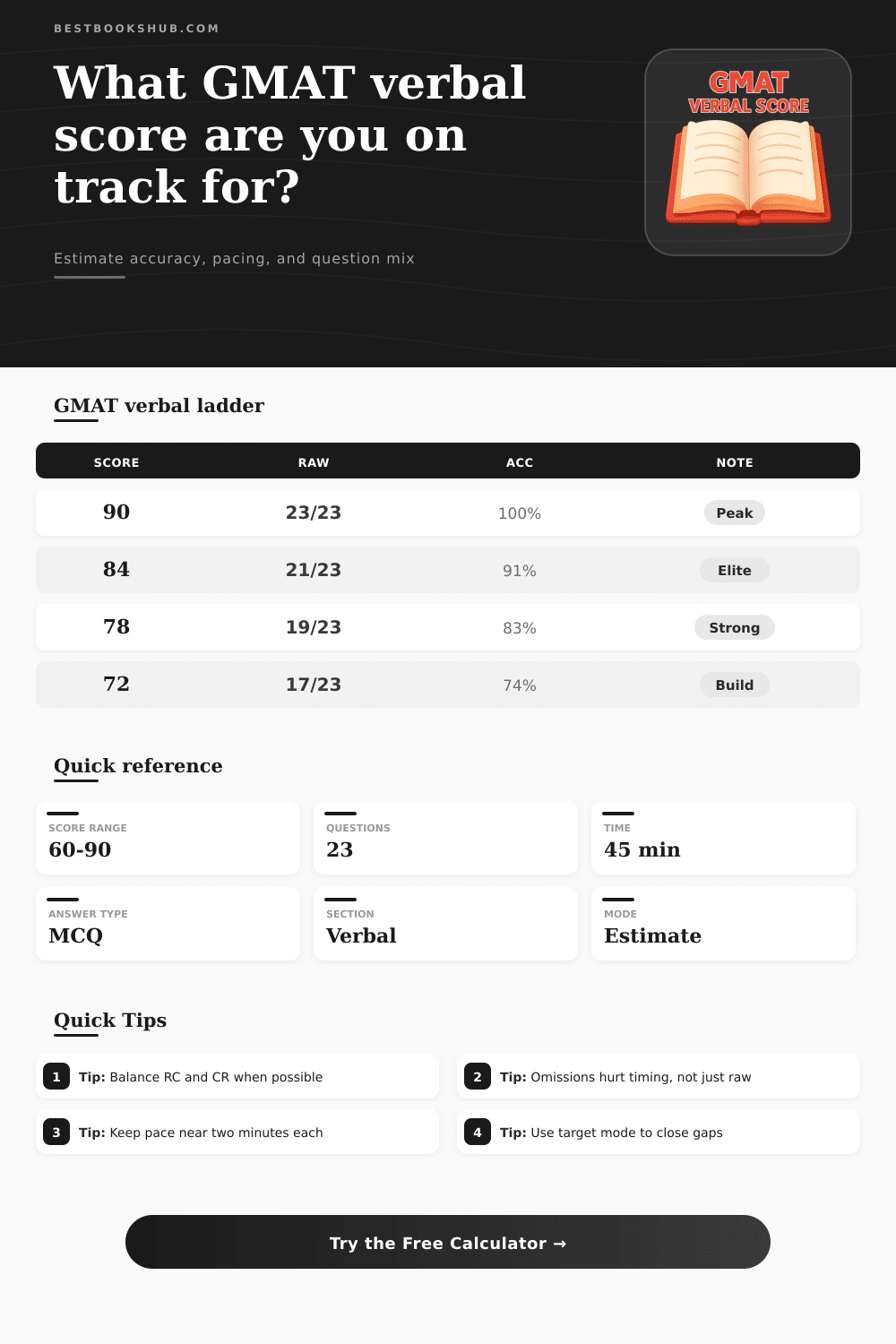
These tables keep the score estimate transparent. They show the section footprint, a quick score ladder, and the way RC and CR interact with pacing.
| Section | Q | Time | Note |
|---|---|---|---|
| Verbal | 23 | 45 min | Adaptive |
| Scale | 60-90 | 1 pt | Section score |
| RC | Mixed | Passages | Long reads |
| CR | Mixed | Logic | Argument work |
| Band | Raw | Pace | Read |
|---|---|---|---|
| 90 | 23/23 | Clean | Peak |
| 84 | 21/23 | Steady | Elite |
| 78 | 19/23 | On plan | Strong |
| 72 | 17/23 | Tight | Build |
| Skill | Share | Signal | Move |
|---|---|---|---|
| RC | High | Passage | Track detail |
| CR | High | Logic | Map claims |
| Pace | High | Time | Trim rereads |
| Review | Med | Confidence | Fix traps |
The model starts with correct answers, then nudges the result for pacing, hard-item performance, and question mix. That keeps the number useful even when the section felt uneven.
Because GMAT verbal is adaptive, the score is best read as a range and a direction of travel. A small mistake streak can matter more than one isolated miss.
The GMAT Verbal section is a big challenge for anyone who prepares for the exam. The total score of the GMAT Focus Edition ranges from 205 to 805 and is split between three parts: Quantitative Reasoning, Verbal Reasoning and Data Insights Each part receives its own score, and test-takers also receive a percentile rank that compares their result with other students.
Test-takers must answer 23 verbal questions during 45 minutes. Those questions appear in two kinds: Reading Comprehension and Critical Reasoning. They mingle through the whole section, so it is not possible to foresee the next.
About the GMAT Verbal Section
The verbal part is computer adaptive in every question, so the difficulty of the next adjusts according to whether you answered correctly the prior. Because the Focus Edition has only three sections, the verbal result weighs more in the total score than in the old version of the test.
Good score in the GMAT Verbal section for 2025 usually reaches the middle of the 80s on the Focus scale of 60 to 90. On the old scale of 6 to 51 that matches the high 30s to low 40s, which puts you close to 80th to 95th percentile. To reach 715 or more, you mostly require V85 or more in Verbal.
Business schools favor balanced Quantitative Reasoning and Verbal Reasoning points instead of extremely diffrent.
The average Quantitative Reasoning score sits around 42, but the average Verbal Reasoning is only 27. The limits for each score vary between the sections. In Quantitative Reasoning, Q49 is possible even with nine wrong questions.
In Verbal Reasoning, V49 requires you to air only in one question. Score in the 30s in Verbal Reasoning come with only some wrong answers.
GMAT Verbal combines content and logical games. As strong Quantitative Reasoning results do not come only from remembering mathematical ideas, same happen for Verbal Reasoning, it is not enough to only learn grammar rules or remember types of traps. The key is to identify your weaknesses and fill knowledge holes.
Learn one theme at a time stays the best way to truly rule every part without leaving gaps. Improve Verbal Reasoning commonly is a long project, that lasts months… Usually six to twelve, rather than only one to three.
Simple but efficient way to prepare for Reading Comprehension is to regularly read, ideally material of same quality as in the exam. Continuous reading of good books strengthens the verbal parts of the test. Books that help to build bases for arguments and effectively read passages are useful for both Reading Comprehension and Critical Reasoning.