📝 Certainty and clarity scan
Hedge Word Counter
Paste prose, essays, claims, book reviews, summaries, or editorial notes to count hedge words, uncertainty phrases, vague quantity, attribution shields, and dense caution clusters.
Load realistic passages with different hedging habits, then adjust the scan settings or paste your own manuscript, research paragraph, critique, or instruction copy.
DISCLOSURE: This post may contain affiliate links, meaning when you click the links and make a purchase, I receive a commission. As an Amazon Associate I earn from qualifying purchases.
The counter tokenizes text, detects phrase and word hedges, separates hedge families, and reports whether caution is scattered naturally or clustered where claims need a closer edit.
| Family | Common terms | What it softens | Edit question |
|---|---|---|---|
| Uncertainty | maybe, perhaps, possibly, likely, unlikely, might, may | Probability and confidence | Do you know enough to be more direct? |
| Qualifiers | somewhat, rather, fairly, quite, relatively, mostly, generally | Degree and intensity | Can a precise adjective or measure replace it? |
| Vague quantity | many, several, numerous, various, a number of, a range of | Scope and evidence | Can the passage name a number, source, or limit? |
| Attribution shield | seems, appears, suggests, tends to, is believed to, according to | Responsibility for a claim | Is the source necessary or just defensive? |
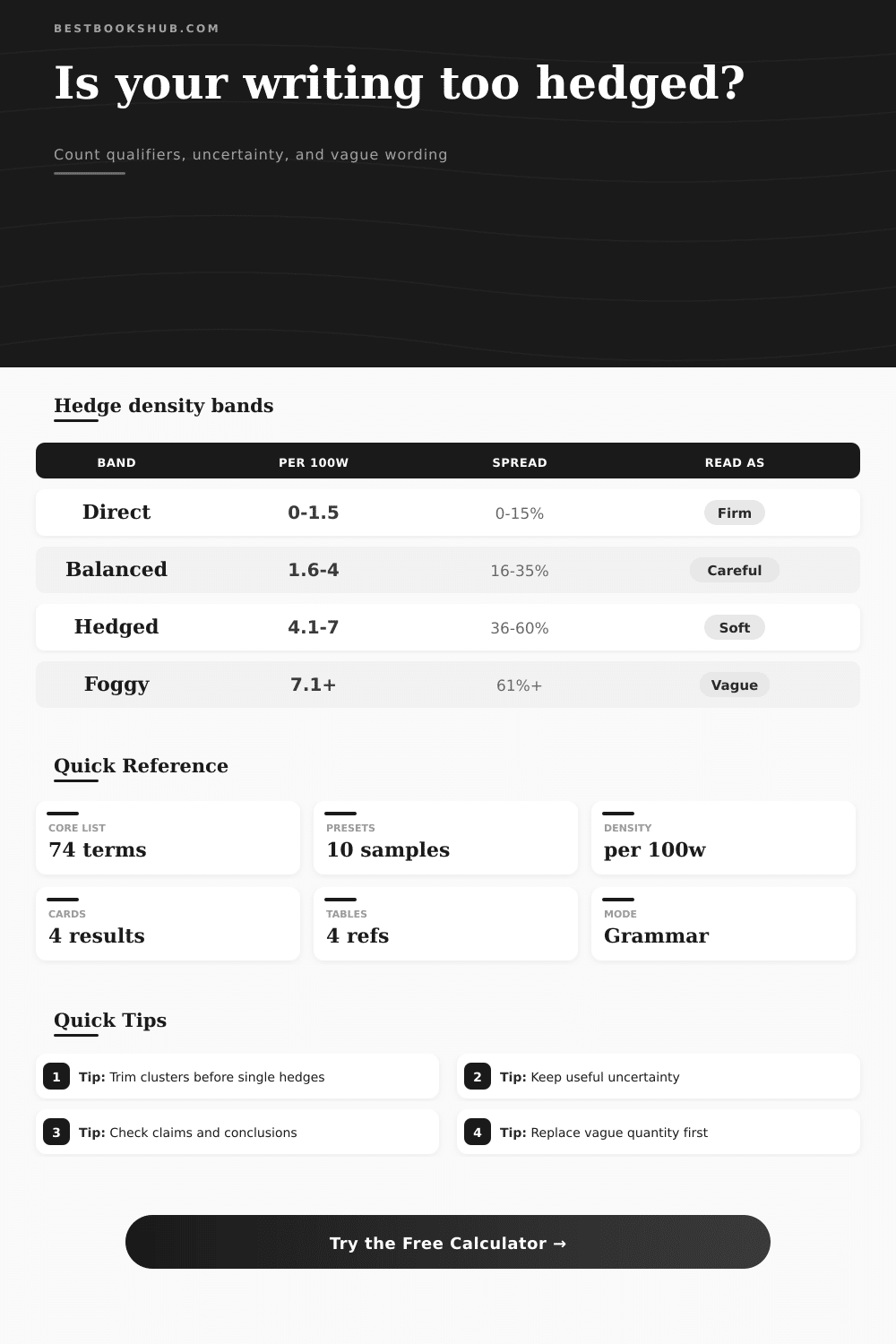
| Band | Hedges per 100 words | Sentence spread | Likely reading |
|---|---|---|---|
| Direct | 0 to 1.5 | 0% to 15% | Claims read firm, compact, and mostly unqualified. |
| Balanced | 1.6 to 4.0 | 16% to 35% | Careful uncertainty appears without taking over the passage. |
| Hedged | 4.1 to 7.0 | 36% to 60% | The reader may notice repeated caution or vague scope. |
| Foggy | 7.1 or more | 61% or more | The passage may feel evasive, tentative, or under-evidenced. |
| Writing context | Useful hedge range | Watch first | Reason |
|---|---|---|---|
| Academic analysis | 2 to 5 per 100 words | Attribution shields | Scholarly caution is useful, but stacked shields slow claims. |
| Book review | 1 to 4 per 100 words | Qualifiers | Too many somewhat and fairly words make judgment sound vague. |
| Marketing blurb | 0 to 2 per 100 words | Possibility words | Blurbs usually need confident, concrete promises. |
| Editorial note | 2 to 6 per 100 words | Weak verbs | Feedback can stay tactful while still naming the issue clearly. |
| Finding | First action | Example edit | Keep when |
|---|---|---|---|
| High vague quantity | Add a number or boundary | many readers becomes early reviewers | The exact quantity is unknown. |
| Repeated maybe or might | Choose the strongest claim | might suggest becomes suggests | The evidence is genuinely limited. |
| Qualifier clusters | Remove the weakest softener | rather somewhat unclear becomes unclear | Tone would otherwise sound too harsh. |
| Attribution shields | Name the source once | it seems becomes the narrator implies | The source of uncertainty matters. |
Direct claim
Low hedge density, low spread, and few clusters. Best for blurbs, conclusions, summaries, and claims supported by clear evidence.
Careful claim
Moderate hedge density with named evidence. Often useful for academic prose, nuanced criticism, and early analysis.
Soft claim
High qualifier share or repeated uncertainty words. The idea may be sound, but wording asks the reader to do extra work.
Foggy claim
Hedges appear across most sentences or inside tight clusters. Start by revising vague quantity and repeated shield phrases.
This probably sounds familiar: It’s that moment in a lecture hall or boardroom when someone makes an assertive statement only to trail off with words such as maybe, perhaps, or it could be argued that. The crowd nods along but the energy seeps out of the room. On one hand, it sounded safe; on the other hand, it rang hollow. Perhaps they was worried about being incorrect. Or perhaps they were trying to sound diplomatic. Or maybe they hadn’t thought through issue enough to reach a solid conclusion. Whatever the reason for hedging, though, the effect is that reader begins to stop believing everything he reads.
The writer hedges with these words above and finds them by using hedge word counter to help him identify his own tentative phrasing, allowing for an accurate claim while avoiding wimpiness.
How to Write Stronger
First: Hedging isn’t necessarily bad. Intellectual humility are a good thing in academics, where a bit of uncertainty implies caution about the claim. But the difference between cautious and vague can be thin.
There is four main categories of hedge phrases used by the calculator. Uncertainty hedges (e.g., “might” and “possibly”) temper the probability. Intensity qualifiers (e.g., “somewhat,” “fairly”) dials down the strength. Vague quantity (e.g., “several” and “many”) obscure the absence of evidence. Attribution shields (e.g., “appears” and “seems”) deflect blame from the claim itself. Knowing what drives your density, i.e., which family (are more helpful than the raw number).
Many folks don’t realize how conspicuous the word cluster can be vs. The word scatter. A single hedge every few paragraphs is generally OK, it indicates you’re thinking about nuance. Pile in a couple of hedge words in same sentence? That’s a signal you’re deep in insecurity. How do you know? By measuring clusters of words within some defined number of surrounding words.
What you’d like to see is the road. When you plug your text into calculator above, it crunches the numbers for you (spares you from having to work out all the conversions and coefficients).
How hard you should hedge depends on context. Almost no one is going to hedge in a marketing blurb. This is sales copy. Tell someone that your product may kinda help them? They’re off shopping. Peer reviews, though, benefit from a little hedging. Hedging make it okay to criticize without coming off like an attack.
This table on the page is labeled Reference Table, which I think is awesome. It does just that by listing genres along with how far you can go without causing harm. Keep those as guidelines, not rules. If you sound like a fortune cookie when writing your academic paper, then you’re too cautious. If your review sounds like a court order, then you’re too brutal.
Here are some tips on trimming hedges. Think before you cut. Don’t cut randomly. Find groups first. Cut the weakest softener in each group. Is it unclear? Write unclear instead of rather somewhat unclear. How many? Next, count your number claims. Saying many readers is a lazy way out. Early reviewers are specific. It invites trust. Overstatement isn’t an issue here. It’s about respect for the reader’s time. Readers don’t want to know just the perimeter of what you might think; they want to know what you think.
Writing strongly has a kind of psychological effect. Committing to something force you to check it. Check the source. Tighten the logic. The hedge words were filling in for that effort. Strip them out and you can see right away where your argument weaken. That’s what the scan is realy good at. It does not just count words, but diagnoses your confidence.
If you come across one that you can’t edit out, then ask yourself why. Are you lacking evidence? Does this claim turn out to be false? Or do you simply fear being direct? What the answer tells you will set the direction of the rest of the draft.
Run your intro and abstract through the counter first. Those two sections establish the tone. Muddled there? The rest won’t be so clear.
What’s the breakdown by family? Do you need to add a qualifier? Sharpen up those adjectives. Too many attribution shields? Name the source. Uncertainty belongs where it serves accuracy. Cut it where it obscures weakness.
Writing clearly takes courage.