📊 Herdan's C Calculator
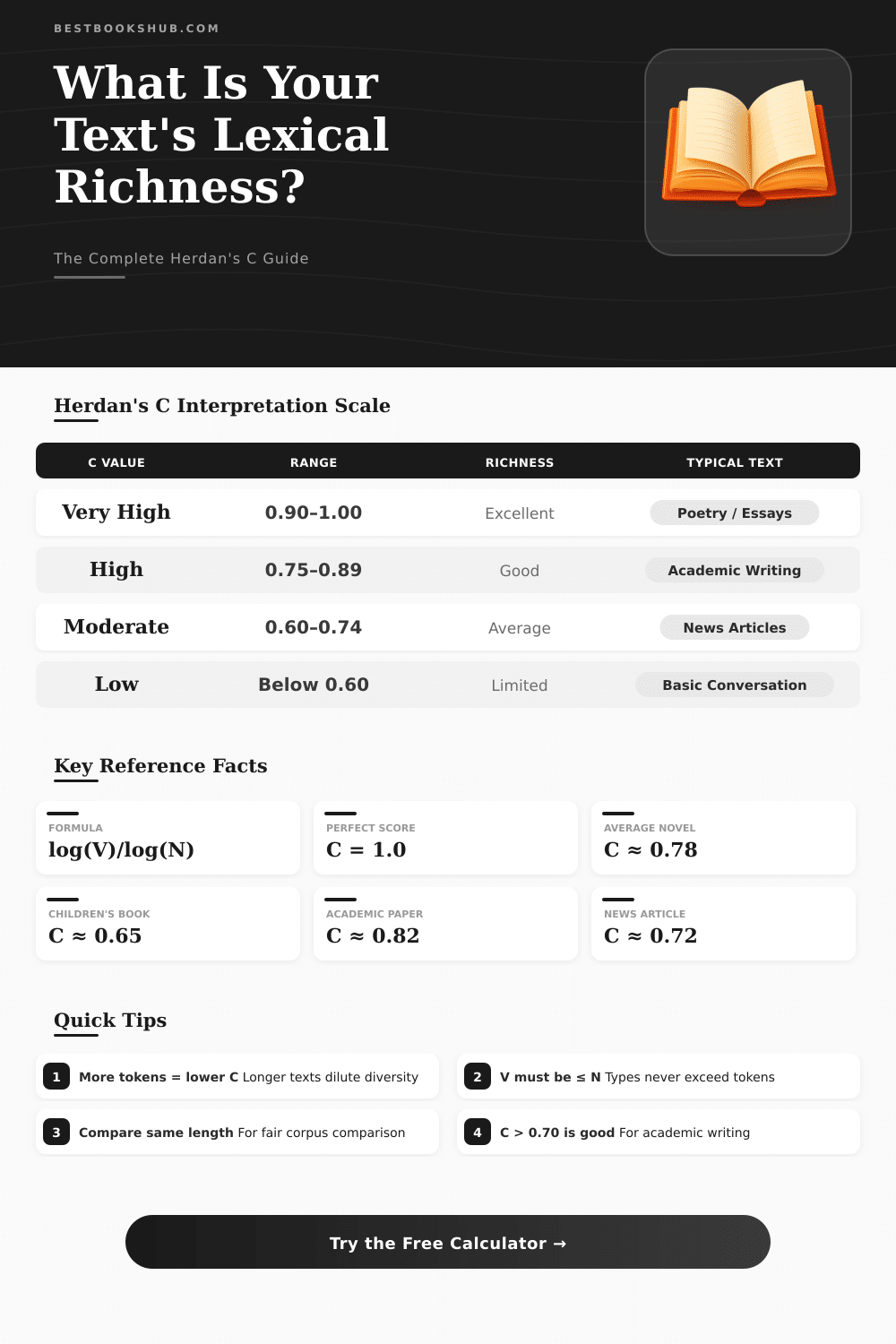
Measure lexical richness & vocabulary diversity using Herdan's C (log TTR)
| Text / Corpus Type | Typical C Value | Typical TTR | Interpretation |
|---|---|---|---|
| Poetry | 0.88 – 0.95 | 0.65 – 0.85 | Excellent |
| Academic / Research | 0.80 – 0.88 | 0.50 – 0.65 | High |
| Literary Fiction / Novel | 0.75 – 0.83 | 0.40 – 0.55 | Good |
| News / Journalism | 0.70 – 0.78 | 0.35 – 0.50 | Moderate–Good |
| Technical / Scientific | 0.68 – 0.76 | 0.30 – 0.45 | Moderate |
| Children's Literature | 0.62 – 0.70 | 0.25 – 0.40 | Moderate–Low |
| Spoken Conversation | 0.55 – 0.65 | 0.20 – 0.35 | Low |
| Basic / Repetitive Text | Below 0.55 | Below 0.20 | Very Low |
| Token Count (N) | Expected V (at C=0.78) | Raw TTR | Herdan's C |
|---|---|---|---|
| 100 | ~43 | 0.43 | 0.782 |
| 250 | ~95 | 0.38 | 0.780 |
| 500 | ~179 | 0.36 | 0.779 |
| 1,000 | ~340 | 0.34 | 0.778 |
| 2,500 | ~772 | 0.31 | 0.779 |
| 5,000 | ~1,477 | 0.30 | 0.780 |
| 10,000 | ~2,818 | 0.28 | 0.780 |
| 50,000 | ~12,025 | 0.24 | 0.780 |
| Measure | Formula | Range | Length Bias |
|---|---|---|---|
| Raw TTR | V / N | 0 – 1 | High (decreases with length) |
| Herdan's C (logTTR) | log(V) / log(N) | 0 – 1 | Low (stable across lengths) |
| Guiraud's R | V / √N | 0 – ∞ | Moderate |
| Yule's K | 10,000 × (∑m²—N) / N² | 0 – 200+ | Low |
| MTLD | Mean TTR segment length | 0 – ∞ | Very Low |
| HD-D (vocd-D) | Hypergeometric probability | 0 – 100 | Very Low |
If you want to calculate a text’s lexical richness right now, just input its number of types (unique words) and tokens (total words), then hit “calculate.” This is provided by Herdan’s C calculator.
DISCLOSURE: This post may contain affiliate links, meaning when you click the links and make a purchase, I receive a commission. As an Amazon Associate I earn from qualifying purchases.
How different is the vocabulary of a given piece of writing? You can’t help but ask question when you read book (or paste in an article and run it through a tool). It’s the heart of lexical richness. And Herdan’s C provides a neat solution, with a scale from zero to one where logarithm stabilizes number against text length, while retaining sense of how distinct the vocabulary feels. Closer to one means more distinct, despite differences in length. This makes it a go-to measure for language researchers, editors, and scholars alike.
Why Use Herdan’s C Calculator?
Plug your text into the calculator. Enter all its tokens (each and every word) and unique types (each different word). The algorithm will immediately spit out its efficiency rating. This rating tell you how many times the language has been used to avoid repeating itself. A brief poem could score upwards of 0.90; the reason is that each line strive for new images. An extended passage from a novel tend toward 0.78. This is not bad. However, you feel rich when you compare it to academic prose, which regularly scores higher by cramming in jargon.
And what’s the distinction? If a kid’s tale score just 0.65, then you know that someone deliberately opted for words that were familiar to him or her, creating comfort instead of dazzling us with newness. But relying solely on raw ratios distorts things based off length. You can’t judge a fifty-thousand-word novel by the same straight division of unique words over total words as a thousand-word news article. The distortion is what the calculator washes away, enabling us to compare a tweet with a research paper without unfairly penalizing either one for being too short or too long.
It’s why Herdan’s C made it into forensic linguistics and stylometry. Linguistic cops uses comparable measures to determine whether two ransom notes were written by the same hand. Educators monitor students’ writing progress throughout a whole semester, watching for increases in C as their drafts mature.
But it’s never just about numbers. There is always context slipping in. One text may sound entirely different than another with the same score; one uses powerful words and repeats them to hammer a point home, while other does not. And we know that when we compare spoken word against written, the former will almost always rate lower, not because humans are boring, but because true speech rely heavily on shared shorthand. A technical report can seem poorer until you hear same words (“variable,” “algorithm”) so many times that you understand they must of been used repeatedly and are not laziness.
Also be aware that you might be comparing apples to oranges. It’s always best to run a few samples of similar length, from the same general genre, perhaps by the same author. Lemmatizing (e.g., runs, ran, running) tends to improve accuracy for meaning-based analysis, and it often surprises by showing just how much score drops off. Keep in mind that genuine natural prose rarely has a perfect score anywhere close to 1.0. Those are reserved for artificially contrived works or very tightly crafted poetry.
In the end, Herdan’s C gives you a way to measure something that was previous only felt in your gut. It is not a ruler to tell if something “sings” or just “marches,” mind you, but it is one for precisely measuring the number and variety of those steps. Once you can see that, clearly, you make sharper revision decisions going forward. This is a great tool for assessing student progress, editing your own work, or exploring your favorite author’s words out of pure curiosity. The vocabulary choices does all the talking when the measure gets to the point.