📝 Grammar usage scan
Indefinite article counter
Paste prose, essays, metadata, dialogue, or lessons to count a and an, review density, inspect following-word patterns, and flag likely article-choice mismatches.
Load a preset to test blurbs, academic paragraphs, dialogue, ESL drills, acronym-heavy copy, title metadata, and edit notes with different a/an patterns.
DISCLOSURE: This post may contain affiliate links, meaning when you click the links and make a purchase, I receive a commission. As an Amazon Associate I earn from qualifying purchases.
The scanner matches whole-word indefinite articles, checks the next word, separates a from an, and reports possible mismatches using spelling or common pronunciation cues.
| # | Article | Next word | Signal | Context |
|---|---|---|---|---|
| Run the calculator to view article contexts. | ||||
| Sentence | A count | An count | Flagged | Read as |
|---|---|---|---|---|
| Sentence rows appear after a scan. | ||||
| Band | Range per 100 words | Typical signal | Useful action |
|---|---|---|---|
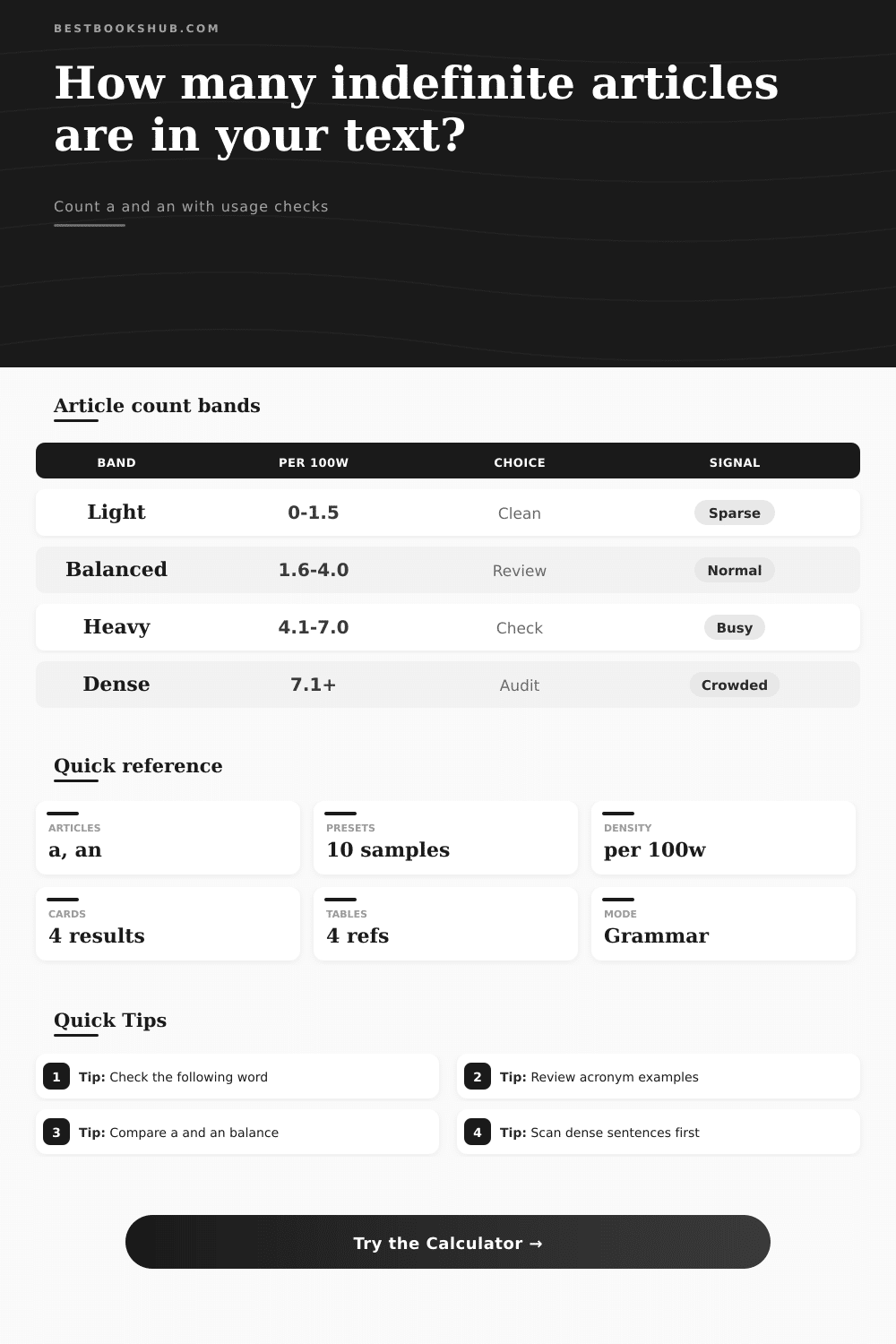
| Light | 0 to 1.5 | Few new noun phrases | Keep unless the passage feels clipped. |
| Balanced | 1.6 to 4.0 | Normal article load | Review only unusual a/an choices. |
| Heavy | 4.1 to 7.0 | Many introduced nouns | Check repetition and sentence openings. |
| Dense | 7.1 or higher | Crowded noun setup | Trim repeated phrasing or combine ideas. |
| Following word type | Expected article | Example | Review note |
|---|---|---|---|
| Consonant sound | a | a book | Most consonant letters follow this pattern. |
| Vowel sound | an | an essay | Most vowel letters follow this pattern. |
| Silent h cue | an | an hour | Pronunciation can override spelling. |
| Long u cue | a | a university | Some vowel letters begin with a consonant sound. |
| Initialism cue | mixed | an MFA | Letter names can change expected article. |
Almost every sentence you write will contain the words *a* and *an*. You may not even realize it’s there. But here’s how they work: as doorways into nouns. They are ways to introduce a new idea in the sentence.
What happens when they work? You don’t even see them. What happens when they don’t? The entire sentence stumble.
How to Use A and An Correctly
So we want to know if our use of these words is okay or not. That’s where math comes in. The calculator up top does it for you. It scans your text and finds each one. It then tells you whether your density is right or wrong.
The count isn’t the only value. Understanding what the count means… What it says about rhythm of your prose… Is valuable.
The rule is pretty straightforward in most people’s minds: *An* before a vowel; *a* before a consonant. And there’s where many gets it incorrect. The rule is not based off spelling but sound. Because you pronounce the first H as silent, you say: an hour. Because the U sounds like yuh, you say: a university.
Native speakers can be tripped up by this one, particularly when it comes to acronyms. Because the M begins with a vowel sound (think of the sound of the word me), you say: an MRI. Because the U begins with a yuh sound (think of the sound of the word university) you say: a URL.
The tool will catch those discrepancies. It will look at what follows each article. If it finds a discrepancy, then that’s the point of auditing your draft. The sound and spelling is pulling in different directions.
Words: Words matter. Not having enough is unnoticeable. One or two here or there; no one notices. Too many make it crowded. Seven words out of every hundred will tell people you’re dropping in too many new nouns too soon.
This is common with summaries. Instead of weaving features into the story, the author simply list them. On this page, we can see it in bands. We can see when the use of articles feels clean (the light areas) and when it feels cluttered (the heavy areas).
If you find yourself in the heavy zone, that doesn’t mean you have to drop words. Sometimes all you have to do is combine ideas. Instead of listing a rug, a chair, and a table, describe living room. The articles dissapears, but the scene come alive.
Quantity isn’t everything. So is scope. Consider how you begin your sentences. Do you use *an* or *a* too often? Too many and your sentence starts choppily. Even though grammar may be correct, it sounds like a list.
The sentence finder uses matches to isolate sentences. Then you can spot where the openings gather. Three times in a row? Maybe it happens three out of four times. When the reader’s ear tire on all those same word beginnings, the text will feel wrong. This isn’t a hard error; it is more a subtle texture problem.
Fix this one by mixing up your structures. Begin with a preposition, or a verb, or a proper noun. Break the pattern. Now, don’t expect the calculator to rewrite your sentences for you. It won’t do that. What it will do is flag the patterns so you know what to break.
The other side of that coin is the balance between *a* and *an*. More often than not, English words begins with consonants rather than vowels. That means, you’ll end up with more *a*’s than *an*’s (almost always). You can also use this to see if you are using too many words that start with vowels if their counts are almost the same. Or maybe it’s pure coincidence. It depends on context.
For example, a novel will appear different than a technical manual. It can filter based off certain paragraphs or quoted speech. It is handy if you’re concerned with only a portion of something longer. No need to scan an entire book to see whether the intro paragraph flows well.
And all of it is about controlling things, those little words that control how readily the reader enters your world. Too many, and the space will be too crowded with text. Too few, and it will be too empty. You want to find the balance. You’ve got the numbers to tell you where you’re at.
Next comes trusting your ear for when to stop counting and begin writing. Articles will fall into place. They’ll go invisable.