📝 Grammar emphasis scan
Intensifier Counter
Paste prose, dialogue, reviews, essays, or jacket copy to count intensifier words, emphasis phrases, stacked modifiers, sentence spread, and revision pressure.
Load realistic samples with different emphasis habits, then adjust the filters or paste your own manuscript, essay, review, blurb, or reading response.
DISCLOSURE: This post may contain affiliate links, meaning when you click the links and make a purchase, I receive a commission. As an Amazon Associate I earn from qualifying purchases.
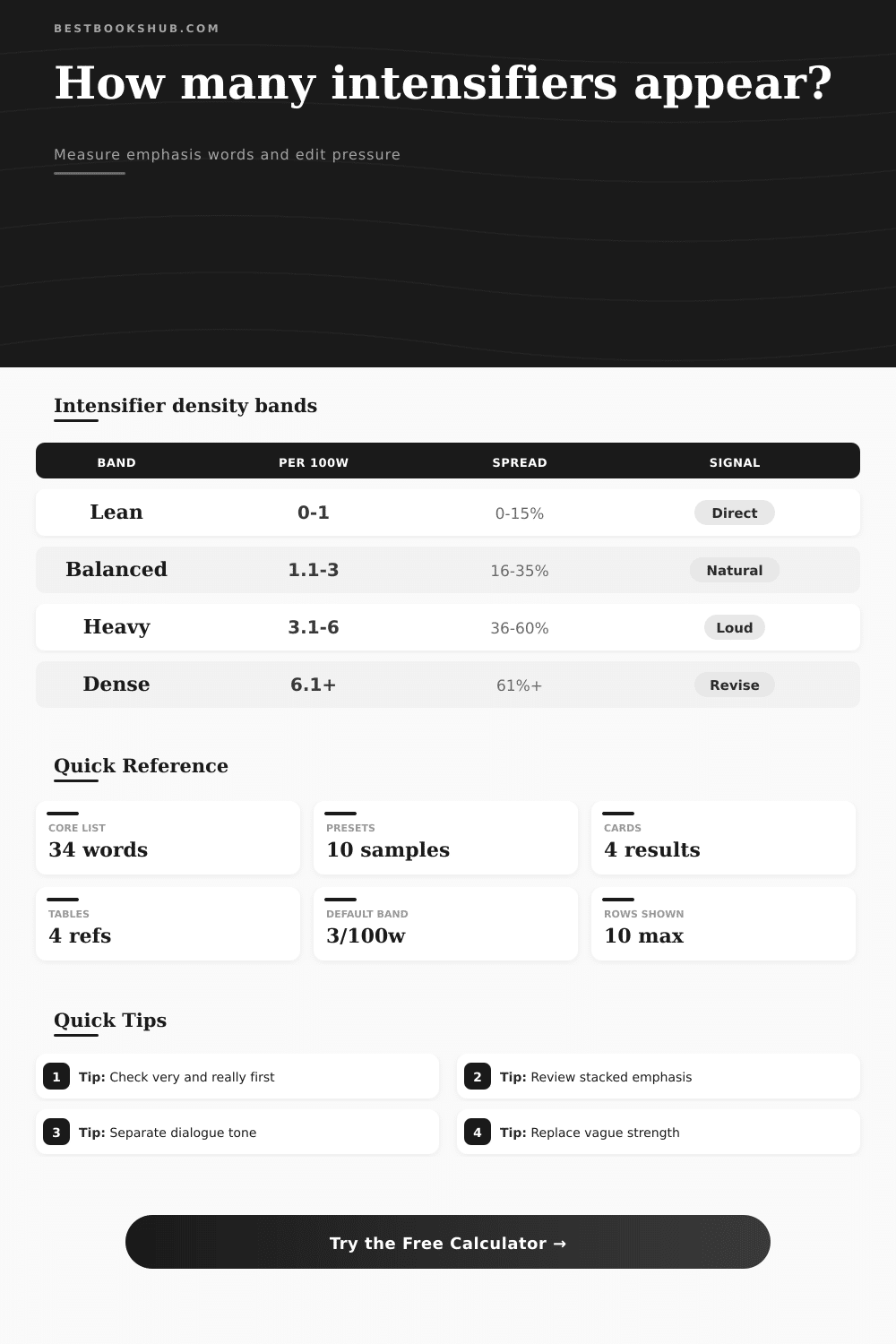
The counter recognizes common intensifiers, maximizers, boosters, downtoners, and custom emphasis terms. Sentence spread helps separate intentional voice from repeated pressure.
| Density band | Per 100 words | Sentence spread | Likely reading | Review action |
|---|---|---|---|---|
| Lean | 0 to 1.0 | 0% to 15% | Direct emphasis | Leave unless voice feels flat. |
| Balanced | 1.1 to 3.0 | 16% to 35% | Natural emphasis | Check only repeated favorites. |
| Heavy | 3.1 to 6.0 | 36% to 60% | Loud or excited | Review clusters and vague modifiers. |
| Dense | 6.1 or more | 61% or more | Overheated prose | Cut or replace repeated emphasis. |
| Family | Examples | Strength | Best context | Watch point |
|---|---|---|---|---|
| Boosters | very, really, so | Medium | Dialogue, informal voice | Repeats can sound padded. |
| Maximizers | utterly, absolutely | High | Strong claims and emotion | Can overstate weak evidence. |
| Downtoners | quite, rather, somewhat | Low to medium | Nuanced review language | Can blur the argument. |
| Custom terms | User-defined list | Varies | House style checks | Phrase boundaries matter. |
| Intensifier | Family | Count | Share | Density |
|---|---|---|---|---|
| Top intensifier rows appear after calculation. | ||||
| Sentence | Words | Hits | Families | Context |
|---|---|---|---|---|
| Sentence rows appear after calculation. | ||||
Fiction narration
Low to balanced intensifier density usually keeps description precise while preserving voice. Clusters deserve review when every image feels pushed.
Dialogue
Higher density may be intentional when a character is excited, evasive, young, comic, or persuasive. Quote scope helps isolate that effect.
Reviews
Book reviews can use measured emphasis, but repeated very or really may weaken praise. Maximizers need clear evidence nearby.
Academic prose
Dense intensifiers often read as unsupported certainty. Downtoners may be useful, but too many can make the claim feel hesitant.
Don’t use extremely, really and very, so you’ve heard. These are some of the copyeditor’s go-to’s: Intensifiers undermine your work. They allow verb to do all the hard work. Makes sense on paper. But then when you take out every single one in your manuscript, you end up with something tinny, lifeless.
It’s not about removal; it’s about finding right level. Sometimes you want an emphasis and sometimes you don’t. And you can’t tell until you see the numbers. So this doesn’t feel arbitrary, yes? A gut instinct is worth less then a tally. That’s what this page’s tool can automate.
How to Fix Your Writing
It doesn’t just count how many times common booster occur; it sorts them into groups, distinguishing between those that only mildly modify (quite) and others that absolute maximize (utterly). Because, as I said, a maximizer in a thriller have a different intent than a downtoner in an academic paper.
What the calculator above will do is run the numbers, but first you should of know what those numbers mean about your own voice. Think about density metric: the number of intensifiers appearing per hundred words. If it’s a lean score, the prose is direct and confident; you have faith that verbs and nouns are doing the job. If it’s a dense score, then writer is either shouting or hedging. That’s laid out neatly enough in the reference table on the page, which reveals that past some thresholds the signal gets drowned in noise.
But that’s only half the story. The other half are spread.
Then there’s sentence spread: Does your emphasis pervade entire piece, or is it isolated? A low spread means you’ve got a bunch of intensifiers… Say, ten, but they’re all concentrated into a single passionate paragraph. Maybe that’s fine; maybe that paragraph are doing exactly what it ought to be doing. A high spread means you’ve got those ten word sprinkled throughout ten separate sentences. Usually this isn’t intentional at all; it’s a sign that you’re reaching for your crutch word, though you don’t even realize it. The tool help you distinguish between those two situation, so that you can choose which passages require revision and which don’t.
And then there’s context. Intensifiers in dialogue can go beyond those in narration. Characters who are young, excited, or manipulative speak with higher emphasis. You may end up flagging really great dialogue as bad writing if you just sweep across an entire chapter without stopping. Isolate the quoted speech using inputs, letting you tighten the narrator while preserving character voices. A little thing, but it keeps that tell-show balance intact.
Emphasis goes too far when it is stacked. Another red flag is when we add really to our writing on top of already using very. It water down the message. The scanner picks up on that type of clustering and points out where the unnatural buildup occurs. Sometimes we think we’re putting heft into it, when all we’ve done is fill space with clutter. Take away one of those word and sometimes you find impact returns for the word left standing.
But it’s all about pattern recognition, and this is where it gets valuable. So maybe you think you’re using way too many there’s. But then the data tells you you’re actualy overusing quite. That one’s more insidious, but also tougher to spot in a straight-up reading of your work. Once you know what your weak points are, you can do some targeted editing: precise cuts rather than a blind-and-dumb search-and-replace, which can leave your prose feeling sterile. Keep the words that move the line; lose the ones that simply fill space.
In short: Editing is a matter of trust. You don’t want to have to add on any adverbs and persuade your reader that what you’re describing is true. The counter lets you see how often you ask this of your reader, which show you when you are doing it too much. It translates a fuzzy feeling of wordiness into numbers, letting you make precise cuts where necessary, removing the fluff and leaving energy in its proper place. Your writing will be both tighter and livelier, exactly the kind of clarity that leads to page-turning.