❓ Question word analysis
Interrogative word counter
Paste prose, dialogue, study notes, interview transcripts, essays, or catalog copy to count who, what, when, where, why, how, whether, if, and optional question-starter cues.
Load a preset to compare direct questions, indirect questions, dialogue, study prompts, interview copy, rhetorical style, and conditional if noise.
DISCLOSURE: This post may contain affiliate links, meaning when you click the links and make a purchase, I receive a commission. As an Amazon Associate I earn from qualifying purchases.
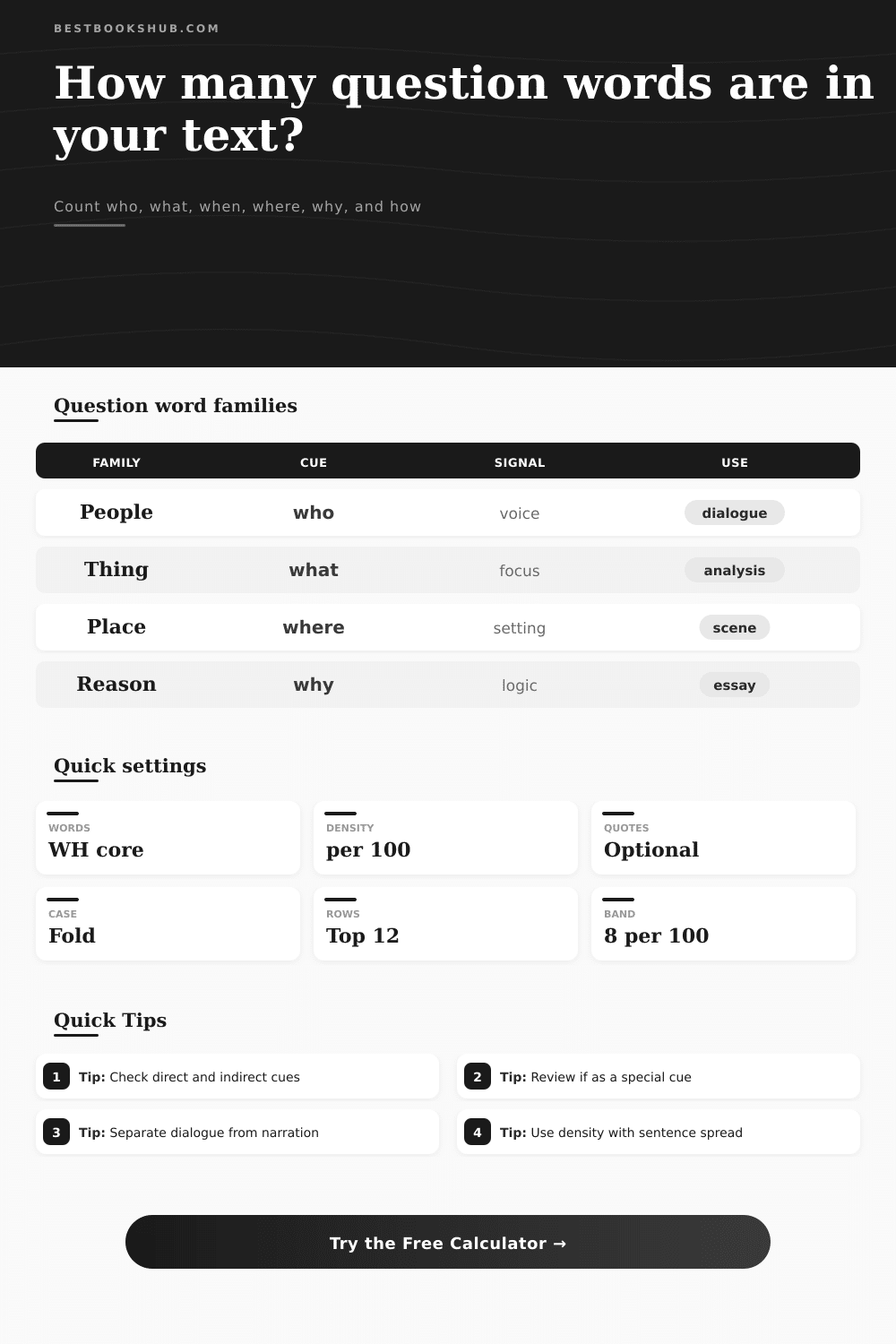
The calculator matches whole-word interrogative cues, groups them by role, and flags whether hits appear in direct questions, indirect questions, quoted speech, or conditional-looking lines.
| Family | Core forms | Extended forms | Typical question role |
|---|---|---|---|
| People | who, whom, whose | whoever, whomever | Speaker, actor, owner, quoted voice |
| Thing or choice | what, which | whatever, whichever | Object, option, title focus, evidence choice |
| Time or place | when, where | whenever, wherever | Scene timing, location, sequence, setting |
| Reason or manner | why, how | wherefore, however | Cause, method, comparison, explanation |
| Binary cue | whether, if | if only when enabled | Embedded yes or no question logic |
| Auxiliary starter | do, does, did | can, could, would, should, is, are | Direct question openings when enabled |
| Density band | Cues per 100 words | Likely feel | Best use |
|---|---|---|---|
| None | 0.0 | Statement-led | Summary, description, formal note |
| Light | 0.1 to 2.9 | Occasional curiosity | Book reviews and scene narration |
| Steady | 3.0 to 7.9 | Guided inquiry | Study questions and essays |
| High | 8.0 to 14.9 | Question-forward | Interviews, classroom prompts, FAQ copy |
| Heavy | 15.0 or more | Interrogative texture | Review repeated cues before publishing |
| Writing profile | Common cue pattern | Review focus | Helpful setting |
|---|---|---|---|
| Dialogue scene | who, what, why in quotes | Repeated speaker pressure | Track quotes separately |
| Study guide | why, how, what at starts | Prompt variety | Sentence-starter cues |
| Interview | direct question marks | Question load per answer | Direct questions only |
| Essay draft | indirect whether and why | Embedded inquiry | Indirect questions only |
| Catalog notes | short label questions | Fragment inflation | Minimum sentence words |
| Row | Band | Cues | Density | Dominant cue | Context |
|---|---|---|---|---|---|
| No text analyzed yet. | |||||
| Cue type | Strong question signal | Common false positive | Best check |
|---|---|---|---|
| If | Ask if, wonder if, know if | Conditional action clause | Enable if only for embedded questions |
| Which | Which edition should we use? | The edition which arrived late | Compare starter and whole-passage modes |
| How | How does the scene change? | How strange, how quiet | Review exclamatory or descriptive lines |
| Whether | Whether the claim holds | Usually still inquiry-like | Keep included for essays and research |
Chances are you’ve read a study guide that didn’t feel like learning, it felt more like being interrogated. There is lots of questions strung together on the page, each one following the next at a rhythm that seem aggressive. This isn’t by chance.
It’s a matter of question word density: How much do you ask vs tell? Questions aren’t just punctuation. They are tools used to manage pace and how much a reader has to thinks about, but most writers uses them like punctuation.
How to Use the Question Word Calculator
After entering your text, the calculator (above) does the work for you. You will no longer have to estimate your way through conversions and coefficients. It lists each occurrence of who, what, where, when, why, and how, classifying each according to it’s rhetorical function.
Why? Because not all question words is created equal. A who question answers a simple “who?”. A why question provides reasons and logic. The breakdown of the cue families show if your text contain mostly who and what questions with few why questions. In that case, it’s possible you’re describing the facts without linking them together. The calculator expose the disparity in your question balance, letting you know how deeply you’re inquiring.
So you see, context is tough. Consider: If I have more question words in a conversation piece than a formal essay, it’s usually because first is a dialogue scene, while the second isn’t. The tension come from characters asking one another questions. But what about when the density occurs? Is there an argument being made with those many questions, or are they merely filling space?
That’s why the reference table appear on the page. Having three to eight cues per hundred words indicates guided inquiry, which work best for educational content. Fifteen or more suggests something else entirely, perhaps a FAQ page where product is the question itself.
And then there’s the issue of false positives, especially around the word if. It’s a binary clue, so many times when you see the word if, it’s not realy a question but instead a conditional statement. So if you’re parsing through a technical manual, every time you hit an if sentence, the counter counts. This make the numbers skew higher and give you wrong sense of how inquisitive this bit of text is. That’s where you can set the tool to filter out just the core words, or count if and whether as special cases.
Ultimately: does this measure curiosity, or logic? Depending on what the essay is doing, whether introduces an embedded question that’s essential to the nuance of writing. Or, depending on the recipe, it’s simply noise. What you want to do has everything to do with what you want to find.
Not distinguishing between direct and indirect questions is another error: a direct question ends with a mark and demands an answer, while an indirect question includes an interrogative word but embeds inquiry inside a statement, such as I wonder why he left. (The latter example is an indirect question.) While both begin with an interrogative word, they performs distinct roles. The former commands instant attention; the latter shows narrative distance, as well as internal reflection.
In other contexts, say you’re editing a novel, you may wish to distinguish narration from quoted dialogue. You can then identify whether your characters is doing too much talking. Or perhaps you’re writing a report, where way you frame questions within your analysis matters most. Quickly look at the density bands to get a sense of whether or not there is something off. Heavy feels overwhelming, light feels naturaly and occasional.
There’s no magic number. There is only one that feel right for the purpose. A cover letter shouldn’t ask questions. The study guide should.
Look for main pattern of clues. Are you asking too many what questions? That will make it feel vague. Or are you asking too many how questions? That makes it procedural. Balance. That’s what writing is all about.
Questions are nothing more than another tool in the orchestra; a way to add rhythm, but too many of them makes it into chaos. The counter is a textural tool, not an error fixing one. Ask yourself if the number look high. Is the curiosity earned? If it looks low, then have you been too blunt?
You’re the one who provides the judgment; the tool merely supplies the data. Look first at the rhythm, let the questions guide you to where you need to go.