📖 Clarity risk tool
Jargon density calculator
Paste book reviews, essays, reports, blurbs, academic notes, or editorial copy to measure specialized vocabulary, acronym pressure, term repetition, and reader clarity risk.
| Term | Count | Category | Editing signal |
|---|---|---|---|
| Run the calculator to list detected jargon terms. | |||
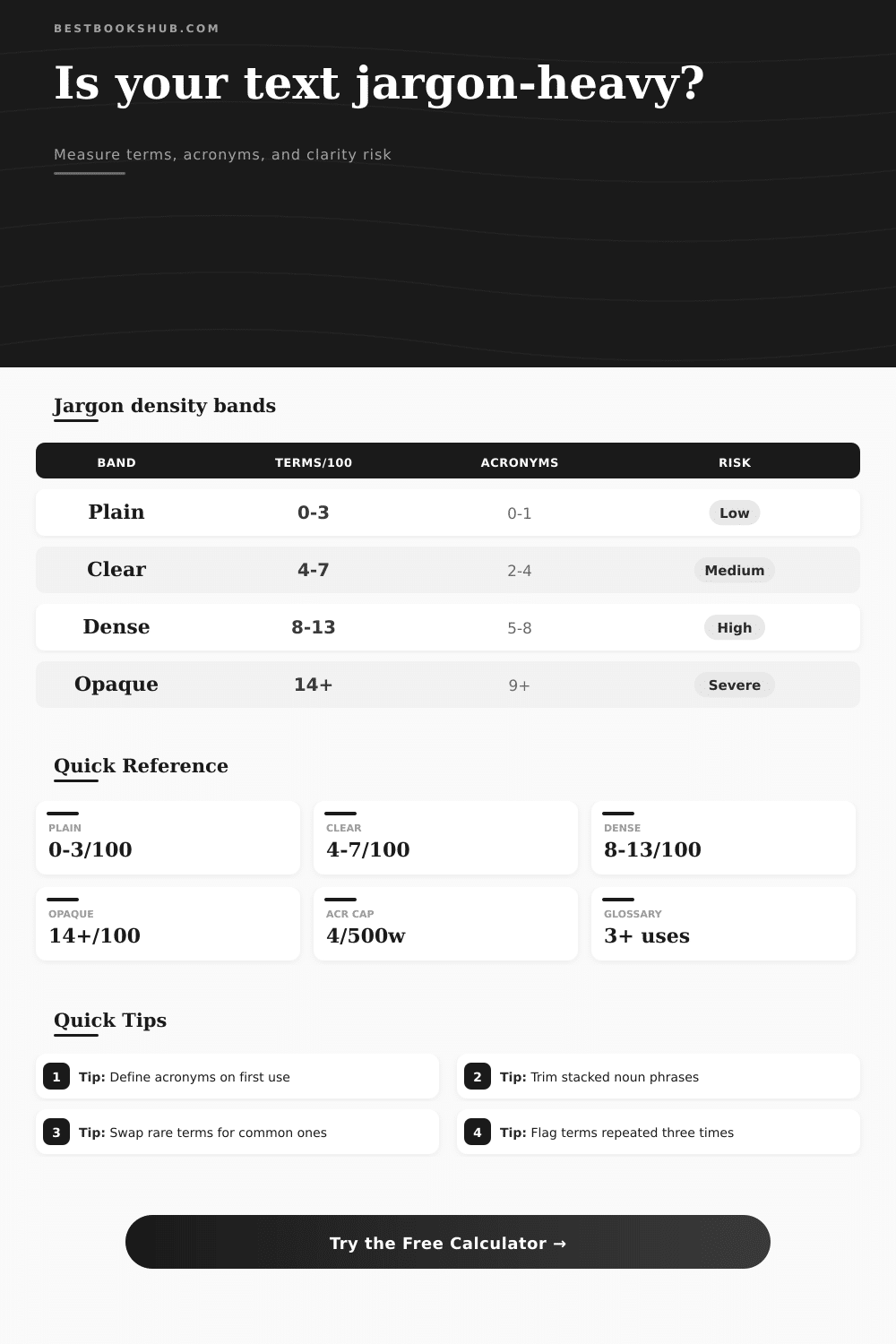
| Band | Terms per 100 words | Acronym load per 500 words | Likely reader experience |
|---|---|---|---|
| Plain | 0 to 3 | 0 to 1 | Mostly everyday vocabulary with low field pressure. |
| Clear | 4 to 7 | 2 to 4 | Specialized words appear, but context usually carries meaning. |
| Dense | 8 to 13 | 5 to 8 | Readers may need definitions, examples, or sentence thinning. |
| Opaque | 14 or more | 9 or more | Specialist language dominates and may block quick comprehension. |
| Domain | Common jargon signals | Density tolerance | Common clarity fix |
|---|---|---|---|
| Book criticism | Intertextuality, diegesis, paratext, narratology. | Moderate in reviews, higher in scholarly notes. | Pair the term with a plain example from the text. |
| Publishing | Metadata, imprint, galley, backlist, comp title. | Moderate for trade readers, lower for public copy. | Use the industry term once, then use the plain noun. |
| Technical | Protocol, latency, schema, deployment, endpoint. | Higher in manuals, lower in onboarding text. | Add a brief definition before the first procedure. |
| Medical | Etiology, contraindication, triage, intervention. | High for clinicians, low for public instructions. | Keep the clinical term and add a common-language gloss. |
| Legal | Statute, compliance, indemnity, jurisdiction. | High in legal analysis, lower in policy summaries. | Break long noun strings into subject and action. |
| Business | Segmentation, KPI, leverage, funnel, alignment. | Moderate in internal briefs, low in reader-facing copy. | Replace abstract process nouns with concrete verbs. |
| Audience profile | Target range | Acronym caution | Best use case |
|---|---|---|---|
| General adult reader | 0 to 6 per 100 words | Define almost all acronyms. | Reviews, explainers, newsletters, and public copy. |
| Bookish or editorial reader | 3 to 9 per 100 words | Define uncommon publishing shorthand. | Book criticism, catalog notes, and editorial memos. |
| Student reader | 2 to 7 per 100 words | Limit acronyms unless taught in context. | Classroom passages, study notes, and essay drafts. |
| Specialist reader | 7 to 16 per 100 words | Known acronyms can remain compact. | Scholarly, technical, legal, or professional material. |
| Executive summary reader | 1 to 5 per 100 words | Use only essential organizational shorthand. | Briefs, decision notes, and high-level reports. |
| Public information reader | 0 to 4 per 100 words | Spell out and explain before shortening. | Instructions, notices, accessibility copy, and forms. |
Term density
Best for finding how often specialist vocabulary appears compared with total word count. It is the main clarity pressure score.
Acronym load
DISCLOSURE: This post may contain affiliate links, meaning when you click the links and make a purchase, I receive a commission. As an Amazon Associate I earn from qualifying purchases.
Best for detecting shorthand overload. Even familiar acronyms can slow readers when too many appear together.
Phrase stacking
Best for spotting abstract noun chains, technical compounds, and compressed professional language in long sentences.
Glossary pressure
Best for deciding which repeated terms deserve definition, substitution, or a small in-text explanation.
The jargon density calculation (above) lets you know how readable your piece of text is. Does it contain lots of acronyms? Is it clear? You don’t want to guess. Most writers think they’re way closer than they are.
They’re so close to what they wrote they can’t see the mess anymore, they forget that readers might not understand certain words; etiology, for example, or why a KPI is relevant in this situation. Unless you spell out those words and explain them, the reader doesn’t know what they mean.
How to Make Your Writing Clear and Simple
Explaining stuff eats up real estate on the page, which costs you space, which means you have fewer characters to devote to your argument. Explain the terms, and you’ve wasted valuable space. Don’t explain the terms, and you lose the reader. It is a tricky balancing act indeed.
The best place to start is the one most relevant: the audience profile setting. It’s the tool with the greatest impact and it will be your best friend in this process. If you’re targeting someone used to dealing with a lot of jargon (a specialist reader), they expect to see it, and it doesn’t bother them. Why? Because they understand what it means, and they have enough confidence in themselves to recognize it and know it won’t hurt their understanding of what’s being said. But if you’re writing to a layperson, i.e., a general audience reader, then the same amount of jargon becomes an obstacle.
Based off whom you select as readership, the tool changes its starting point. That’s why so many mistakes happen during editing; writers assume everyone thinks like them. Everyone does not think alike. You could write a policy brief for a community group that reads very different than a legal summary for a judge. Same facts, totally different words. The tool shows you that difference before it hurts.
And then there’s acronym overload. Acronyms are great when used sparingly. A few is okay. Seven on a page? It is a sure way to confuse people. And even if you explain one, the brain tires of translating acronyms. It becomes like trying to navigate a city without street signs. Eventually, you just kind of guess where you are but it stresses you out.
Here’s how this plays out on the page (the reference table makes it pretty clear), and here’s where that translates into confusion. If you end up in the dark bands, dense or opaque; you’re probably confusing more reader than you’re clarifying. Perhaps you’re reinforcing your credentials at the expense of clarity. That’s a poor bargain.
The key here: Look at the breakdown, not the total score. Are certain terms appearing too frequently? A quick glance through that glossary flag should pick up words like leverage if they show up three times. Time to replace with a simple synonym. How about power instead of leverage? Or how about growth in place of synergy? Small stuff, sure, but it helps sentence flow, which relaxes the reader.
Phrase stacking is another term to be on the lookout for. When you find nouns piling up without any verbs, that’s when you know you have a case of phrase stacking. The improvement of efficiency through the use of this strategy can easy become: Implement the strategy to improve efficiency. Nouns is just sitting there. Verbs do the heavy lifting.
“Editing is largely subtraction. What you don’t need is for me to explain my idea with more words. You need to remove the noise. The tool provides a snapshot of that noise and lets you know where the friction lies. It’s then up to you to smooth it out.
Consider your last couple of drafts: How many were hard to read? I’m betting there are more than you’d care to admit. Put them through this tool. Run them through to check their density, and trim back on excess. You’ll be thanked by your readers; they’ll understand you better. And understanding is the whole point.”