🔤 Adjacent letter pair analyzer
Letter pair frequency counter
Count fixed adjacent two-letter pairs, compare vowel and consonant pair categories, test cross-word handling, and rank the top letter bigrams in your text.
Load a realistic sample, then adjust spacing and cross-word rules. This counter stays fixed at two adjacent letters only.
DISCLOSURE: This post may contain affiliate links, meaning when you click the links and make a purchase, I receive a commission. As an Amazon Associate I earn from qualifying purchases.
This table ranks fixed adjacent letter pairs only. It does not count word bigrams, trigrams, or variable n-grams.
| Rank | Letter pair | Category | Count | Share | First seen | Bar |
|---|---|---|---|---|---|---|
| Choose a preset or paste text to see top adjacent letter pairs. | ||||||
| Category | Meaning | Count | Share | Signal |
|---|---|---|---|---|
| Run the counter to compare pair categories. | ||||
| Common pair | Typical role | Category | What to watch |
|---|---|---|---|
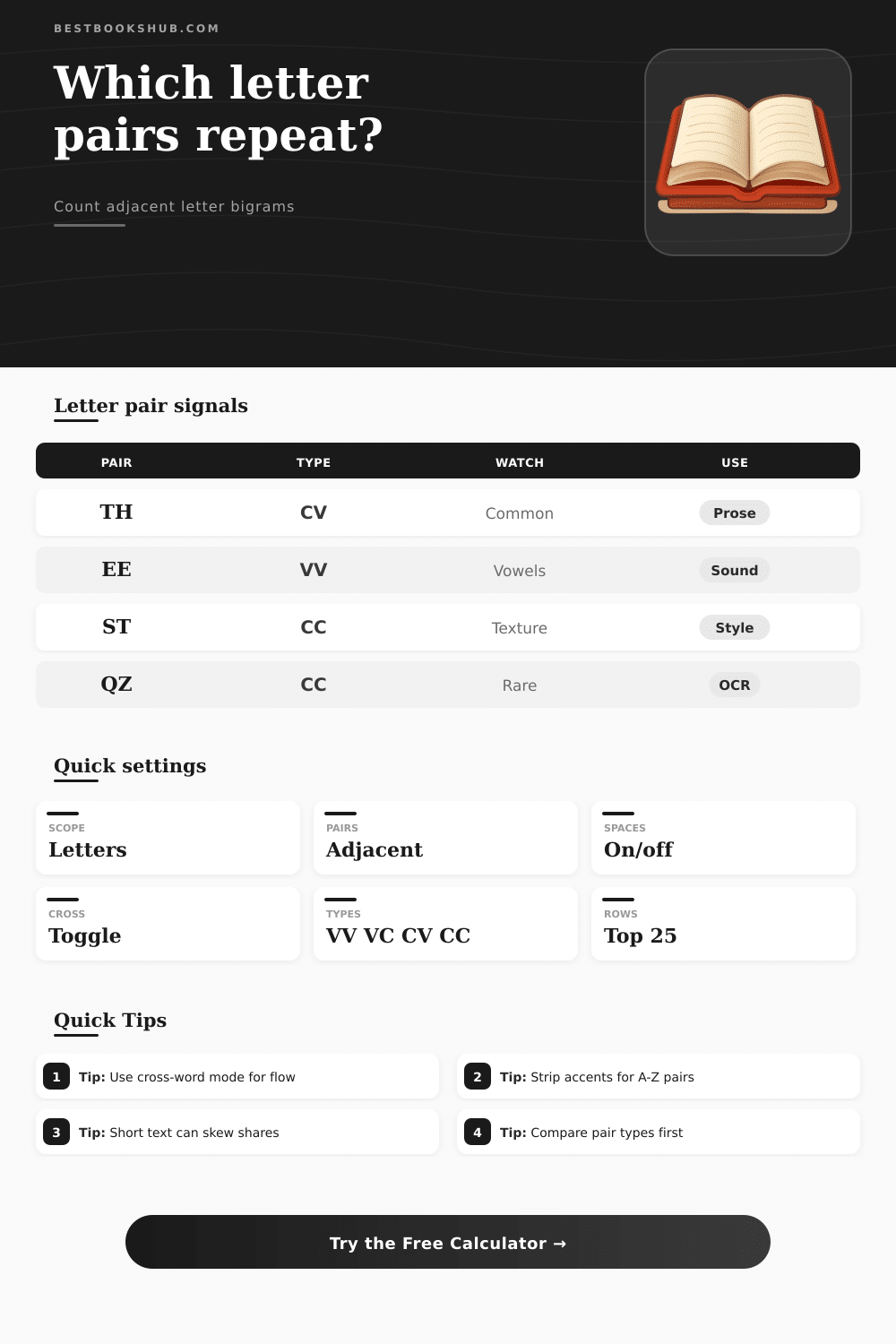
| TH | English function words | CC | High in prose with the, that, this |
| HE | Common word endings and words | CV | Often rises with he, she, the, her |
| IN | Suffixes and prepositions | VC | Common in -ing, in, inside |
| ER | Endings and comparison words | VC | Can show narrator or character terms |
| AN | Articles and word stems | VC | Often strong in general prose |
| Control | Default | Effect | Best use |
|---|---|---|---|
| Spaces | Break pairs | Keeps word interiors separate | Spelling and morphology checks |
| Cross-word | Off | Requires word-end to next-word joining | Sound flow and phrase texture |
| Accent strip | On | Maps accented letters to A-Z bases | Multilingual samples using A-Z output |
| Vowel set | A E I O U | Defines VV, VC, CV, and CC labels | Sound and readability review |
| Sample size | Pair count | Reliability | Interpretation |
|---|---|---|---|
| Title or headline | 5-80 | Low | Useful for exact styling, not baselines |
| Paragraph | 100-800 | Moderate | Good for repeated pair clues |
| Page excerpt | 800-3,000 | Good | Stable enough for category balance |
| Chapter sample | 3,000+ | Strong | Better for comparing drafts |
| Category | Example | Sound feel | Editorial clue |
|---|---|---|---|
| VV | EA, OO, IE | Open vowel runs | Can indicate soft or lyrical passages |
| VC | AN, ER, IN | Closing syllables | Common in suffix-heavy prose |
| CV | HE, RE, TO | Consonant release | Often linked to function words |
| CC | TH, ST, ND | Dense consonants | Can show texture, names, or OCR noise |
This letter pair frequency counter ranks your bigrams (letter pairs) by proximity, checks cross-word rule matches, shows vowel-consonant categories, and even lets you compare different drafts too see how they change. The way we arrange text creates its feel before we recognize why. Writers don’t often realize that TH has rhythm; EA bounces. Much more is done than we give credit.
When you start counting these pairs rather then guessing, you begin to see the structure of language. It’s not about hidden codes it’s about recognizing the texture you’re weaving. English is a habitual language. Certain letter pairs dominates in prose: TH, HE, IN, ER, and AN. They turn up in little words that glue sentence after sentence. So when those pairs rise in your sample, you typically see an increase in normal density of function word.
What the Letter Pairs Mean
Interesting times arrive when the balance move. An increase in CC pairs can indicates OCR errors, or tight alliteration. An increase in VV pairs tend to open the sound, slowing the eye. This is why poems tends to have more vowels next to each other. The calculator sorts it out; it’s up to you to know what the shift reveals about pace and voice.
It all depends on spacing decisions. By leaving the spaces to separate the pairs, you stay within limits of words and see more clearly how the spelling patterns work. When you turn on cross-word mode, you start to measure over phrase boundaries where flow begins. That’s important for judging sentence breathing, or editing dialogue. Pairs bridged by word edges can produce unintended hiss or an appealing liquid quality. Until you see the numbers, most writers don’t even notice.
Then there’s accent handling. This one is more of a quiet gatekeeper. On the one hand, removing diacritics allows you to put multi-lingual words on same A-Z field for comparison. But at times these marks carry phonetic weight we may want to preserve. If your focus is sound vs spelling, you makes that call.
And then there are vowel definitions. Want to include Y? That re-shuffles a few categories… And shows some patterns you wouldn’t see in the more strict A-E-I-O-U set. These is small toggles with big consequences for how things are interpreted.
It’s also honest in its own way: sample size matters. You might have 50 letter pairs in a headline. That’ll jitter around. A whole novel page begins to settle down. And several chapters is stable enough that you can begin to compare drafts with confidence in your result. In fact, short text can skew results dramtically. That’s why it allows you to filter by minimum count. The noise doesn’t crowd out the signal.
Common pairs do typical work, for example. “TH” likes to hang out with other words that mean “this,” “that,” or “the.” “ER” pops up in agent nouns and comparative adjectives. ST” brings a sharp feel that readers experience as tension or precision, depending on context. Uncommon pairs (like “XK” or “QZ”) tend to mark loanwords, proper noun, or scanning glitches. Get to know the usual suspects so you know what’s amiss when it isn’t right.
You may notice something. There is a story within the categories themselves. It point to syllable weight and mouth shape. CC runs are compressed. VV sequences linger and breathe. Even when readers can’t say why, this balance affect how easy text is to read. And editors who pay attention to these patterns will often be able to diagnose a problem with tone more quickly than those who must depend only on their instincts.
It’s not about the numbers, though. It’s a mirror of choices we already make without thinking. Once you can see yourself in it clearly revision becomes more precise. Your style decisions is more deliberate. When you paste a poem or a chapter into the tool and listen to its hidden rhythm, then you’re not just counting letters. You’re listening to what readers feel.