📚 Lexile Reading Level Calculator
Estimate Lexile scores, match reading levels to grades, and find your ideal reading range
| Grade | Typical Age | Lexile Range | Mid-Year Target | Reader Type |
|---|---|---|---|---|
| Kindergarten | 5–6 | BR–200L | ~100L | Emergent |
| Grade 1 | 6–7 | 170–370L | ~270L | Beginning |
| Grade 2 | 7–8 | 300–470L | ~370L | Early |
| Grade 3 | 8–9 | 520–650L | ~585L | Transitional |
| Grade 4 | 9–10 | 640–780L | ~710L | Transitional |
| Grade 5 | 10–11 | 730–850L | ~790L | Intermediate |
| Grade 6 | 11–12 | 830–1010L | ~920L | Intermediate |
| Grade 7 | 12–13 | 970–1080L | ~1025L | Proficient |
| Grade 8 | 13–14 | 1010–1120L | ~1065L | Proficient |
| Grade 9 | 14–15 | 1050–1200L | ~1125L | Advanced |
| Grade 10 | 15–16 | 1080–1250L | ~1165L | Advanced |
| Grade 11–12 | 16–18 | 1185–1385L | ~1285L | Advanced |
| College / Adult | 18+ | 1215–1540L | ~1380L | Expert |
| Book / Text | Lexile Level | Grade Range | Interest Age |
|---|---|---|---|
| The Cat in the Hat | 490L | K–2 | 4–8 |
| Charlotte's Web | 680L | 3–4 | 7–10 |
| Harry Potter & Sorcerer's Stone | 880L | 5–6 | 8–12 |
| The Hunger Games | 810L | 5–6 | 12+ |
| The Giver | 760L | 5–6 | 11–14 |
| Diary of a Wimpy Kid | 1010L | 5–7 | 8–12 |
| To Kill a Mockingbird | 870L | 6–8 | 14+ |
| The Great Gatsby | 1010L | 9–12 | 16+ |
| New York Times Article | 1380L | College | 18+ |
| SAT Reading Passage | 1200–1440L | 11–12 | 16–18 |
| Reader Lexile | Independent Zone | Instructional Zone | Stretch Zone |
|---|---|---|---|
| 200L | 100–300L | 200–400L | 400–450L |
| 400L | 300–500L | 400–600L | 600–650L |
| 600L | 500–700L | 600–800L | 800–850L |
| 800L | 700–900L | 800–1000L | 1000–1050L |
| 1000L | 900–1100L | 1000–1200L | 1200–1250L |
| 1200L | 1100–1300L | 1200–1400L | 1400–1450L |
Open a book to any page and read it. Hold up one finger for each word you don’t know. 0–1 fingers = easy, 2 fingers = just right, 3–4 = challenging, 5 = too hard. Use this alongside Lexile scores to confirm a book match.
A book’s Lexile measures text complexity, NOT maturity level. Diary of a Wimpy Kid is 1010L (Grade 7 complexity) but is age-appropriate for younger readers. Always consider both reading level AND interest age when selecting books.
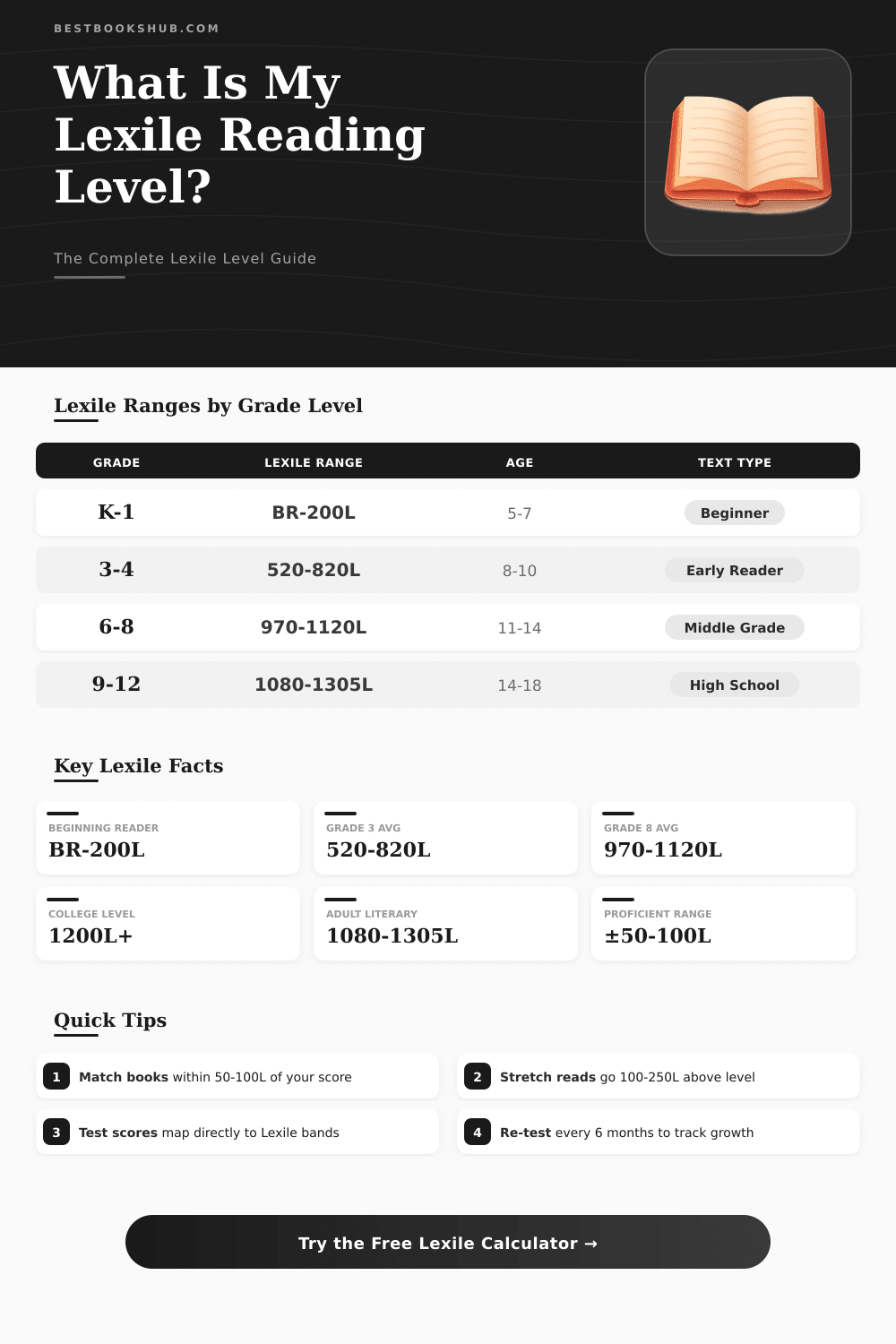
The Lexile Reading Level simply estimates, as far as one can, the content of text. It intends to match the reading skills of average people at a particular age, so if one hears about “5th grade Lexile Reading Level“, that means that the text works for a typical student in the 5th year.
DISCLOSURE: This post may contain affiliate links, meaning when you click the links and make a purchase, I receive a commission. As an Amazon Associate I earn from qualifying purchases.
Various methods help to estimate where text sits according to difficulty. The AR system for books uses numbers for instance 4.2 or 4.5; a book at 4.5 works for a student whose reading skills reach that grade and can read it almost on their own. Lexile points show as bigger whole numbers, around 770 or even more.
How Reading Levels Help You Choose Books
There are also guided reading levels (also called Fountas and Pinnell levels), that are based on letters like R, E or I. The advantage is that one can compare them against each other by means of reading level charts, which simplifies the choice of fitting books for different readers.
Choosing books at the right level does not need to be hard. Programs like the Accelerated Reader Bookfinder allow students, teachers, parents and librarians to search by ATOS level, Lexile point, interest or title. The Book Wizard works similarly, it helps with sorting of classroom libraries and building of book lists.
For quick checking there are useful free websites for readability, that show the grade level of any text that one reads, and mark phrases that could confuse you.
Here is quick advice: when your child reads, ask them to raise a finger for every unknown word. Two or three fingres for a book? It is exactly the good measure.
Four or five fingers? Then the book is probably too hard.
Here is something that commonly confuses people. Leveled texts do not match decoded texts. Recent research stresses the benefit for students of clear, step-by-step teaching about phonemic awareness, phonetics and firm ties too literature, together with practice using decoded material.
That forms an entirely different approach than leveled reading.
Automatic programs become mainly difficult with fiction books, even so. One tool for readability could estimate a chapter at 6th grade, while another points to 11th or 12th grade. Such difference comes from the fact that various elements are weighed differently, word count matters, naturally, but also other parts that not always can be easily measured.
The Lexile Reading Level matters most when some learn to read on their own. At around 4th grade the world of books opens broadly. Most books in average libraries sit at around 6th grade reading level.
Even so, do not let the level stop you from taking something interesting. Read a bit of difficult pages every day and write what seems confusing at first, and you becomecleverer over time. Libraries now add Lexile points to their catalogues, so finding material by reading level becomes much more easily.