📚 Reading-life forecast
Lifetime books read estimator
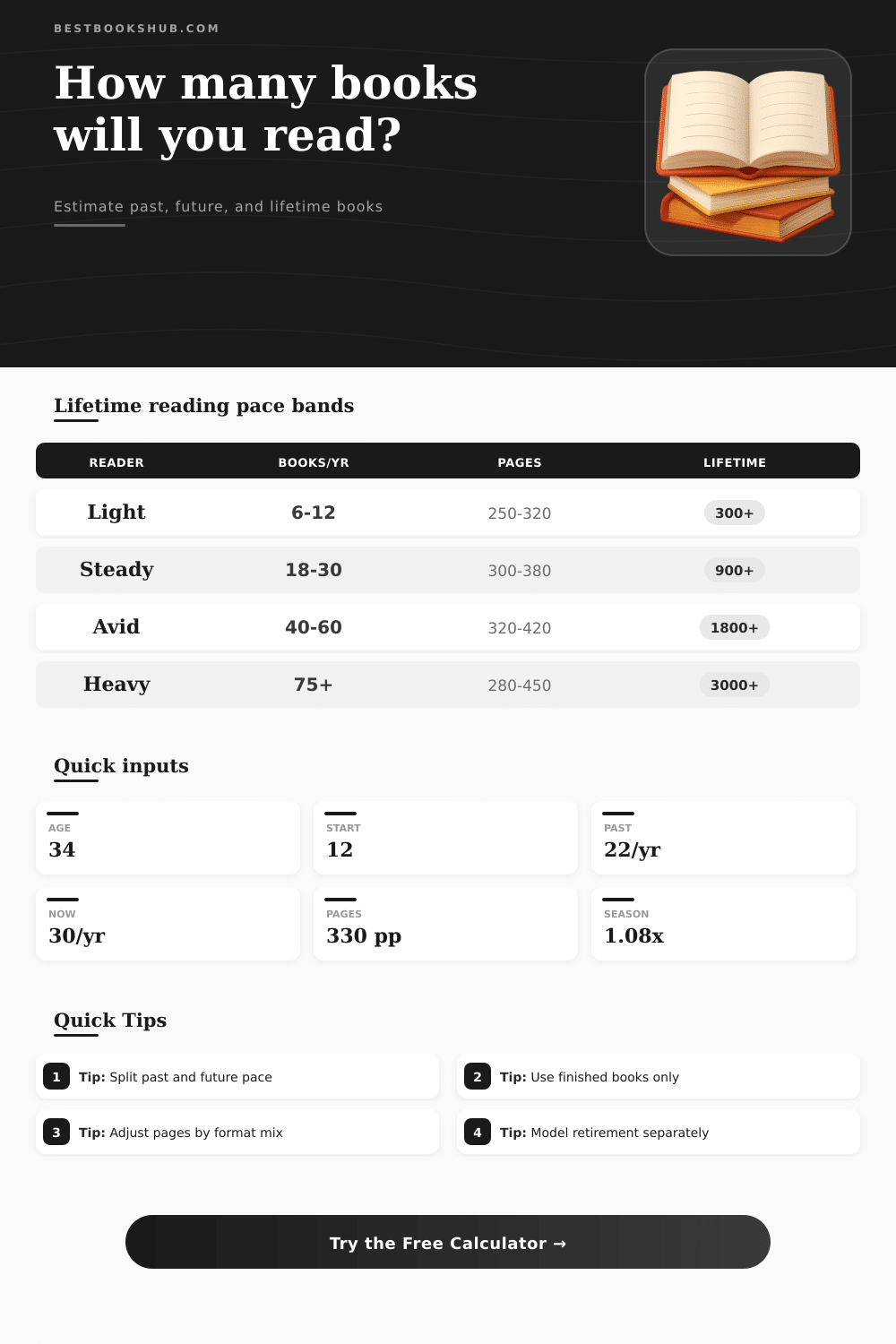
Estimate how many books you have already read, how many remain in your likely reading life, and how pace changes, average pages, seasonal habits, and retirement shifts change the total.
| Pace profile | Books per year | Pages per year at 330 pp | 30-year total |
|---|---|---|---|
| Occasional reader | 4 to 8 | 1,320 to 2,640 pages | 120 to 240 books |
| Monthly finisher | 12 | 3,960 pages | 360 books |
| Steady habit reader | 24 to 36 | 7,920 to 11,880 pages | 720 to 1,080 books |
| Avid weekly reader | 52 to 75 | 17,160 to 24,750 pages | 1,560 to 2,250 books |
| Heavy challenge reader | 100 or more | 33,000 pages or more | 3,000 books or more |
| Average book | Words per page | At 220 wpm | At 300 wpm |
|---|---|---|---|
| Short novel, 220 pages | 250 | 4.2 hours | 3.1 hours |
| Modern paperback, 320 pages | 275 | 6.7 hours | 4.9 hours |
| Dense nonfiction, 420 pages | 325 | 10.3 hours | 7.6 hours |
| Long fantasy, 650 pages | 300 | 14.8 hours | 10.8 hours |
| Graphic or illustrated, 180 pages | 120 | 1.6 hours | 1.2 hours |
| Multiplier | What it means | Example from 30/yr | Use when |
|---|---|---|---|
| 0.80x | Work, caregiving, study, or reduced free time | 24 books per year | Your future has tighter reading windows. |
| 1.00x | Current habit stays stable | 30 books per year | Your recent log feels realistic long term. |
| 1.10x | Gentle habit improvement | 33 books per year | You are adding small regular sessions. |
| 1.40x | Later-life or retirement lift | 42 books per year | Open-time years create more reading room. |
| 1.75x | Major reading priority shift | 52.5 books per year | Reading becomes a central leisure habit. |
| Life stage | Typical reading pressure | Estimator input to watch | Best adjustment |
|---|---|---|---|
| Teen and student years | Assigned reading may lift pages but lower choice | Past books per year | Count only completed books you want included. |
| Early career | Time varies by commute, energy, and routines | Current books per year | Use a two-year average if one year was unusual. |
| Family or heavy work years | Reading may drop but audiobooks may offset it | Pace change | Use 0.80x to 1.00x unless your log proves more. |
| Open-time years | More flexible days can raise consistency | Retirement multiplier | Use 1.20x to 1.75x for realistic modeling. |
| Later years | Comfort, eyesight, format, and health matter | Reading-through age | Model the age you expect to keep finishing books. |
DISCLOSURE: This post may contain affiliate links, meaning when you click the links and make a purchase, I receive a commission. As an Amazon Associate I earn from qualifying purchases.
To account for this, the estimator divide your past reads from your prospective ones (because your pace of reading isn’t always consistent, sometimes life gets crazy, and then it settles back down). Every big transition, be it quitting your first full-time job, or leaving the corporate rat race to become a retiree, will cause your pace to shift. And while you may recall those high school textbooks, the vast majority of us overlook those years as we measure what we’re doing now. But those basic experiences frequent establish our relationship to narratives as adults, which is why the tool enables you to divide your past from projected future.
It models those changes by first requesting how many books per year you read now (on average), and then asks you how much faster (or slower) you will read as you get older. Based off your gut feeling about the upcoming decade, you can pick a modest increase or dramatic decrease. That accounts for the fact that you’ll probably be reading different when you’re 30 than when you’re 50, you may read less during a busy work year; you may find yourself with more free time in retirement. Plug in these life events, and the calculator does the rest: it projects your book count over time, saving you the trouble of plotting out complex trends over several decades. It estimates your total book production without requiring any trend analysis.
Why This Tool Is Good For You
There’s also another factor that needs some detail: average page count. If you’re suddenly reading lots of dense biographies or super-thin thrillers, just counting books doesn’t tell the whole story. Fifty thin novels read is a far cry from twelve monster historical sagas, even though they’re both major mental efforts. By using your personal reading speed in words per minute and an estimate of average number of pages per book, the calculator translates abstract titles into concrete hours spent engaging with them. It puts a clock on your hobby, making the numbers behind your goal feel more real than a raw number of titles ever could.
Another unexpectedly important factor in long-term totals is seasonality. A lot of folks are voracious readers on their vacation (or when it’s cold outside) but only crack open a book between projects at work in the summer. To adjust for these natural reading ebbs and flows, the estimator has a seasonal multiplier that accounts for things like reading more during vacations or less during busy work seasons. But as years go by, it all averages out to about one annual total; and that’s what helps set reasonable expectations. Knowing how your reading ebbs and flows will help you not get discouraged if you have a slower month: the ledger will be balanced out later in another month or two.
Finally, let’s discuss retirement, which is always worth thinking about when plotting out your lifespan. When folks imagine retirement, they tend to picture reading a lot more. But of course, health and energy may interferes with that expectation. For some, retirement brings a reading revival; for others, it simply means travel plans or a new round of caregiving obligations. You’ll get to tweak accordingly for those post-peak years. Life after 50 doesn’t need to be scripted like life before 50. We hope this tool encourages all of us to consider what our future selves realy do with all that spare time.
At the end of the day, keeping track of all the books you’ve ever read isn’t really about reaching some random milestone; it’s about gaining insight into how you relate to books. It’s a reflection on your habits, both past and future. When we look at our complete reading history, no matter if it consists of hundreds of book or just dozens, it can be pretty inspiring. It helps turn abstract curiosity into a real experience, and suddenly you begin viewing each completed book less as an individual act and more as one piece in a grander story arc. In my opinion, this change of perspective makes the exercise worth doing. It constantly reminds us that when we finish a book, we are adding to the growing pile of knowledge and happiness that make up our entire lives.