✍ Editing schedule lab
Line edit time calculator
Estimate line editing hours, active workdays, finish date, deadline pressure, and daily word targets from manuscript length, edit depth, prose density, queries, passes, and working schedule.
| Edit situation | Typical speed | Best use | Planning caution |
|---|---|---|---|
| Final polish | 800 to 1,100 words/hr | Clean manuscript after revision | Do not use for first-pass problem drafts. |
| Standard line edit | 500 to 800 words/hr | Book chapters, essays, trade nonfiction | Queries and style decisions can slow the pace. |
| Heavy line edit | 300 to 550 words/hr | Awkward sentences, voice issues, repetition | Leave room for author review and second pass. |
| Academic edit | 250 to 450 words/hr | Theses, journal drafts, source-heavy chapters | References, terms, and hedging need extra time. |
| Fiction voice pass | 450 to 750 words/hr | Scene flow, dialogue, interiority, rhythm | Chapter openings and endings often take longer. |
| Project size | Word count | Standard hours | Heavy hours |
|---|---|---|---|
| Short sample | 2,000 words | 3.1 hours | 4.4 hours |
| Book chapter | 8,000 words | 12.3 hours | 17.8 hours |
| Novella | 30,000 words | 46.2 hours | 66.7 hours |
| Novel draft | 80,000 words | 123.1 hours | 177.8 hours |
| Long nonfiction | 100,000 words | 153.8 hours | 222.2 hours |
| Complexity factor | What it captures | Time effect | Use when |
|---|---|---|---|
| Dialogue share | Quoted speech and conversation | Can reduce time slightly | Scenes are clean and easy to follow. |
| Notes share | Citations, footnotes, captions | Adds time | Every note needs style or accuracy attention. |
| Query intensity | Questions left for the author | Adds time | Draft has unclear facts, timeline, or intent. |
| Pass count | Second look and partial rereads | Multiplies time | Editing includes a second pass or cleanup pass. |
| QA handoff | Style sheet, comments, final scan | Adds time | Deliverable needs a clean professional package. |
DISCLOSURE: This post may contain affiliate links, meaning when you click the links and make a purchase, I receive a commission. As an Amazon Associate I earn from qualifying purchases.
It’s polished. It’s on the table. Now it’s time to send it out. However, you suspect it would benefit from one last pass. This is the line edit that makes all the difference when your manuscript lands on an agent’s desk.
The time has come where the issue isn’t the work itself. Now the issue is time. Can you find another free weekend to fit this project in? Or will it be a three-week marathon? Most editors guesses. They look at page count and cross their fingers. And then the schedule unravels.
How to Plan Your Editing Time
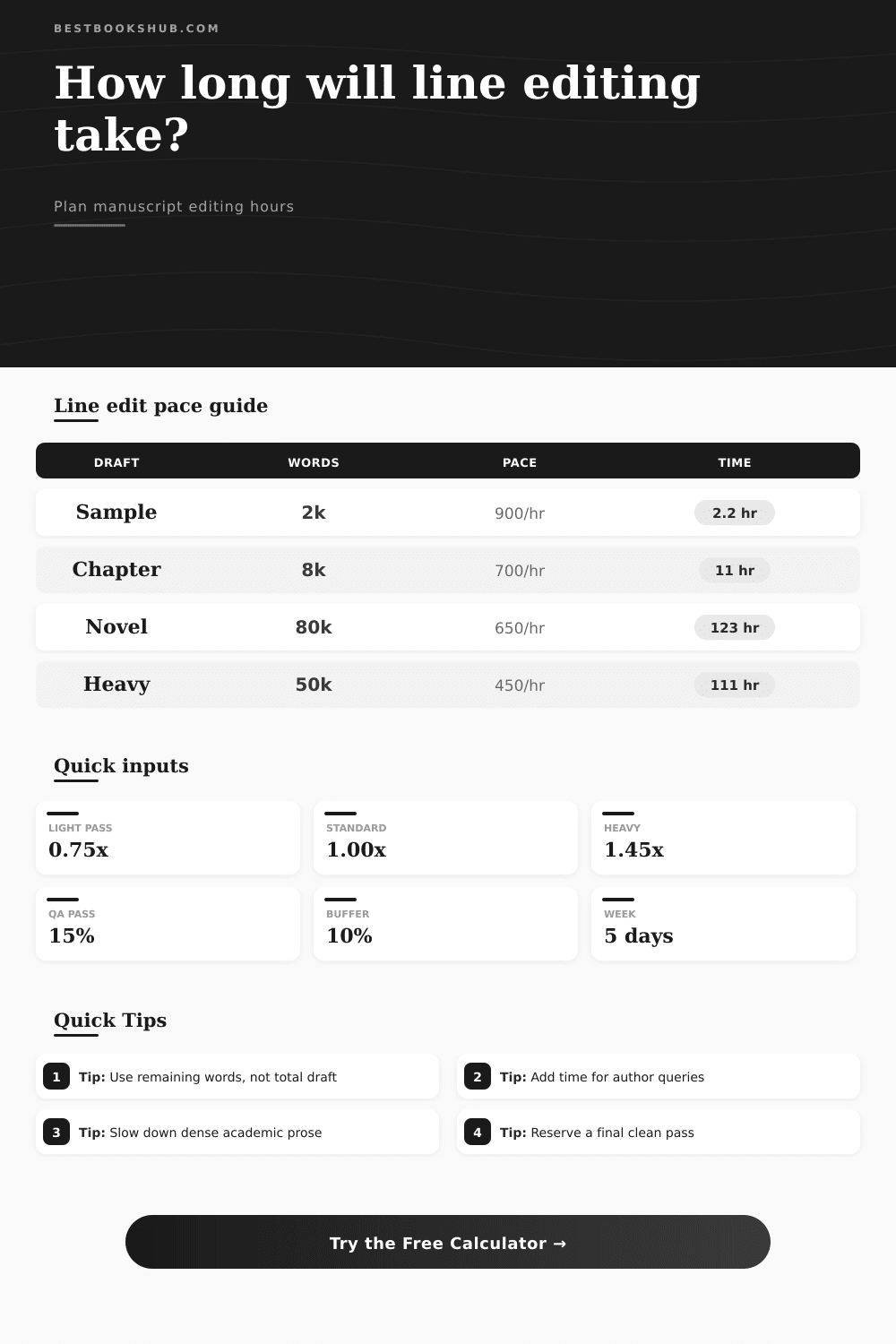
Word count isn’t line editing, but line editing take up cognitive labor. It’s not a simple check for typos. It involves checking the rhythm and tightness of sentence structure, making sure everything have a consistent voice, and rewriting sentences to make them flow. Sometimes you rewrite whole chunks. On average, people can edit around six hundred and fifty words an hour. That doesn’t sound like much (until you consider how much time is spent thinking). If there’s anything dodgy about the structure, if the language starts getting dense, you’ll slow down.
Plug in what pace you’d like to work at with this calculator, along with length of your manuscript, and it does all the maths for you, no more need for guesswork conversions and coefficients. It provides a realistic estimate of time, based off actual editing behavior, rather than idealized behavior.
So where do you begin? You’ll want to start by estimating your base rate: perhaps you can crank out nine-hundred words an hour polishing cleanly written copy. Or maybe you’re starting from scratch, facing a draft riddled with clunky phrasing and repeated sentence patterns, in which case you’ll be slowed to four-hundred-and-fifty. Because, as the tool explains, “Cleaning up a finished piece is different than editing a first draft,” you can choose how deep that estimation goes.
Prose density matters too. Straightforward dialogue will be easier to read than academic writing or technical manual text; those demand more mental effort on a per-word basis. When you pick the correct profile (which the calculator does automatically) it accounts for this difference, and factors in additional time required for complex terminology and/or citations.
Remember editing expenses, too. Every query you leave for an author takes time to write and later to resolve. Tack on that percentage if your client is a questioner. And then there’s multiple passes, which adds up even more hours. Sure, the second pass tends to be slower than the first one, but it still take some time. Your basic workload gets multiplied according to how many times you intend to read through it.
Avoid the trap of lowballing review time. Realistically set your daily limits. Your brain will fog up after four hours of editing a day. Type in how many minutes a day you’re willing to actively be working. Then the tool computes your finish date by spreading out all of your work over however many days youve got. It’ll tell you if you’re ahead, behind, or just right for meeting a hard deadline. This visual feedback helps manage expectations with clients who imagine that editing happens instantly.
To put this speed in context, there’s a table of references on the page. It shows how long it takes an average editor working at normal speed to edit certain types of projects, such as a 20k word novella. It also shows how long it takes when they are working extra hard on revisions. The reason I say “normally” is because both sets of times originate from actual editors’ logs and have become part of our industry standards. Pull out those numbers and use them as a standard for your own work. Adjust your inputs to reflect your efficiency if you tend to be faster than what’s considered normal. Bump up your buffer if you’re falling behind. Ten percent is generally enough time to cover tricky chapters or other unexpected issues.
There’s more to planning your editorial timeline than math. It’s about maintaining your reputation. And sanity. Over-committing results in burnout; rushing result in overlooked mistakes. With a structured estimate in place, you set boundaries that are respected by all involved parties. You grant yourself the right to pace yourself so you can produce high-quality work. The outcome? You will have a clear mind and a cleaner manuscript.
Afterward, use your numbers. Commit yourself to follow your plan and don’t get pressured into throwing it out. If you’re going for six weeks, the calculator is telling you six weeks, so give it six weeks. Believe in the system, and when that last page flips over perfectly, your future self will smile with gratitide.