📖 Pitch drafting
Logline length checker
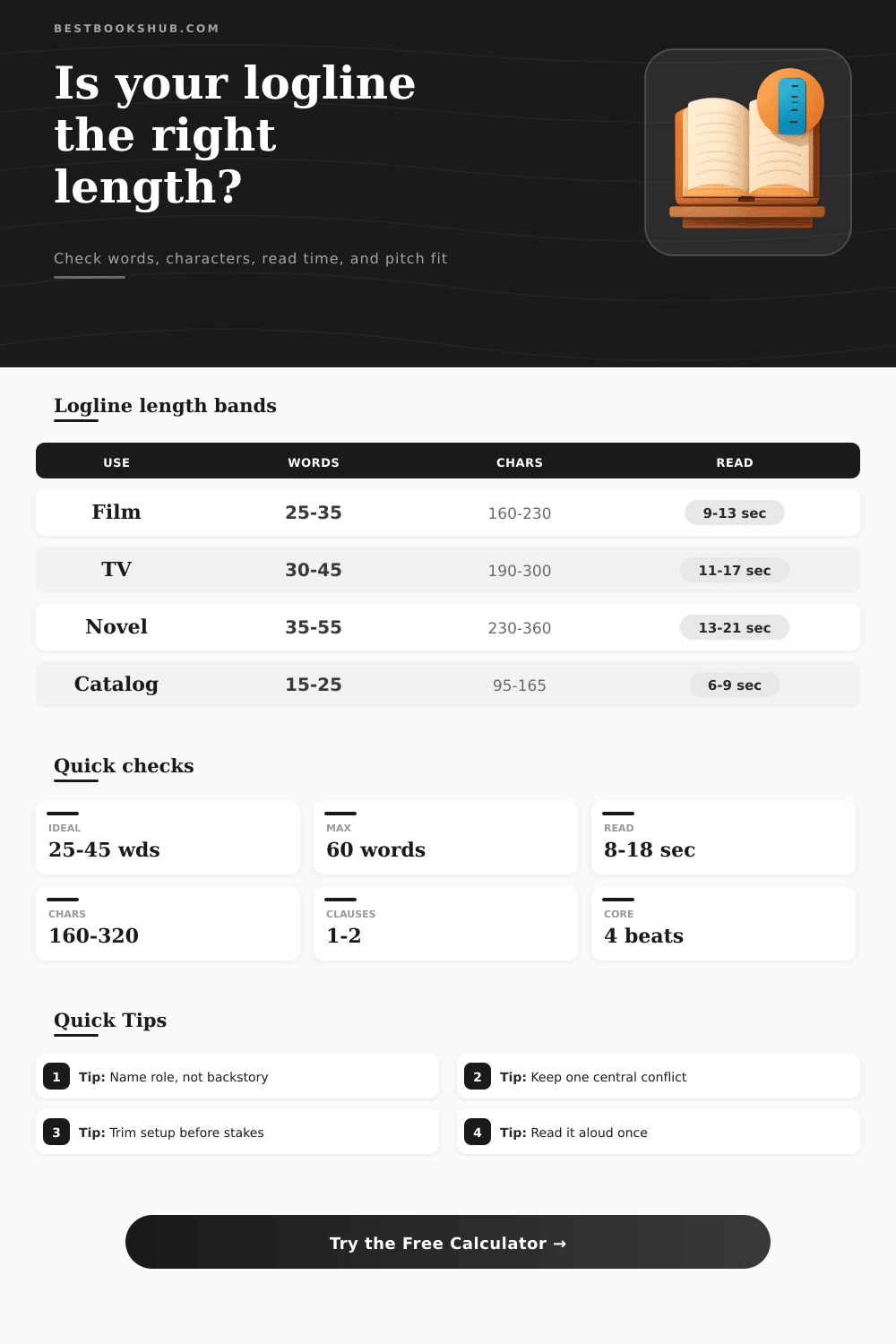
Measure a film, TV, book, documentary, or game logline against practical pitch-length ranges for words, characters, reading time, and core story beats.
Ranges are practical editorial targets used for pitch readability: short enough to scan, long enough to carry lead, goal, conflict, and stakes.
| Pitch use | Recommended words | Character range | Read-aloud range |
|---|---|---|---|
| Feature film logline | 25-35 words | 160-230 characters | 9-13 seconds at 150 wpm |
| TV pilot logline | 30-45 words | 190-300 characters | 12-18 seconds at 150 wpm |
| Novel query hook | 35-55 words | 230-360 characters | 14-22 seconds at 150 wpm |
| Short film listing | 15-28 words | 95-185 characters | 6-11 seconds at 150 wpm |
| Documentary pitch line | 30-50 words | 200-330 characters | 12-20 seconds at 150 wpm |
| Story beat | Typical word budget | What to include | Length warning |
|---|---|---|---|
| Lead / protagonist | 3-8 words | Role, flaw, or identity | Backstory usually bloats this beat |
| Inciting pressure | 4-10 words | The change that starts the story | A full setup clause can slow the line |
| Goal or pursuit | 5-12 words | What must be done or won | Multiple goals blur the hook |
| Obstacle / antagonist | 4-12 words | Main opposition or impossible condition | Named side plots add length fast |
| Stakes | 5-12 words | Consequence if the lead fails | Abstract stakes read weaker when long |
| Context | Best length | Best structure | Checker setting |
|---|---|---|---|
| Verbal elevator pitch | 25-40 words | One sentence, one turn | Natural pitch speed |
| Pitch deck slide | 20-35 words | Readable at a glance | Compact or standard band |
| Query letter opening | 35-55 words | Voice plus clear stakes | Expanded band |
| Streaming tile copy | 15-25 words | Premise first, fewer clauses | Compact band |
| Grant application summary | 35-60 words | Subject, tension, public relevance | Expanded band |
| Format comparison | Lead detail | Conflict detail | Stakes detail |
|---|---|---|---|
| High-concept thriller | Short role label | Immediate external threat | Concrete danger |
| Literary novel | Specific inner wound | Relationship or moral pressure | Emotional consequence |
| Fantasy or sci-fi | Role plus world clue | Rule-breaking situation | World or identity cost |
| Documentary | Subject or community | Real-world investigation | Public question or impact |
| Comedy or romance | Contrasting identity | Forced proximity or reversal | Personal loss or choice |
DISCLOSURE: This post may contain affiliate links, meaning when you click the links and make a purchase, I receive a commission. As an Amazon Associate I earn from qualifying purchases.
You are staring at an open notebook while standing in a green room. Your logline have morphed from a sentence to a paragraph. You have thirty seconds. The exec is about to move on.
Your brain reels: How can I condense two hours of screen time into a single sentence? It seems impossible until you grasp that “long” doesn’t mean “wordy.” It is about rhythm and respecting attention span of the person listening.
How to Write a Short and Clear Logline
A logline is to most writers what a summary is: something they dump all their subplots into in one breathless sentence. The more details they gives, the clearer it’ll be… but they’re almost always wrong. Constraint leads to clarity. Take away secondary motivations and decorative adjectives, and you’ve got the engine of your story. And if it doesn’t run by itself, throwing in extra fuel isn’t going to help. It’s just going to make things messier.
Once you input your draft, calculator does all of the work (no need to guess if you meet industry standards). It counts structural beats, word count and minutes to read. That’s key, as way someone speaks a verbal pitch is different than how something looks on a written page. When someone says something, pauses are meaningful.
If it takes eighteen seconds to verbally pitch your logline, odds are you’ve got some setup. You’re looking for succinct but impactful. Nine seconds can land better then twenty seconds that explain everything. This leaves time for listeners to imagine what happens next.
How does this play out? Compare describing the backstory with giving us protagonist’s name. Backstory is weight, it slows you down when it comes to a logline. All we need to know is: Who is the lead? What do they want right now? Anything else can be revealed later (in the book, in the script).
Too many pitches stall because they attempt to explain character’s brokenness before they get around to explaining the conflict. Flip that and open with action. If stakes are clear enough, then emotional resonance will follow. This also takes into account structural elements like stated stakes, a clearly identified obstacle, and a defined goal. Those is the four pillars of a good hook.
If you leave one out, your sentence will feel vague or unfinished. A logline with no stakes is a recounting of actions. No conflict is a logline that’s really just a character study, dangerous in a pitch meeting. It needs to have tension and we knows something will happen if the lead fails.
Try reading your draft aloud. See if you trip up on certain clauses. Get rid of them. See where you’re out of breath. Get rid of the adjectives. The check provides instant honest feedback, which compels you to justify each word. What you may find is that there’s too much explanation layered over your premise. Peeling away the layers lets you know if core idea holds water by itself.
Editing a logline is an exercise in subtraction that requires rhythm and precision. It’s math. Less is more. Shorter is better. Tighter is clearer.
You should of practiced this. And while there are reasonable ranges for various formats laid out on the page, think of those as loose guides, not strict boundaries. Tell me what I need to know if your story requires thirty-eight words to get across. Don’t tell me in forty-five because you can. Clarity is a selling point.
Before you ever get up to pitch, your logline does the work for you. It’s the proof of your understanding of your material. The establishment of stakes. It sets the tone. That first sentence that you use when you step into that room says one thing: I am confident. You are respecting my time, as well as your own craft.
First impressions matter, and that first hook has got to land cleanly. Actually, it’s about the moddern way people listen. It should of been easyer.