📖 Manuscript format desk
Manuscript Page Count Calculator
Estimate manuscript pages from word count, font, page size, margins, line spacing, lines per page, chapter starts, title pages, scene breaks, and the standard 250 words per page rule.
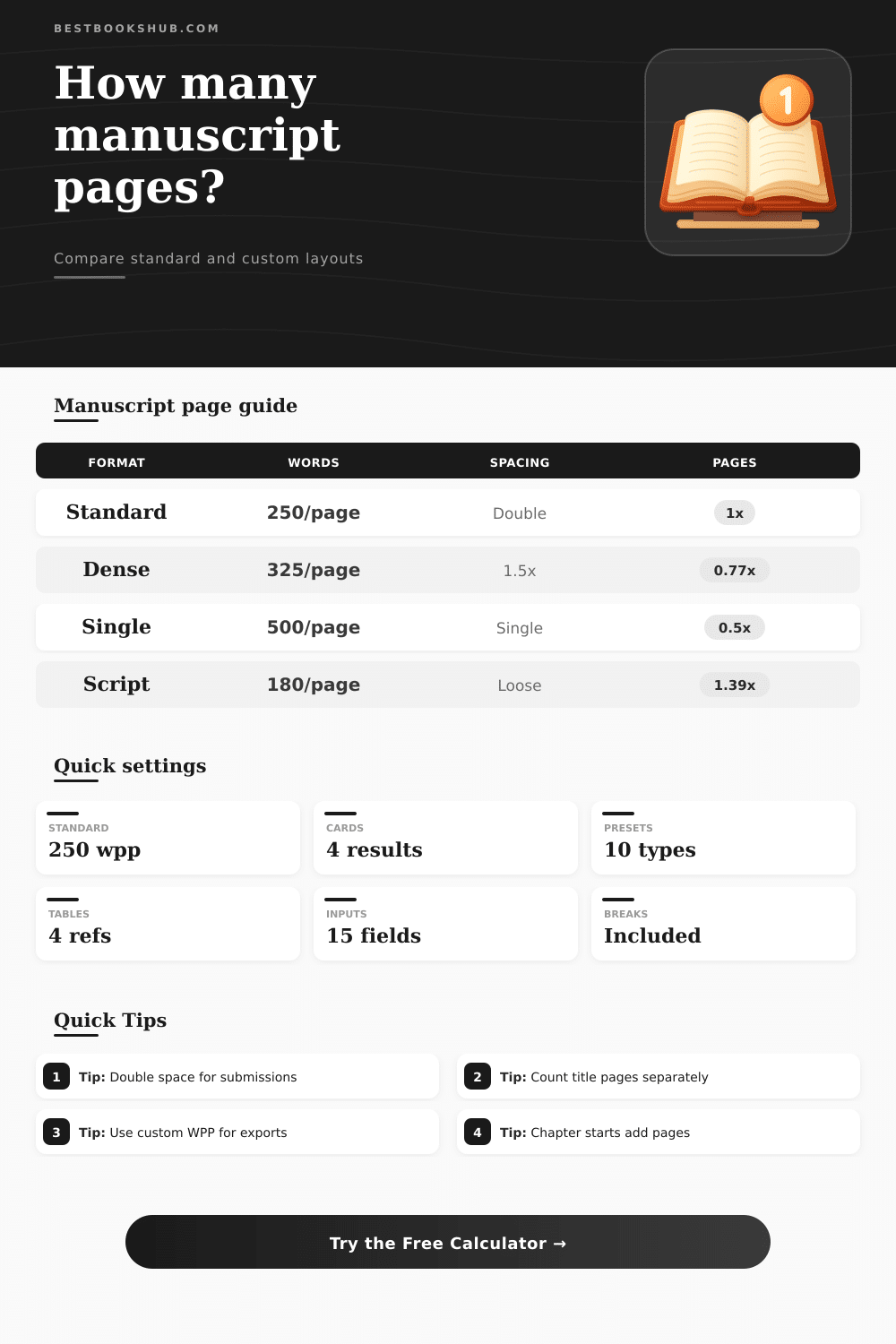
Use the 250 words per page result for a quick submission-style estimate. Use the custom layout result when you know the exported page dimensions, spacing, and break behavior.
| Format cue | Common setting | Page count effect | When it helps |
|---|---|---|---|
| 250 words per page | Quick industry estimate | Baseline | Fast word-count to page-count conversion for drafting and queries. |
| 12 pt Courier | Monospace with 1 inch margins | Often near 250 WPP | Useful when each character occupies a predictable width. |
| 12 pt Times New Roman | Proportional serif | Usually fewer pages | Common readable draft format for editing and sharing. |
| Double spacing | About 24 to 27 lines | More pages | Leaves room for review notes, markup, and submission reading. |
| Single spacing | About 45 to 55 lines | Fewer pages | Useful for internal edits, not typical for submissions. |
| Manuscript layout | Typical words per page | Approx pages for 80,000 words | Planning note |
|---|---|---|---|
| Standard double-spaced submission | 240-280 WPP | 286-334 pages | Use 250 WPP when you need a simple conservative estimate. |
| Dialogue-heavy novel draft | 180-235 WPP | 341-445 pages | Short paragraphs and scene breaks increase page count. |
| Dense nonfiction draft | 280-350 WPP | 229-286 pages | Long paragraphs and fewer breaks reduce page count. |
| Single-spaced editorial export | 430-560 WPP | 143-187 pages | Good for compact review copies and internal reference. |
| Large-print review copy | 120-190 WPP | 421-667 pages | Useful for accessibility review but much longer physically. |
| Break setting | What it adds | Best for | Calculator behavior |
|---|---|---|---|
| New page chapters | Partial blank page before each chapter | Most novels and memoir drafts | Adds estimated chapter-start waste based on chapter count. |
| Half-page chapter starts | More white space before chapter text | Formatted review copies | Adds half page per chapter after the first. |
| Right-hand starts | Odd-page starts in print-style layouts | Book-like proof layouts | Adds a light verso-page allowance to the estimate. |
| Scene break blank line | One extra line per section break | Most prose manuscripts | Converts extra lines into page equivalents. |
| Symbol scene break | Symbol line plus surrounding blank lines | Readable exports and proofs | Uses three extra lines per section break. |
| Font or spacing | Relative width | Page tendency | Use case |
|---|---|---|---|
| Courier New | Wide monospace | More pages | Classic manuscript look and predictable line length. |
| Times New Roman | Compact serif | Fewer pages | Common draft sharing and readable exports. |
| Garamond | Very compact serif | Fewer pages | Book-like review pages, not the strictest submission cue. |
| Double spacing | Low line density | More pages | Submission, critique, and copyedit markup workflows. |
| 1.5 spacing | Moderate line density | Middle pages | Readable drafts where fewer pages are preferred. |
DISCLOSURE: This post may contain affiliate links, meaning when you click the links and make a purchase, I receive a commission. As an Amazon Associate I earn from qualifying purchases.
Manuscript length are the measurement of how long a written work is. There are two way to measure manuscript length. One way to measure manuscript length is by providing a quick estimate of the length of a manuscript.
The other way to measure manuscript length is by calculating the number of physical pages that will result from formatting the manuscript file with specific font, spacing, and layout choice. These two values often have a large difference between them, so it is important to understanding the difference between these two measurements of manuscript length. One of the standard for measuring manuscript length is the assumption that each page of a manuscript contain 250 words.
Two Ways to Measure Manuscript Length
The 250-word page count are calculated under the assumption that the manuscript is formatted with double-spacing, one-inch margin, and a twelve-point monospace font. These type formatting setting have been the industry standard for decades, in part, because they provide room for editor to write notes on manuscripts by hand, and in part, as a means of ensuring that the page count of different manuscripts are the same. The 250-word page count is a helpful standard that allows for the quick comparison of manuscripts, but it does not account for the effect of a manuscripts export settings on the final page count.
The line spacing within a manuscript is one factor that can affect the page count of that manuscript. If a manuscript use double-spacing, there will be more lines of text per page than if the manuscript use single or 1.15 line spacing. The font that is use within a manuscript is another factor that can impact its page count.
Because different font have different number of characters per line, manuscripts that use fonts that contain more character per line will have a higher page count than those that use fonts with fewer character per line. The margins within a manuscript can also impact its page count. Additionally, manuscripts contain section of content that do not contain text and are used to separate paragraphs or chapter.
These section of white space can impact the page count of a manuscript. The beginning of each chapter in a manuscript, as well as scene break, can also impact the total page count. In most instance, the start of a chapter begins on a new page.
As a result, the last line of one chapter may leave a partial blank page on a sheet of printed paper. The more chapter that are contained within a manuscript, the more partial blank page will be created. Additionally, scene breaks can also impact the total page count of a manuscript.
A symbol that is centered on the page often separates scenes. These scene breaks, while small in size, are often repeated throughout a manuscript. For these reason, scene breaks can increase the total page count of a manuscript.
In addition to the content of a manuscript, some manuscript contain front matter. Front matter include element like title page, copyright statement, and dedication page. While the content of a manuscript has a word count that is measured during its production, front matter do not have a word count.
Additionally, while it is included in the total page count of a manuscript, front matter do not have a page count. Because nonfiction writing proposal often contain more front matter than novel, the page count of a nonfiction writing proposal may be higher than that of a novel, even if their word count are the same. The amount of front matter in a manuscript can be adjusted in a manuscript length calculator so that the page count calculated reflect the total number of page of the manuscript that the editor of the manuscript will print.
It is important to determine which of the two manuscript length measurement is more important for the particular task for which a manuscript will be used. For instance, if an author is querying agent for publishing the manuscript, the 250-word count will be more useful. In contrast, if the manuscript will be used for the creation of a review copy of the manuscript, the page count that results from the custom layout of the manuscript will be the more important of the two count.
Most writer should consider both the 250-word count and the custom layout page count for their manuscript. Understanding why factor like line spacing, font choice, and chapter behavior impact the page count of a manuscript is important. Once a writer understand why certain design choice can change the page count of a manuscript, a writer will not be surprised by the difference between the quick estimate of the manuscript length and the calculated page count of the manuscript.
Additionally, understanding why certain factor can impact the page count of a manuscript allows those writer to use the page count as a planning tool to prepare for their writing project.