📖 Manuscript timing lab
Manuscript read-through time calculator
Estimate how many hours, sessions, reading days, and notes blocks a manuscript read-through needs, with separate settings for beta reading, critique, editing, proofreading, and aloud passes.
Switch between total word count, standard manuscript pages, and a section list. The calculator converts everything to words, then layers pace, notes, rereads, breaks, passes, and schedule pressure.
| Read-through type | Typical WPM | Notes overhead | Best use |
|---|---|---|---|
| Triage skim | 300 to 350 | 0% to 10% | Fast first look, sample chapters, obvious structure problems |
| Story beta read | 210 to 260 | 10% to 20% | Reader experience, pacing, plot clarity, emotional reaction |
| Critique read | 150 to 190 | 20% to 40% | Chapter comments, reader report, scene-level feedback |
| Developmental edit | 110 to 150 | 35% to 70% | Structure, stakes, argument, continuity, major revision planning |
| Line edit pass | 90 to 130 | 50% to 100% | Sentence craft, style, repetition, transitions, voice consistency |
| Final proofread | 120 to 180 | 5% to 20% | Typos, punctuation, formatting, small continuity checks |
| Read aloud check | 130 to 170 | 10% to 30% | Dialogue, cadence, awkward phrasing, missing words |
| Project type | Words | MS pages at 250 WPP | Critique read estimate |
|---|---|---|---|
| Short story packet | 7,500 | 30 pages | 1.1 hours before notes and buffer |
| Novella draft | 35,000 | 140 pages | 3.4 hours before notes and buffer |
| Genre novel | 82,000 | 328 pages | 8.0 hours before notes and buffer |
| Long fantasy draft | 145,000 | 580 pages | 14.2 hours before notes and buffer |
| Academic manuscript | 95,000 | 380 pages | 9.3 hours before notes and buffer |
| Session length | Good for | Break habit | Planning note |
|---|---|---|---|
| 30 minutes | Proofread bursts, chapter checks | 5 minutes after each block | Useful for busy beta readers and low-stamina days |
| 60 minutes | Story beta reading | 5 to 10 minutes | Enough time to hold continuity without fatigue |
| 75 minutes | Critique reading | 10 minutes | A strong default for notes and chapter-level reactions |
| 120 minutes | Developmental passes | 15 minutes | Works when you need large-scale pattern recognition |
| 180 minutes | Weekend catch-up | 20 to 30 minutes | Use sparingly for dense edits; fatigue can hide errors |
DISCLOSURE: This post may contain affiliate links, meaning when you click the links and make a purchase, I receive a commission. As an Amazon Associate I earn from qualifying purchases.
Then it’s time to send your manuscipt off into the ether with great hope. You envision your beta reader diving into it over a weekend of coffee breaks.
In reality, it’s much less romantic: they’re probably staring at ceiling fan for an hour, unable to recall why your protagonist does what she do. They might end up sending back notes that resemble broken diary entries different than actionable feedback. Why? Because we don’t account for actual time required for deep reading. We estimate based off words, without considering the mental effort of pausing, reflecting, and crafting commentary.
How to Plan Your Beta Reading Time
Once you plug in pass type and length, the calculator above take over and does the math, saving you from having to guess how long it will take, and thus whether a deadline is realistic or merely optimistic. Most folks who attempt to schedule feedback aren’t factoring in the difference between overhead (notes) and pure reading time.
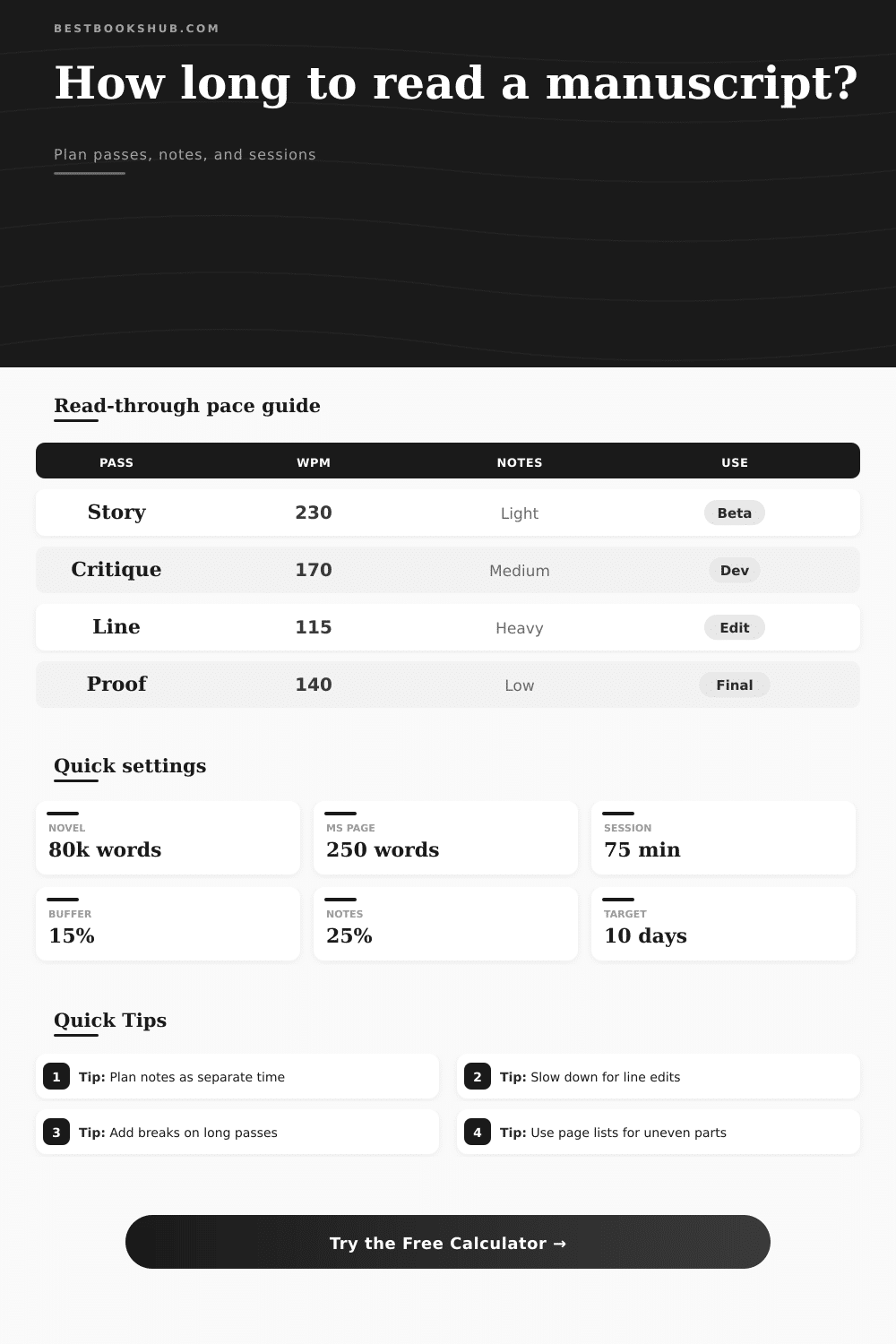
Depending on the pass you’re performing, you may be able to read through a story at 230 wpm because you really care about its emotional punch and flow. Switching to line edit? That number’s going to drop dramatically. Instead of just reading the story, you are now breaking down the sentence structure, hunting for repetition, and inspecting rhythm. The tool will account for these changes in hours.
Take review vs. Take reading as an example. While you read for fun, your eye just glides across the text. But when you’re critiquing, you build a mental map of the story that also tracks the typos. That takes a toll on your brain. It needs breaks. Because prolonged concentration result in rapid decline. The calculator has options to choose how long you want to work and how long you want the break to be. A single 90-minute block might actualy yield more errors than two 45-minute sessions split by a walk. Setting aside time for tiredness isn’t laziness, it’s precision.
The second thing is density of what you’re working on. A piece with a clean, linear story flows at a different rate from one loaded with complexity. This include things like complex technical explanations, lots of history, or lots of internal monologue. The tool’s difficulty multiplier handles this variation. The denser your writing, the longer it takes for you to decode the sentence, so you has less time to assess its effectiveness.
Rushing your feedback means you miss structural element. Plan to go slow and end up ahead of schedule rather than run fast and miss some analysis spots. People also underestimate the time required for Notes. Thinking about comments take less time than writing down those thoughts in detail. When you deliver a reader report, writing the notes will take up 25% or more of the time you spent reading. It’s not additional work, it’s the deliverable itself. Since the tool includes this in the total time, you’ll see a clear picture of how everything fits together. Reading isn’t separable from responding if the response is meaningful to author.
Because there are deadlines, and we don’t get those subtleties across until it’s too late. When someone tells you they’ll have something back within ten days, we think: “They’re making allowances for life.” What happens often is they aren’t. The calculator also lets you verify whether the schedule align with the workload. Is this a sustainable workload? See if the deadline load bears out. If not, reduce the scope of the pass or ask for more time. A quick look is better than no feedback at all. It is better than promising a deep dive that will never come.
Think about your passes in advance. Know what you’re after when you open the document. Are you searching for typos (final proof) or do you want to check the pacing (beta reader)? Each of these aims will require a different level of speed and cost. Check out the table on the page that shows the standard speeds per type of pass so you can get an idea of what to expect. This will help you avoid getting frustrated if you are hoping for line-edit precision but someone is working at beta-reading velocity.
In the end, time is what you need to get good feedback, and we’re all reluctant to invest time, or ask for it. Calculating the true hours for reading, taking notes, and taking breaks removes the guesswork from how much time it will take. It goes from guessing time to scheduling time. And yes, the manuscript’s still got issues, but now you’ve got a timeline that accounts for the time spent discovering said issues. You should of planned ahead.