📖 EFL readability score lab
McAlpine EFLAW readability calculator
Paste English text to count words, miniwords, and sentences, then calculate the McAlpine EFLAW score for ESL and EFL reader difficulty.
Load a realistic passage, then adjust the sample window, miniword definition, and sentence-count rules to see how the EFLAW score changes.
| Rank | Miniword | Count | Share of miniwords | EFL signal |
|---|---|---|---|---|
| Load a sample to list recurring miniwords. | ||||
| Sentence | Words | Miniwords | Sentence score | Preview |
|---|---|---|---|---|
| Load a sample to inspect sentence-level EFLAW pressure. | ||||
| EFLAW score | Difficulty band | ESL/EFL reading signal | Revision action |
|---|---|---|---|
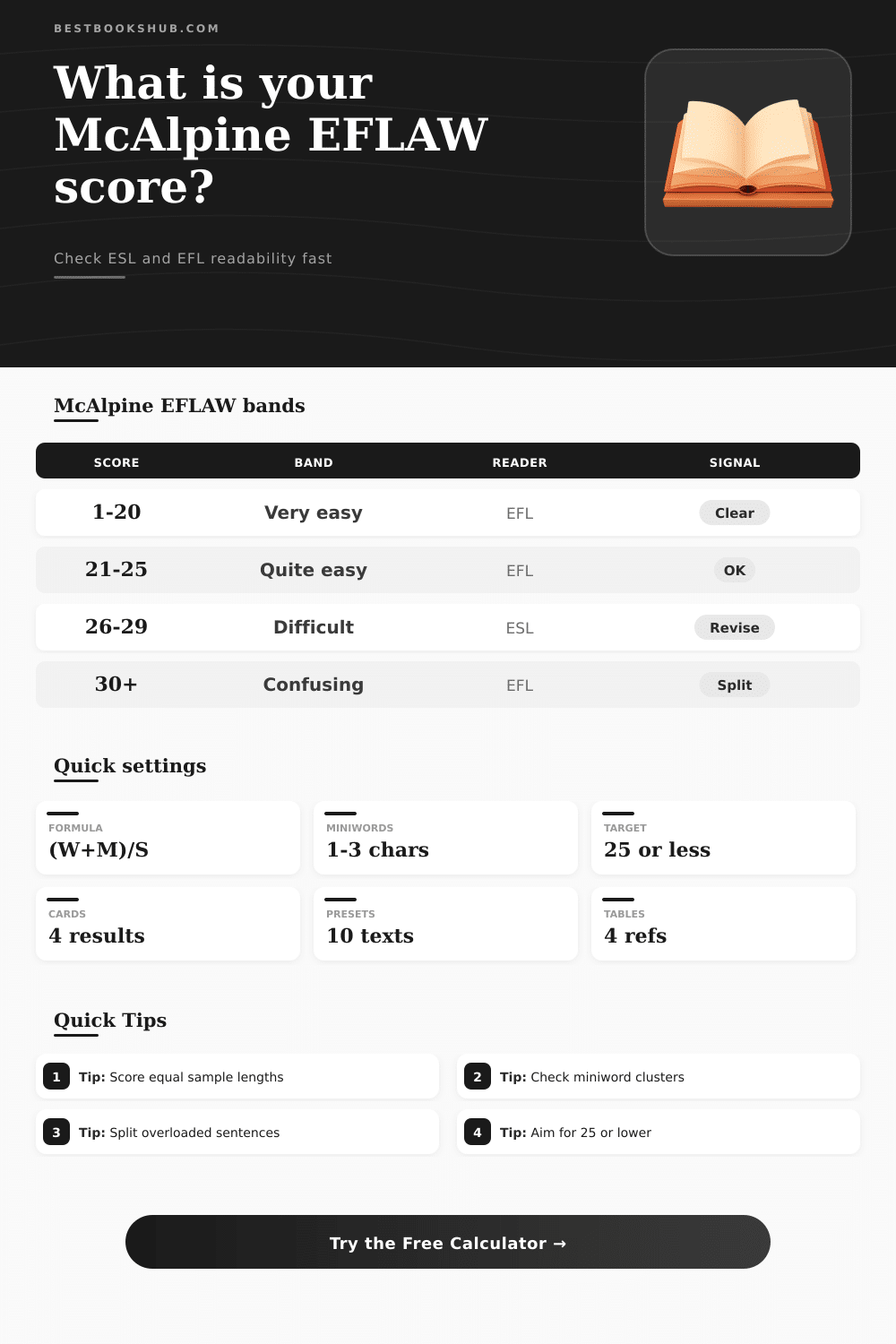
| 1 to 20 | Very easy to understand | Short sentences with manageable miniword load | Usually suitable for broad EFL access |
| 21 to 25 | Quite easy to understand | Acceptable for many adult EFL readers | Check the longest sentence before publishing |
| 26 to 29 | A little difficult | May require stronger English fluency | Split dense sentences or reduce linking phrases |
| 30 and above | Very confusing | High EFLAW pressure for foreign-language readers | Rewrite, shorten, and retest the passage |
| Control | Default | What it changes | When to adjust |
|---|---|---|---|
| Sample window | All words | Selects which words and sentences are scored | Compare equal-length excerpts |
| Miniword definition | 1-3 characters | Defines M in the formula | Use strict or expanded mode for sensitivity checks |
| Sentence mode | Punctuation | Defines S in the formula | Use manual mode for bullets or fragments |
| Hyphen treatment | Combined | Changes word count around compounds | Use split mode for learner materials |
| Miniword type | Examples | Why it matters | Check |
|---|---|---|---|
| Articles | a, an, the | Frequent short function words raise M | Usually normal, not automatically bad |
| Prepositions | of, to, in, for | Clusters can make noun phrases dense | Look for stacked phrases |
| Pronouns | he, she, it, you | Dialogue may have many short references | Confirm the referent is clear |
| Linkers | but, and, so, yet | Many linked clauses can raise sentence pressure | Split if the sentence is long |
| Method | Main input | Output style | Best use |
|---|---|---|---|
| McAlpine EFLAW | Words, miniwords, sentences | EFL readability pressure | ESL/EFL editing and plain-English checks |
| Syllable formulas | Words, sentences, syllables | Grade or ease score | General readability screening |
| Word-list formulas | Familiar and unfamiliar words | Grade-band estimate | School text matching |
| Manual review | Context, purpose, vocabulary | Editorial judgment | Final learner-facing decisions |
DISCLOSURE: This post may contain affiliate links, meaning when you click the links and make a purchase, I receive a commission. As an Amazon Associate I earn from qualifying purchases.
To estimate your own reading level, try the McAlpine EFLAW readability calculator (which count words), sentences, and miniwords in a piece of writing. Before you edit text that will be read by learners, see if it’s an EFL/ESL level that are appropriate for them. Each additional clause and syllable tangles the web for anyone learning to speak English.
By zeroing in on just two easily measurable bottlenecks that really do make reading harder, how many words pile up before a full stop and how many tiny “function” words cluster together, the EFLAW score eliminate the guessing game. It simply asks how many words follows another word before a full stop, then divides by how many sentences is there. Simple math: (words + miniwords) divided by sentences.
How to Use the EFLAW Calculator
But it is consistent at finding out what sounds easy to a native ear but more tiresome than a student still mastering fluency. But those are the miniwords where the real insight lies: the short bits of grammar glue such as “the,” “of,” “and,” “but,” and even “you.” These words is barely worth noting by themselves. But when you find them clustered within a twenty-word sentence, the reader’s working memory begin juggling relationships while failing to absorb ideas. That’s the mental tax the score measures.
Below twenty-five typically means that the text allow readers to focus on meaning, not decode its structure. Above thirty, it signals that even highly motivated adult learner might have to reread, translate, or just give up. The other half of the equation is sentence length. Native readers glide over one long elegant sentence. But for an EFL reader, such a sentence require them to keep several ideas in their heads all at once, something that will overwhelms them. Often splitting this sentence into two halves will drop the score dramatically but not dumb down the content.
You might have a policy note, an email, or a student handout all side-by-side. The calculator above do the math after you set the sentence counting rules and sample window. No one number should of matter above all else: context is always king. If it’s a complicated legal paragraph targeted at expert readers, go ahead and put that in the high twenties; expert readers are going to use their own background knowledge to understand what you wrote. Should you use the same score for beginner directions on how to open a bank account? That is problematic.
This is why there are multiple target bands in this thing. First, pick who you’re writing for, and let the score tell you if your draft aligns with the promise you made to that person.
The first time writers try actualy drafts, common errors jump out fast: They overdo scene-setting details in the first sentence, then write the rest shorter. That’s what catches the eye of the score immediately. A second pitfall is piling on prepositional phrases, where each adds another miniword. Official-sounding phrases like “In accordance with the rules of the office and the terms of the plan” sound good till you notice they makes the reader follow four different relationships to get to main verb. Two direct sentences tend to be clearer and better for the EFLAW score, too.
What I like about this method is that it doesn’t try to make things easier by saying that all cultural references and vocabulary difficulty can be boiled down into a single number. What it does do is identify for us the mechanical load to be fixed before worrying about anything else. Yes, you will have to read the passage out loud, count any pronoun reference, and imagine the reader on the other end as they make their way through it. But at least the score let you know ahead of time that there’s something wrong before that reader ever lays eyes on the passage.
The purpose isn’t to achieve an ideal score on a dial. Rather it’s to feel confident in your ability to get the point across with minimal friction. If the calculator says green and our gut tells us the same, we’re at that quiet but practical moment where there’s a reasonable shot of the message sticking the first time. This tool is mainley for that.