📖 Story structure planner
Midpoint placement calculator
Find the target word, page, chapter, and scene position for a manuscript midpoint, then compare the planned or drafted turn against genre structure ranges.
Load a draft profile, then adjust manuscript length, scenes, chapters, actual turn placement, and target story model.
| Model | Core target | Usual window | Best fit | Turn signal |
|---|---|---|---|---|
| Classic central turn | 50% | 46% to 54% | Commercial fiction, book club fiction, memoir, and narrative nonfiction. | The story changes direction or meaning. |
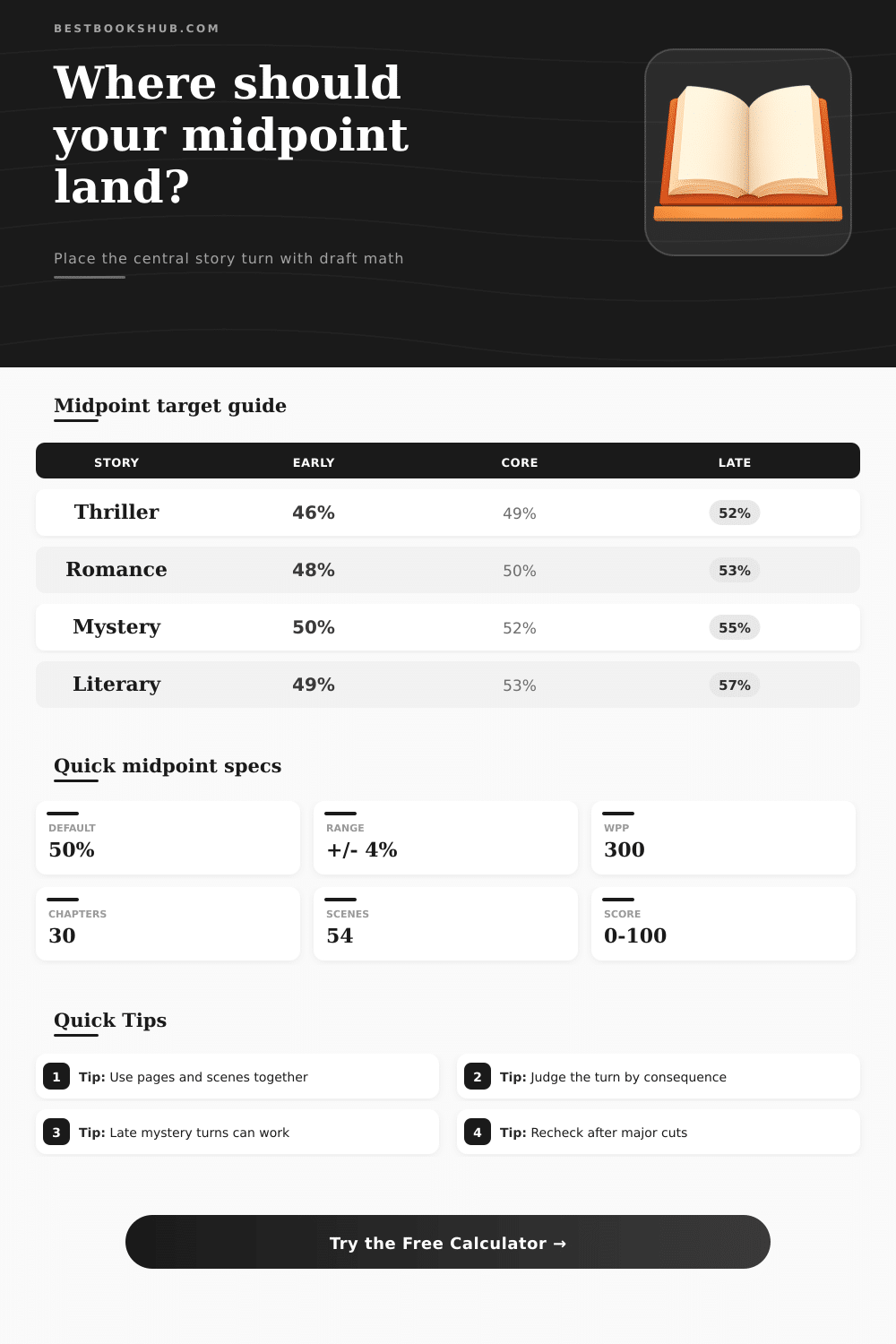
| Early thriller reversal | 48% | 45% to 51% | Suspense, chase plots, survival stories, and high-pressure adventure. | A danger, betrayal, or pursuit changes the plan. |
| Mystery reveal curve | 52% | 49% to 56% | Investigations where clues must accumulate before the central reveal. | A clue reorders suspicion or exposes a deeper crime. |
| Romance emotional pivot | 50% | 47% to 53% | Relationship arcs, romantic comedy, romantasy, and dual-POV love stories. | Connection deepens, breaks, or becomes impossible to ignore. |
| Literary slow-burn | 53% | 49% to 57% | Character-led novels, reflective memoir, and voice-driven structures. | The inner problem becomes visible in a new way. |
| Epic expansion | 51% | 47% to 56% | Large casts, quests, political fantasy, and layered series openers. | The main quest, war, or power map changes shape. |
| Draft size | Words | At 300 WPP | 50% midpoint | Revision note |
|---|---|---|---|---|
| Novella | 35,000 | 117 pages | 17,500 words / page 58 | Midpoint and Act II turns sit close together, so keep setup lean. |
| Short novel | 60,000 | 200 pages | 30,000 words / page 100 | One strong central event can carry the whole middle. |
| Standard novel | 85,000 | 283 pages | 42,500 words / page 142 | Check chapter and scene placement together. |
| Long novel | 110,000 | 367 pages | 55,000 words / page 183 | Use sequence turns around the midpoint to avoid a flat middle. |
| Epic manuscript | 140,000 | 467 pages | 70,000 words / page 233 | Subplot turns can orbit the main midpoint without replacing it. |
| Turn type | Structural job | Common example | If early | If late |
|---|---|---|---|---|
| Reversal or false victory | Changes the protagonist's strategy. | The plan succeeds, but exposes a worse problem. | Build more first-half escalation. | Trim repeated setup or travel beats. |
| Revelation | Reframes the central question. | A clue changes the case, motive, or identity of the threat. | Add a clue chain before the reveal. | Move an earlier clue into consequence. |
| Commitment | Makes retreat impossible. | The protagonist chooses the hard path in public. | Let the first half test the old strategy first. | Combine hesitation scenes. |
| Major loss | Raises stakes and strips protection. | A mentor, ally, cover, map, or belief is lost. | Make the loss feel earned. | Cut low-impact obstacles before it. |
| Moral choice | Turns the internal arc. | The protagonist acts against an old identity. | Add pressure that makes the choice harder. | Bring the dilemma forward scene by scene. |
| Signal | Likely placement issue | First check | Revision move |
|---|---|---|---|
| Middle feels soft | Midpoint lacks consequence. | Ask what becomes impossible afterward. | Strengthen fallout before moving chapters. |
| Opening feels long | Midpoint may be late because setup over-expanded. | Mark first irreversible commitment. | Compress repeated context scenes. |
| Second half feels rushed | Midpoint is late or Act III starts too soon. | Measure pages from midpoint to finale. | Move revelation earlier or expand pressure. |
| Turn feels random | Midpoint is placed well but under-seeded. | Trace causes in the first half. | Add setup beats rather than shifting the turn. |
| Draft feels predictable | Midpoint is mathematically centered but too mild. | Check whether the protagonist's goal changes. | Make the midpoint alter the plan or belief. |
DISCLOSURE: This post may contain affiliate links, meaning when you click the links and make a purchase, I receive a commission. As an Amazon Associate I earn from qualifying purchases.
A midpoint at exactly 50 percent still fails if nothing changes afterward. Use the calculated mark as a diagnostic, then test whether the next scene behaves differently.
If the turn is late, the problem may be two or three preparation scenes before it. Shift the cause chain as a group so the reversal still feels earned.
Most drafts fail at halfway point. Weeks in, you’ve got all of your character built up and all this world stuff, but then, bam! You hit a wall. For like fifty pages, nothing happens. Why? Because stakes haven’t changed enough to make us want to turn the page. And it’s not necessarily a creative problem; it’s a structural problem. Turn too soon and your second half will feel rushed and unearned. Too late, and your setup gets unbearable.
How do you find that sweet spot? That takes more than gut feeling. It takes measuring where the narrative gravity realy shifts from passive to active. But that’s where the calculator (above) does all the math for you after you input your draft length. Structure isn’t static, most writers thinks about it like a block of text, but it’s not. A thirty-chapter book acts different than an eighty-scene book, even if both have the same word count. Where is the mathematical middle? How do your actual scene breaks line up? Input your chapter breakdown and total word count, and the tool will convert those unclear percentages into solid mile-markers.
Finding the Right Midpoint in Your Story
Depending on how dense your writing is, it will probably be somewhere between page one-hundred-forty-two and chapter fifteen. Those are hard markers to use when you’re outlining so now you can shoot for something. More than most author acknowledge, genre expectations matter more. Suspense depend on momentum. Because of this, a thriller need to hit its moment of reversal earlier, typically at the forty-eight percent threshold. In contrast, literary fiction has the space to delay the emotional pivot longer, sometimes even beyond the fifty-three percent mark. That’s because if the protagonist find out her best friend betrayed her and makes a critical mistake on page two-hundred of a three-hundred page novel, there isn’t much left to be tense about. The tool comes with a handy reference table breaking this down. Think of it like a way not to judge your romance structure based off mystery metrics or vice versa.
When you’re using the wrong model, something feels off, it’s just not the right gait for you. People can get too hung up on being right on the nose at 50%. And sometimes, that’s the trap of perfection. From the perspective of the reader, a mid-point at 49% is no different than a mid-point at 51%. There is enough room for scenes to naturaly end as they do. Don’t force a scene closure arbitrarily because it lands on an even number of words. Find the next closest piece of action that concludes within range of tolerance, and then place it there.
The tool will show you the difference between your actual turn location and its calculated location. That difference isn’t always a sign you should of go back and rewrite. It’s a signal to examine the result. Is the plot turning on its heel here? Is the protagonist learning something new but pursuing the same course of action? In that case, you haven’t reached the midpoint no matter how far into the manuscript it occurs. Complications arise when subplots is involved. With multiple threads (or even just an ensemble cast), sometimes one of those threads reaches a minor revelation at the same time the main plot hits its midpoint. That’s okay, provided the main plot gets its proper portion of narrative weight. You can tweak this on the calculator by adjusting the subplot load, moving the expectation a bit. It will remind you: Complexity = needs careful pacing.
Emotion should not be dictated by the math. But it can informs how you approach it. Is your draft sluggish? Maybe the midpoint is dragging behind target. Does the second half feel frenetic? Perhaps the turn came too early, with not quite enough space for rising action. Structure is not a means of constraint. It is a scaffolding for the story you wish to create. Let the characters breathe inside that structure and trust the numbers to help you get there.