📖 Reading recovery planner
Missed days makeup calculator
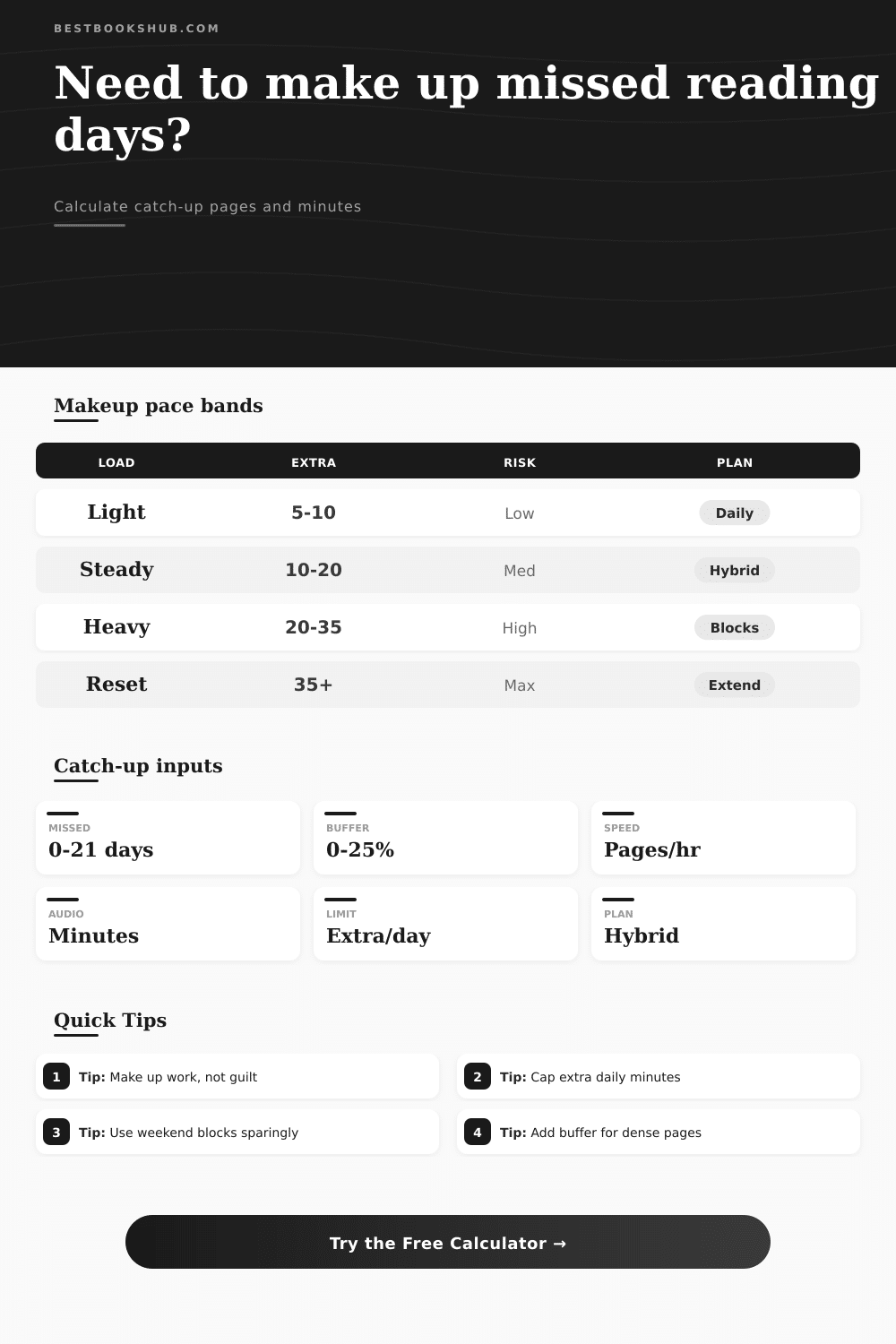
Turn missed reading days into a realistic catch-up plan with extra pages, extra minutes, weekend blocks, deadline risk, and buffer built in.
Enter the remaining work and the days left in the plan. The calculator separates normal pace from catch-up load so the makeup plan stays practical.
| Missed days | Normal daily pages | Makeup pages | Best recovery pattern |
|---|---|---|---|
| 1 day | 15 pages | 15 pages | Add 3 pages across five sessions. |
| 3 days | 20 pages | 60 pages | Add 10 pages for six sessions or one block. |
| 5 days | 25 pages | 125 pages | Use a hybrid daily plus weekend plan. |
| 7 days | 30 pages | 210 pages | Consider extending or reducing review load. |
| 14 days | 20 pages | 280 pages | Reset the schedule unless deadline is firm. |
| Reading type | Typical speed | 30 minute output | Catch-up note |
|---|---|---|---|
| Careful notes | 15-25 pages/hour | 8-13 pages | Add buffer before adding extra days. |
| Dense fiction | 25-35 pages/hour | 13-18 pages | Use smaller daily makeup chunks. |
| Comfort novel | 35-45 pages/hour | 18-23 pages | Daily spreading usually works well. |
| Light nonfiction | 40-60 pages/hour | 20-30 pages | Weekend blocks can clear gaps fast. |
| Audiobook | 1x listening time | 30 minutes | Use walks, chores, or commutes as blocks. |
| Strategy | Best when | Watch point | Calculator signal |
|---|---|---|---|
| Daily spread | Extra load is under 20 minutes | Can feel endless if misses are large | Extra per day stays under your cap. |
| Hybrid | Some weekdays and one open block exist | Weekend block should not carry all work | Daily extra drops after block credit. |
| Weekend first | Weekdays are short but deadline is near | One lost weekend breaks the plan | Block coverage clears most missed load. |
| Extend | Extra load exceeds comfortable time | Needs a real new finish date | Extension days are lower than overload days. |
| Preset | Workload type | Common gap | Useful makeup pattern |
|---|---|---|---|
| Book Club | Pages | Four missed days | Daily spread with one longer session. |
| Exam Reading | Pages | Dense notes | Hybrid blocks with a 15% buffer. |
| Audiobook Trip | Minutes | Commute lost | Two listening blocks plus daily extras. |
| Family Read | Chapters | Skipped evenings | Short daily fallback plus weekend catch-up. |
| Slump Reset | Pages | Low energy | Extend gently and protect tiny sessions. |
DISCLOSURE: This post may contain affiliate links, meaning when you click the links and make a purchase, I receive a commission. As an Amazon Associate I earn from qualifying purchases.
You mean well. You’re going to make good progress through your latest book club selection, 50 pages a day! And for the first few days, you do. Life gets in the way with things like a power outage, an unexpectedly late meeting at work, or a sick child. Before you know it, you’re four days behind.
The issue isn’t that you didn’t get around to reading. It’s that our brain don’t process backlog well unless we has a plan. When most people miss time, they default to one of two thing: (1) Panic-reading mode; six-hour Saturday binges until our eyeballs bleed; or (2) Giving up completely because the gap feels insurmountable. Neither is productive.
How to Catch Up When You Fall Behind in Reading
What you want is a system to manage your guilt, turning chaos into minutes. Now feed those numbers into the calculator at the top of this page, along with your current speed of reading and the number of pages left (and it’ll do the rest). The important factor is your “comfort ceiling” for additional reading time. That’s not just how many days you’ve fallen behind; rather, it’s how much more time per day would make you uncomfortable. Or push you beyond your breaking point.
This distinction matters because it separates your normal workload from the “penalty interest” you owe for being away. And that difference help stop you from expanding your daily goal to the point of impossibility.
Another thing that catches people off guard is reading speed. Perhaps you think you can get through forty pages per hour? That’s typically how fast you read when you’re churning through some fluffy fiction on a Friday evening. When you’re tackling something academic or complex non-fiction, though, it’ll slow you way the hell down, you’re not merely following along with a story; your brain has to digest content. Set a generic reading speed if you plan to tackle a challenging book and guess what? Your make-up schedule will be overly aggressive. This tool lets you adjust this value, ensuring the page targets reflect the mental effort of whatever you’re reading.
It’s a calculation of recovery time, not a test of your memory. One thing’s certain: You need some buffer. Build it into your schedule. Add 10% or 15% to whatever estimate you have, because there will be bad days (or bad chapters), you’ll get distracted by something on your phone, etc. If you don’t build in some extra time, then the smallest slipup puts you right back into arrears.
Better to over-estimate and finish ahead of time than under-estimate and have to scramble at the last minute, three weeks from now. This reality shows up in how the tool lets you pick your strategy: Do you want to spread things out evenly across each day? Or dump them into bigger chunks on weekends? Each one comes with its own mental price.
Block reading is intense, but finite. Spreading it out feels easier, but it never ends. Don’t let yourself forget your fallback floor. What’s the bare-minimum thing you’ll do on your worst day to keep the plan alive? That’s your fallback floor, and it’s something you must know if you’re ever behind.
If you have ten minutes, that’s all it takes to stay in motion without torpedoing the rest of your evening. Even with low energy, it keeps the habit intact. And as the missed day impact table shows, little gaps compound fast. A single missed day is a rounding error. Seven is a restructuring event. Knowing the difference early allows you to change before the math turns ugly.
Multitasking is where audiobooks really become different. They let you use catch-up minutes in a way you couldn’t otherwise: while you commute, do your chores, etc. The tool respects those minutes and realizes that not everyone can read as long visually as they listen to audio. For example, you might get through two hours of audio over the weekend but only half an hour of focused text during the workweek. This means we’re adjusting for reality, making it sustainable instead of heroic.
To wrap things up: managing pages isn’t the same thing as managing expectations. When you miss an evening, it’s tempting to look at how far behind you are and avoid it for a whole week. The distance seems too great to overcome. Breaking it down into actual minutes takes away the emotion and leaves you with math.
Yes, you should of be doing more reading. No, you shouldn’t be suffering to do it. Treat the calculated limits as hard boundaries, not guidelines. Stick to ’em, trust the process, and know that consistent beats intense every time. Let go of the idea of perfection and aim instead to be steady; your reading goal will thank you for it.