📝 Grammar frequency scan
Modal Verb Counter
Paste a passage to count modal verbs, semi-modal phrases, and modal-like contractions while checking density, sentence spread, obligation tone, possibility tone, and repeated certainty patterns.
Load realistic writing samples with different modal habits, then adjust the filters or paste your own manuscript, essay, lesson page, policy note, or review copy.
DISCLOSURE: This post may contain affiliate links, meaning when you click the links and make a purchase, I receive a commission. As an Amazon Associate I earn from qualifying purchases.
The counter tokenizes text, recognizes common modal categories, optionally includes contractions and semi-modals, and highlights sentences where modal verbs may be shaping certainty or authority.
| Modal | Family | Count | Share | Density |
|---|---|---|---|---|
| Run the calculator to list the most frequent modal verbs. | ||||
| # | Words | Matches | Family mix | Sentence |
|---|---|---|---|---|
| Sentences with modal signals will appear here. | ||||
| Family | Common forms | Typical meaning | Editing signal |
|---|---|---|---|
| Possibility | can, could, may, might | Ability, permission, uncertainty. | Useful for nuance; heavy use can sound hesitant. |
| Obligation | must, should, ought to, have to | Requirement, advice, expectation. | Can sound firm, instructional, or corrective. |
| Future | will, shall, going to | Prediction, intention, planned action. | Separate future meaning from certainty claims. |
| Conditional | would, could, might | Hypothetical or softened claim. | Clusters often mark tentative argument. |
| Semi-modal | need to, be able to, supposed to | Modal meaning carried by a phrase. | Important in lessons, policy, and instructions. |
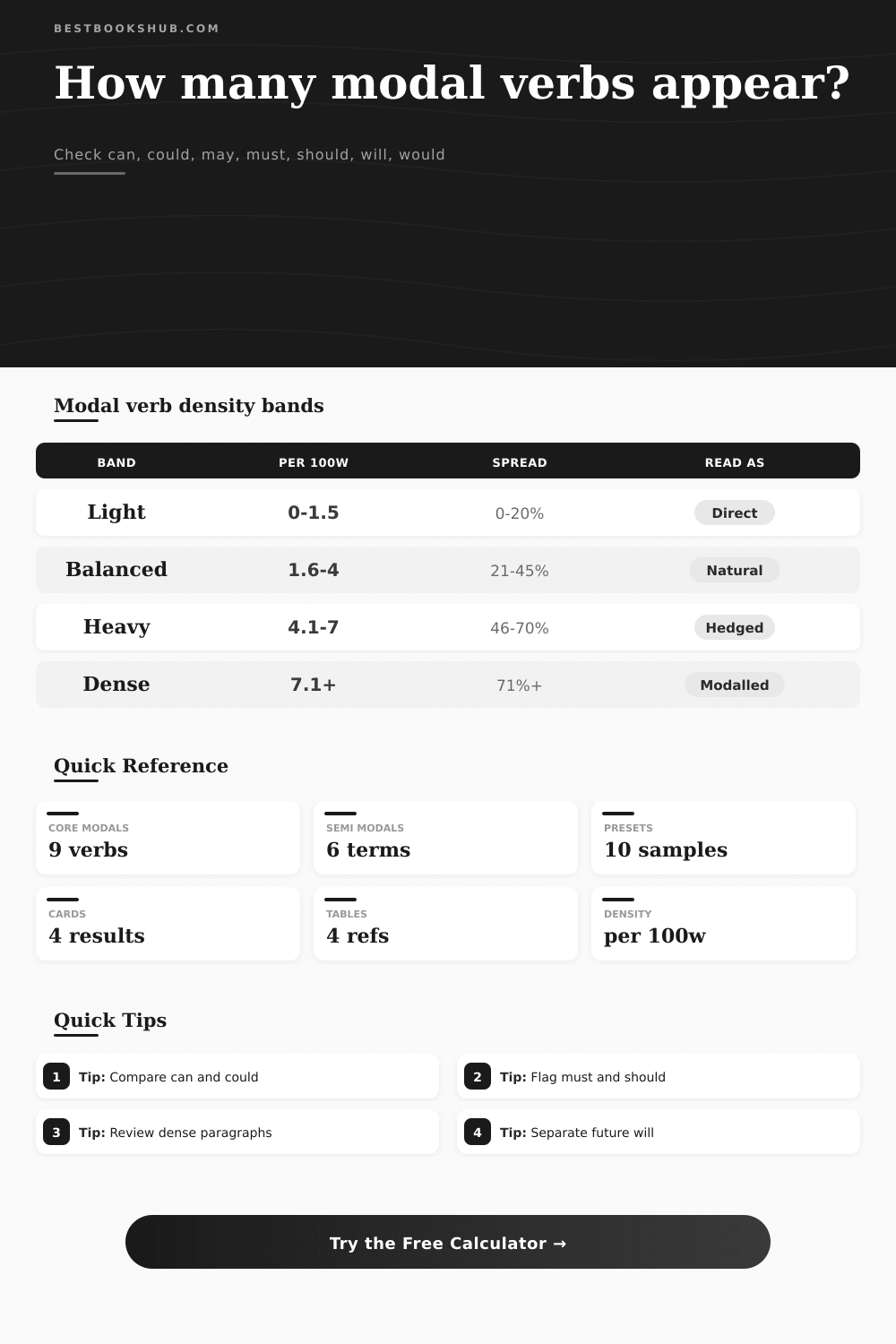
| Band | Modal density | Sentence spread | Best next check |
|---|---|---|---|
| Light | 0 to 1.5 per 100 words | Under 20% of sentences | Confirm the prose is not too abrupt or command-like. |
| Balanced | 1.6 to 4.0 per 100 words | 21% to 45% of sentences | Check whether one modal dominates the passage. |
| Heavy | 4.1 to 7.0 per 100 words | 46% to 70% of sentences | Review clusters in long sentences and paragraphs. |
| Dense | Over 7.0 per 100 words | More than 70% of sentences | Decide whether the voice needs more certainty or variation. |
Fiction dialogue
Modal verbs often show caution, desire, refusal, or negotiation. Compare quoted speech with narration when the voice feels uneven.
Academic prose
May, might, could, and would can help qualify claims, but too many can weaken the argument before evidence appears.
Instructions
Should, must, need to, and have to signal obligations. Use the obligation count to check whether directions sound too forceful.
Future planning
Will, shall, and going to can inflate modal totals without adding hedging. Use the future family to separate planning from uncertainty.
This grammar calculator uses pattern matching and sentence heuristics. Treat results as an editing guide, especially when words like can, may, and will depend on context.
Instead of a straight line, you read a sentence that sounds tentative. Each statement is hedged, softened. What was meant as a point become lost in a cloud of possibilities.
Writers use modal verbs when they want to sound precise or diplomatic. But cumulatively it can create an unconvincing voice. This is why modal density is important. Why you should care about it.
Why Modal Density Matters for Your Writing
Not because it’s a gramm shackles. It is a tuning fork for your authorial voice. And that’s where the calculator come in. It does the math for you (see it in action above). It removes guesswork. How many helper verb are shaping your narrative?
Most writers don’t know how many helper verbs they use until they see words like should, might, and could counted in front of their eyes. The tool finds these core modal words, as well as semi-modal and contraction words, then counts them out and normalizes the number per hundred words.
Why normalize? Because what seems like a dense paragraph in a three-sentence blurb feels different than the same amount of density in a ten-page chapter. Normalization create a consistent metric against which you can judge whether your writing is direct or diluted.
For example, take the difference between obligation and possibility. These are two families of modals that have very different functions for rhetorician. Obligation modals such as should and must carries authority with them. Too much of this, though, makes your arguments sound harsh, or makes instructions come across as authoritarian.
Possibility modals (e.g., might and may) bring in shades of gray. That’s good when you’re admitting some kind of limitation in academic writing. But in fiction, too much hedging can make your hero seem wishy-washy. In persuasive copy, it can weaken an argument.
You’ll find the reference table on page that helps you to understand not only the count but flavor of the count. You should also note that these counts frequently includes the future tense verb will. Will, while grammatically connected, tends to indicate prediction more then doubt. In a project plan, many uses of will may reflect reality. No problem.
The tool lets you filter by family. You can tell difference between conditional hesitancy and future intent. It is a little feature. Keeps you from over-diagnosing certain language as vague when it’s clearly a plan.
Do you sound unsure? Don’t confuse decisiveness about the future with vagueness. There’s another wrinkle: semi-modals. Words such as need to, have to, be able to acts as modal words. They use more room. Even though your modal density count might not look that high, they can still make your sentences seem clunky. You can also see them on the counter to get a clearer sense of how heavy your sentences are.
A large spread percentage mean there is almost one modal per sentence. And that’s usually an indication of repetitive rhythms. Whether it’s that word or any other doesn’t really matter. Variety counts.
It’s very rare that editing has to do with a precise count. We don’t live in an ideal world where there’s a magical point at which your writing becomes good or bad. These are guidelines. They’re bands, not rules. Some pieces need light density (punchy fiction, urgent news). Most blogs & essays works well with balanced density. Dense / heavy density may work better for scientific caveats and legal disclaimers. But generally speaking, it drags down creative writing.
Alignment: Use modals that fit the piece’s intent.
In short: This is all about taking back ownership of your own language. Perhaps you use could too much instead of will. Maybe you cover yourself with should when what you want to say is must. After a while, you’ll start to recognize the patterns and decide which hedges you need and don’t need.
Data doesn’t make the sentence for you; it informs you about the weight of what you’re saying. If you know where the weight is, you are halfway there. You should of be halfway to writing with purpose and clarity.