📖 simple-word rhythm lab
Monosyllabic word counter
Count one-syllable words, compare simple-word ratios, and test sentence rhythm for children's books, ESL passages, read-aloud drafts, and plain-language copy.
| Audience target | Monosyllabic ratio | Sentence length | Rhythm goal |
|---|---|---|---|
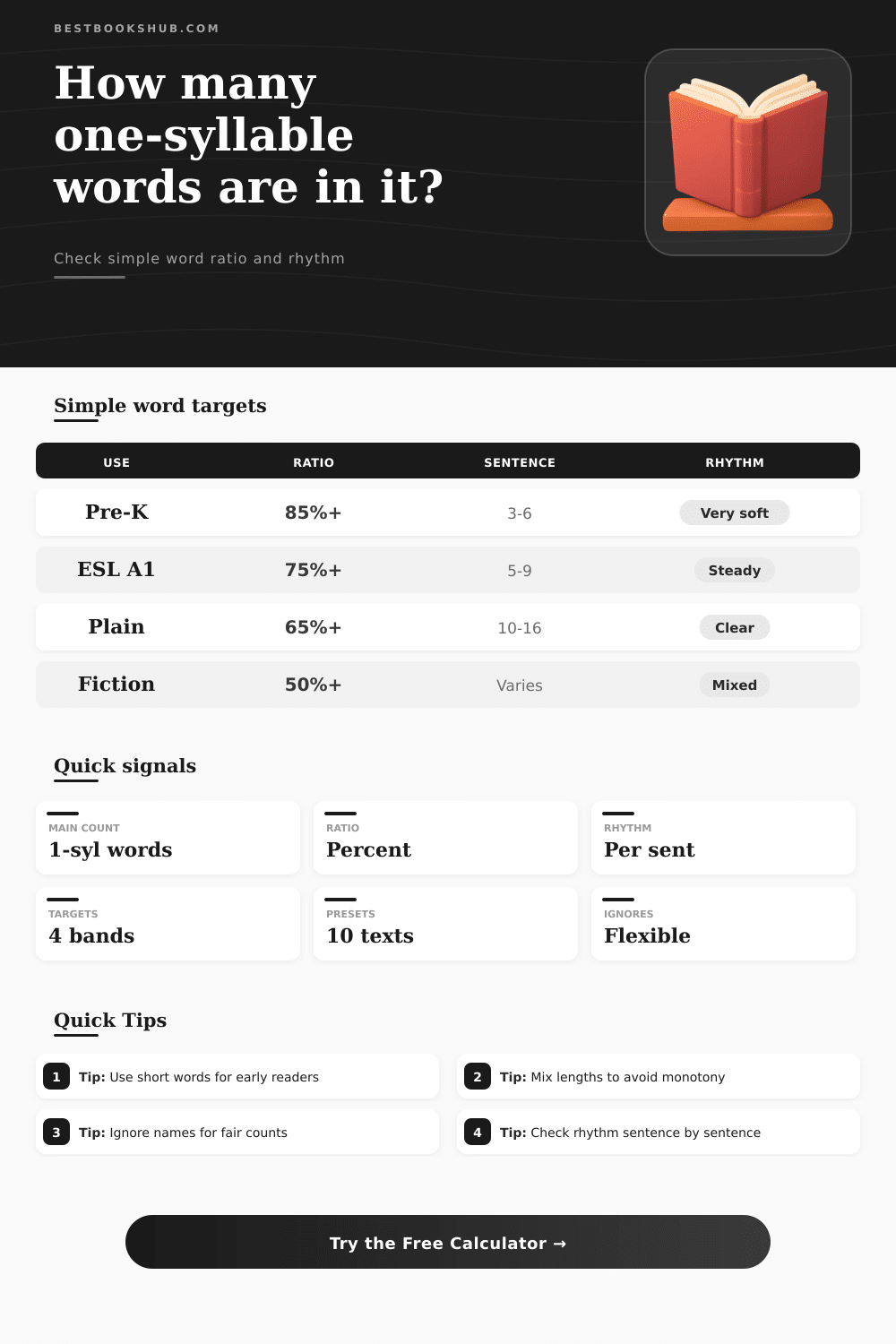
| Pre-K read aloud | 85% or higher | 3 to 6 words | Soft, chant-like beats |
| Early reader / Grade 1 | 78% to 88% | 4 to 8 words | Predictable simple beats |
| ESL beginner / A1 | 72% to 85% | 5 to 10 words | Steady practice pace |
| Plain-language public copy | 62% to 78% | 10 to 16 words | Clear but not choppy |
| Middle grade fiction | 50% to 70% | 8 to 18 words | Mixed short and long beats |
| Adult general prose | 42% to 65% | 12 to 24 words | Varied natural cadence |
| Word type | Likely one syllable | Often multi-syllable | Counting note |
|---|---|---|---|
| Common nouns | book, dog, rain | paper, story, river | Vowel-group count handles most cases. |
| Action verbs | run, read, jump | listen, open, follow | Silent-e endings are reduced. |
| Function words | the, and, but, with | because, under | Short grammar words raise the simple ratio. |
| Contractions | can't, I'll, she's | we're going | Choose spoken word or expanded mode. |
| Compounds | moon-lit split | moonlight kept | Hyphen mode changes the beat count. |
| Rhythm signal | Simple beats per sentence | Best fit | Revision clue |
|---|---|---|---|
| Very soft | 2 to 5 | Picture books and chants | Keep lines short and concrete. |
| Steady | 5 to 8 | ESL and first readers | Repeat structures for fluency. |
| Clear | 8 to 12 | Plain-language passages | Break heavy sentences when needed. |
| Mixed | 12 to 18 | Fiction or older readers | Vary long lines with short beats. |
| Dense | 18 or more | Academic or technical prose | Trim clauses for easier reading. |
| Option | Use when | Effect on count | Example |
|---|---|---|---|
| Proper names | Draft has character names | Removes name-driven distortion | Maya, Sam, Brooklyn |
| Acronyms | Lessons include labels | Keeps acronym beats out | ESL, NASA, PDF |
| Numbers | Text has dates or page refs | Counts words, not numerals | 2026, 12th, 3.5 |
| Quoted text | Only narrator text matters | Skips dialogue sections | "Run," she said. |
| Custom words | You need a house style filter | Removes entered terms | brand names or names |
DISCLOSURE: This post may contain affiliate links, meaning when you click the links and make a purchase, I receive a commission. As an Amazon Associate I earn from qualifying purchases.
A monosyllabic word counter are a tool that help a writer determine the numbers of one-syllable words in a piece of text. One-syllable words is short words that contains only one syllable. Using a monosyllabic word counter can help writers determine if there texts uses too many short words or if they uses too many long words.
Texts that use many one-syllabic words is generally considered to be lighter in type and to be more easier to read by the reader. A monosyllabic word counter contains several different setting that allow writers to adjust the way the counter count the number of monosyllabic words in a text. One such setting is the audience target setting.
Using a One-Syllable Word Counter
A preschooler will have a different target ratio of monosyllabic words to total words than will a middle-grade student. Another setting that you can adjust is the syllable sensitivity. Because spoken English is not the same than printed English, syllable sensitivity will ensure that the counter correctly count the syllabic words in a text.
Other settings include the hyphen and contraction options, the ignore names and acronyms option. Each of these settings reflect an editorial choice by the writer. The results of a monosyllabic word counter will show the writer how even the sentences of a text are.
Using a high number of monosyllabic words and using short sentences will create a different type of text than one that use a lower ratio of monosyllabic words within long sentences. The rhythm strip that is published with the results for a text will display the density of each sentence in the text. Using this strip, a writer can find a specific sentence that is too dense.
Finding such a sentence help a writer to understand why a certain passage in the text is difficult to read. A writer does not have to ensure that every sentence in a text is within the same range of monosyllabic words. For instance, a text that is written as a picture book may use many monosyllabic words, but it may also include a three syllable word to describe the name of a creature in the picture book.
Similarly, a dialogue that is written for speakers who is learning English as a second language (ESL) may contain many monosyllabic words, but it may also include a location name that has many syllable. The monosyllabic word counter will help you to see the changes that you make to your text. However, it is up to you to decide whether these changes will help the reader or whether they will cause friction for the reader.
Many people makes mistakes when they use a monosyllabic word counter. One mistake is treating the count as a ceiling for the number of monosyllabic words that you use. Such people will replace every long word in their text.
Another mistake is to overlook the relationship between sentence length and word length. Writing many short sentences that use only monosyllabic words may seem effective, but it may not be the best strategy for the writer. Another common mistake with monosyllabic word counters is failing to decide which word the counter should ignore.
The counter should probably ignore words like capitalized names. The same is true of technical term or brand names. You should adjust the ignore rules before you run your text through the monosyllabic word counter to ensure that the measurement is honest about the complexity of your text and that the measurement are accurate.
The reference tables that come with most monosyllabic word counters will help you to understand what different count mean for the complexity of your text. These tables will help you to understand the difference between texts that have a “soft” rhythm and those with a “steady” rhythm. They also indicate that adult prose contain many short words.
However, the difference in adult prose is in how the short words are arranged alongside longer words. These tables provides a map for you to revamp your text, but you must actualy make the changes to your draft. Finally, read your passage out loud.
If it sound good when read aloud, you have likely reached your goal for using a monosyllabic word counter. If specific lines of your text cause you to stumble when reading them aloud, the rhythm strip has likely highlight a problem in your text. The monosyllabic word counter makes visible the pattern in your text that your ear recognize when you read your text aloud.