Monthly reading planner
Monthly Reading Target Calculator
Plan a realistic monthly books-and-pages target from your current progress, remaining days, average book length, reading speed, weekly time, and protected buffer.
Presets fill the planner with realistic combinations of book goals, page progress, available days, reading speed, weekly time, and buffer days.
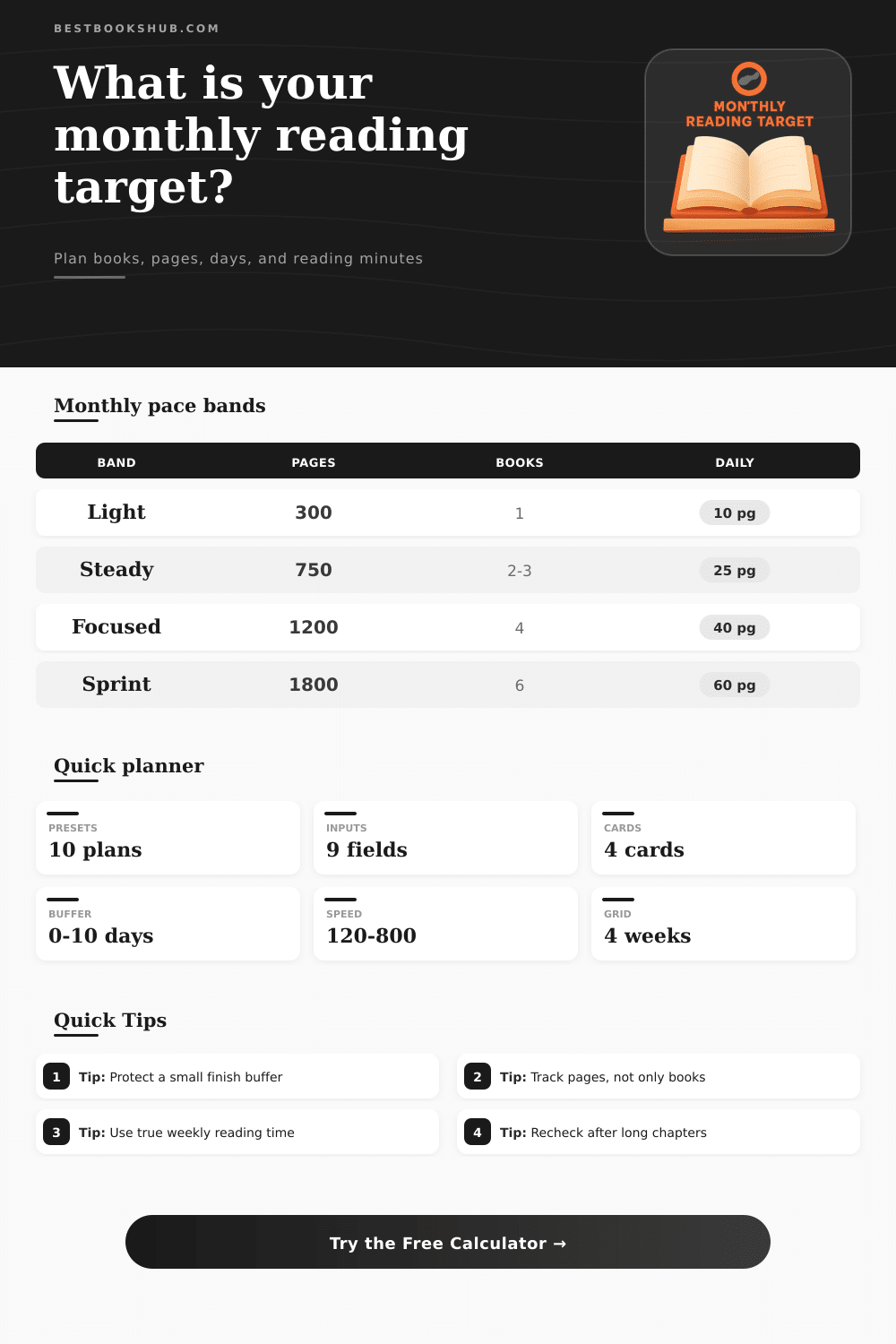
| Monthly plan | Books | Pages | Daily pages over 30 days |
|---|---|---|---|
| Light maintenance | 1 book | 300 pages | 10 pages/day |
| Book club steady | 2 books | 650 pages | 22 pages/day |
| Focused reader | 4 books | 1,200 pages | 40 pages/day |
| Challenge sprint | 6 books | 1,800 pages | 60 pages/day |
| Book mix | Average length | Best use | Planning note |
|---|---|---|---|
| Short fiction stack | 180 pages | High book-count months | Book totals rise quickly. |
| Modern paperback mix | 320 pages | General reading goals | Balanced books and pages. |
| Dense nonfiction | 420 pages | Study-heavy months | Use a lower speed if needed. |
| Long classic focus | 650 pages | One major book | Page target matters most. |
| Weekly availability | Pages per week at 250 wpm | Pages per month | Typical fit |
|---|---|---|---|
| 2 hours/week | 109 pages | 470 pages | One short book |
| 5 hours/week | 273 pages | 1,182 pages | Three to four books |
| 8 hours/week | 436 pages | 1,891 pages | Large challenge month |
| 12 hours/week | 655 pages | 2,836 pages | Sprint or vacation month |
| Buffer choice | When to use | Effect | Example |
|---|---|---|---|
| 0 days | Open schedule | Lowest daily target | Casual month |
| 2 days | Normal routine | Small pace lift | Finish before weekend plans |
| 5 days | Travel or work load | Clear early deadline | Protect final week |
| 10 days | Contest or hard stop | Aggressive catch-up | Reading challenge sprint |
DISCLOSURE: This post may contain affiliate links, meaning when you click the links and make a purchase, I receive a commission. As an Amazon Associate I earn from qualifying purchases.
Maybe you purchase a book on day one and complete it within three days, with 27 days left to go. You’re stressed, right? That’s the kind of stress that happens when you want to keep reading but are also required to do work, wash clothes, sleep, etc. Focusing on a goal for a month may seem excessive, but it is what will help you reach your yearly goals. Or give up in October.
Once you input your time and progress into the calculator, it does the rest for you. You do not need to try to convert estimates. When people begins reading, their initial goal is typically “I want to read four or five books per month.” It’s a nice round number! Except books aren’t all equally energetic. One book may be a fat history and another might be a breezy murder-mystery. They both count as one book, but the effort required are completely different. When you track pages rather than just covers, you get an accurate picture of how much work you’re doing. Three skinny thrillers + one fat biography ≠ the same amount of paper consumed vs. The same level of brain-fatigue. To compensate for this, tool allows you to adjust your average book size, and doesn’t treats a 100-page pamphlet as equal of a 500-page novel.
How to Read More Without Stress
Most people overestimate how fast they can read: they mistakenly believe that skimming also constitutes “reading.” The calculator allows you to adjust your speed based off what feels realistic rather than what you wish were true. The standard baseline for comfortable silent reading sits around 250 words per minute. When we’re reading unfamiliar material or a text is dense, our speed will decrease even further. If you input an unrealistically high number here, then your daily page goals won’t be sustainable. You can tweak this value downward to reflect your own realistic reading speed, not your idealized version. (That’s a kick in the pants: forcing yourself to consider your stamina, not your aspirational self.)
Most plans has a problem. People think that “I have two free hours per night.” But not all nights are the same. Sometimes you want to eat. Other times, you need to sleep. Other evenings, you’re tired and just want to relax without any stimulation. Instead of being pessimistic, it’s strategic to set aside a few buffer days at the end of the month. You’ll miss some days in life. If you don’t have a buffer, one busy evening can ruin your entire monthly goal. Having a three-day buffer ensures you never has to read for four hours nonstop during the last week of the month.
• If you’re not sure where to start, there’s a set of reference tables on the page with some benchmarks. Depending on how focused you are as a reader, you can shoot for 40 pages per day. You can even do just ten pages a day when things get crazy, which is doable. The range helps illustrate what is realistic and not so realistic. It’s tempting to feel guilty that you aren’t getting through books quickly enough, but slow and steady wins the race. If you burn yourself out trying to read six books in the first two weeks and quit cold turkey, it wouldn’t of be quite as satisfying as if you plod along reading three at a steady clip.
This isn’t about optimizing reading as a productivity measure. You want to get in the habit of finishing things that you start. It’s about using numbers to back up the behavior. After you set your target number (go read). Put down the spreadsheet and open the book. The math is only useful if it leads you back to the text.