✍ Writing pace lab
NaNoWriMo Daily Target Calculator
Plan a novel, memoir, revision pass, or any word-count project from your goal words, current progress, dates, rest days, buffer, and catch-up style.
Load a realistic writing scenario, then adjust every field. Presets vary goal size, progress, deadline length, rest days, buffer, and catch-up behavior.
| Milestone | Target date | Cumulative target | Week target | Planning cue |
|---|
DISCLOSURE: This post may contain affiliate links, meaning when you click the links and make a purchase, I receive a commission. As an Amazon Associate I earn from qualifying purchases.
These four cards compare how the same remaining word count behaves under different pace strategies.
Use these references to sanity-check the calculator output against common project goals, daily word targets, rest-day choices, and drafting speeds.
| Project preset | Goal words | Common window | Best catch-up mode | Planning note |
|---|---|---|---|---|
| Classic NaNo draft | 50,000 | 30 days | Smooth or front-load | Works best with a small buffer. |
| Camp or novella draft | 20,000-30,000 | 30 days | Smooth | More forgiving for rest days. |
| Memoir or nonfiction | 40,000-60,000 | 45-60 days | Front-load | Research days often interrupt drafting. |
| Finish-the-draft push | 10,000-25,000 | 7-21 days | Final sprint | Best when the ending is already mapped. |
| Daily target band | Typical effort | Good for | Risk level | Session cue |
|---|---|---|---|---|
| 1-900 words | Light | Long projects, busy weeks | Low | One short block can work. |
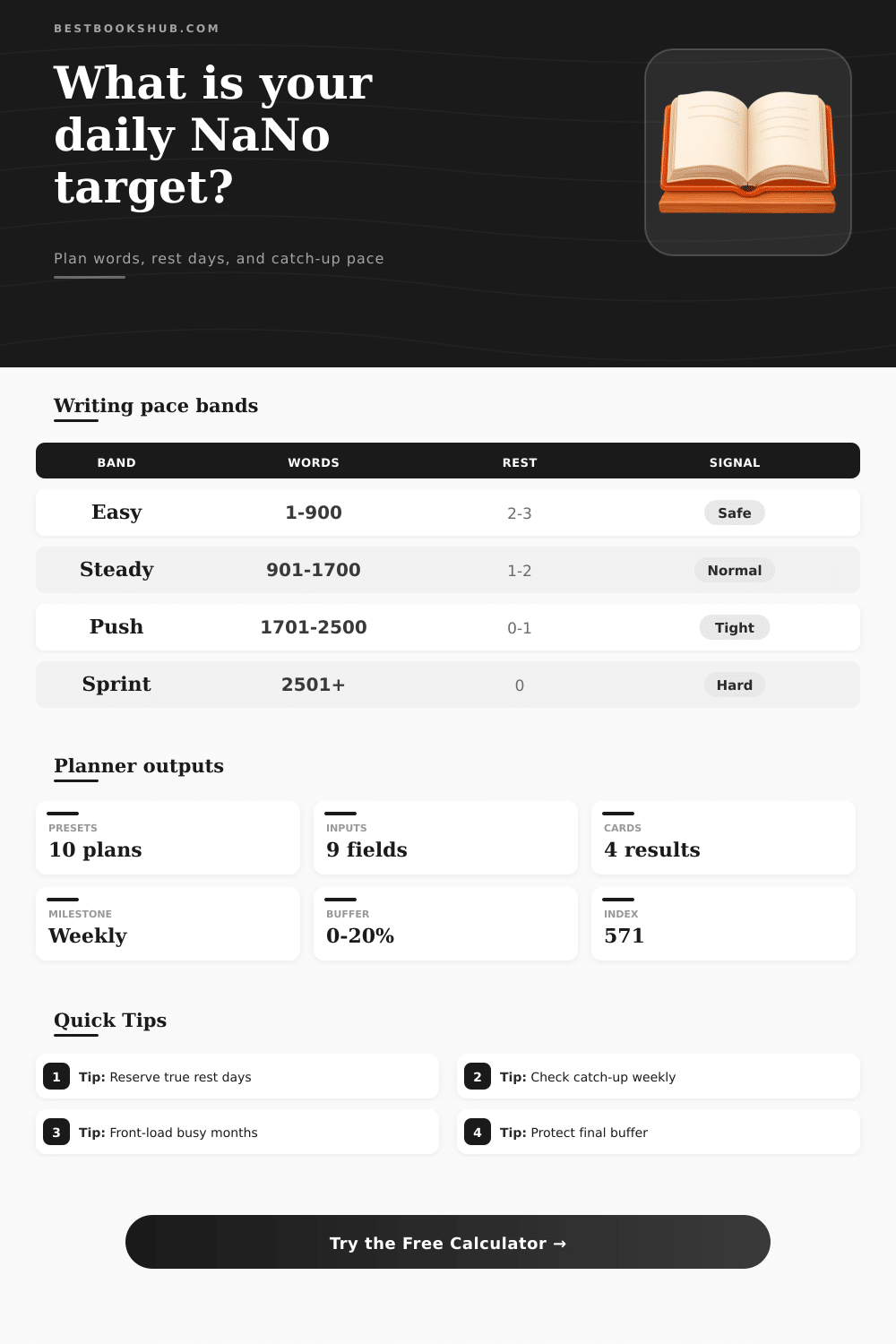
| 901-1,700 words | Steady | Most NaNo-style plans | Normal | Protect one focused session. |
| 1,701-2,500 words | Push | Late starts or rest-heavy plans | Medium | Use two smaller writing blocks. |
| 2,501+ words | Sprint | Catch-up weekends or final week | High | Plan recovery after big days. |
| Rest choice | Writing days/week | Works well when | Target effect | Watch out for |
|---|---|---|---|---|
| 0 rest days | 7 | Small daily habit is realistic | Lowest daily target | No natural recovery margin. |
| 1 rest day | 6 | You want a weekly reset | Moderate target lift | Do not spend the day twice. |
| 2 rest days | 5 | Weekday or workday rhythm | Noticeably higher target | Missed sessions matter more. |
| 3-4 rest days | 3-4 | Block writing is preferred | High target per session | Needs longer protected blocks. |
| Writing speed | Words/hour | 90-minute output | Best use | Planning advice |
|---|---|---|---|---|
| Careful drafting | 300-500 | 450-750 | Research, hard scenes | Use lower targets or more days. |
| Steady drafting | 600-900 | 900-1,350 | Most fiction sessions | Works for classic NaNo with rest days. |
| Fast drafting | 1,000-1,500 | 1,500-2,250 | Outlined scenes | Keep breaks so pace stays repeatable. |
| Dictation or sprinting | 1,600+ | 2,400+ | Timed bursts | Budget cleanup time separately. |
A practical writing plan includes goal words, dates, buffer, catch-up mode, rest days, and current progress. Every year, November bring a challenge. Fifty thousand words is mostly just a big number on a blank page, something that feels like math for you. Because there’s always some life taking up three day next week, you want to know: How many words do I write today? The deadline doesn’t change, so we know what to expect. We’ve been here before.
This time around, you don’t have to guess because all this other stuff, tired evening, dentist appointment… Turn into a sentence pace you can sustain. That’s what a daily target calculator takes out of the equation so you can concentrate on sentences rather than spreadsheets.
How to Make a Writing Plan
Which brings us to the inputs. They matters more then they look. Zero words on day one doesn’t feel like fifteen thousand already in the bank. A 30-day commitment pressures you different than a lax six weeks does. And because taking a rest day isn’t laziness: It’s part of the structure. Choose one or two intentionaly. Make daily number higher, but make your legs last longer. The tool shows you that tradeoff.
Then tack on a little buffer (ten percent, perhaps) because then you has wiggle room for the cuts that always need making. Sometimes the buffer lets you hit exactly the right mark on the last day, but book still needs work.
Your personal style will also come through in your writing habits. Some writer prefer an even pace (it’s fair!). Some like to front load first week when motivation is high and then let it coast a bit. Some are weekend warriors who clump their efforts into larger chunk. Others love to sprint for the finish line at the end. Just make sure you look after your nervous system afterwards! Each of these strategies shifts the same amount of words over the exact same number of sittings. The only difference is that each create a different kind of rhythm. And that’s what the calculator helps with: It gives you a sense for what those rhythms actualy feel like in action, and there’s no need to run this arithmetic yourself.
Writers don’t account for session length versus speed enough. When you’re working with full focus, drafting eighty-hundred words during a concentrated ninety-minutes? That’s what you can realistically do on an average day. Don’t force yourself beyond it too many times because burnout sneaks up on you. Your results’ pressure meter lets you know when you respect this boundary, or when you’re gently nudging past it without realizing. When the number reads higher than a hundred percent, that doesn’t indicate failure, it just suggests that current configuration is asking for more than the allotted writing time can provide. Adjust one of those variables to lower the percentage (switch modes, add a rest day) and let small tweaks avoid the dramatic crash down the road.
The page includes sanity-check reference tables that remind you when your hunches are right (and wrong). Which catch-up style fit a certain size of project? What’s a reasonable window? Why does a collection of flash fiction usually require less runway than a memoir? How does writing in short, intense bursts compare to writing for the long term?
All that matters is that November isn’t the only time in your life that you’ll write. Whether you’re revising a book, working on a dissertation chapter, or tackling another deadline-driven project, the same kind of thinking apply.
The common pitfalls are right there in plain view. A buffer is insurance, not extra words. Rest days get scheduled and then the person writes anyway, making it all for naught. Front loading is exhilarating until it’s not (week two) and you run out of steam. They looks at those last couple of days like a victory lap rather than a death march.
Finally: The calculator doesn’t write your book for you. It only uncovers what your commitment look like. After you know how fast it needs to happen, the daily choice is easy. Sit yourself down. Guard the time. Believe in the numbers you’ve crunched. The words will follow, one session at a time, all the way to a finished draft that pushed you to finish.