📚 Grade planning
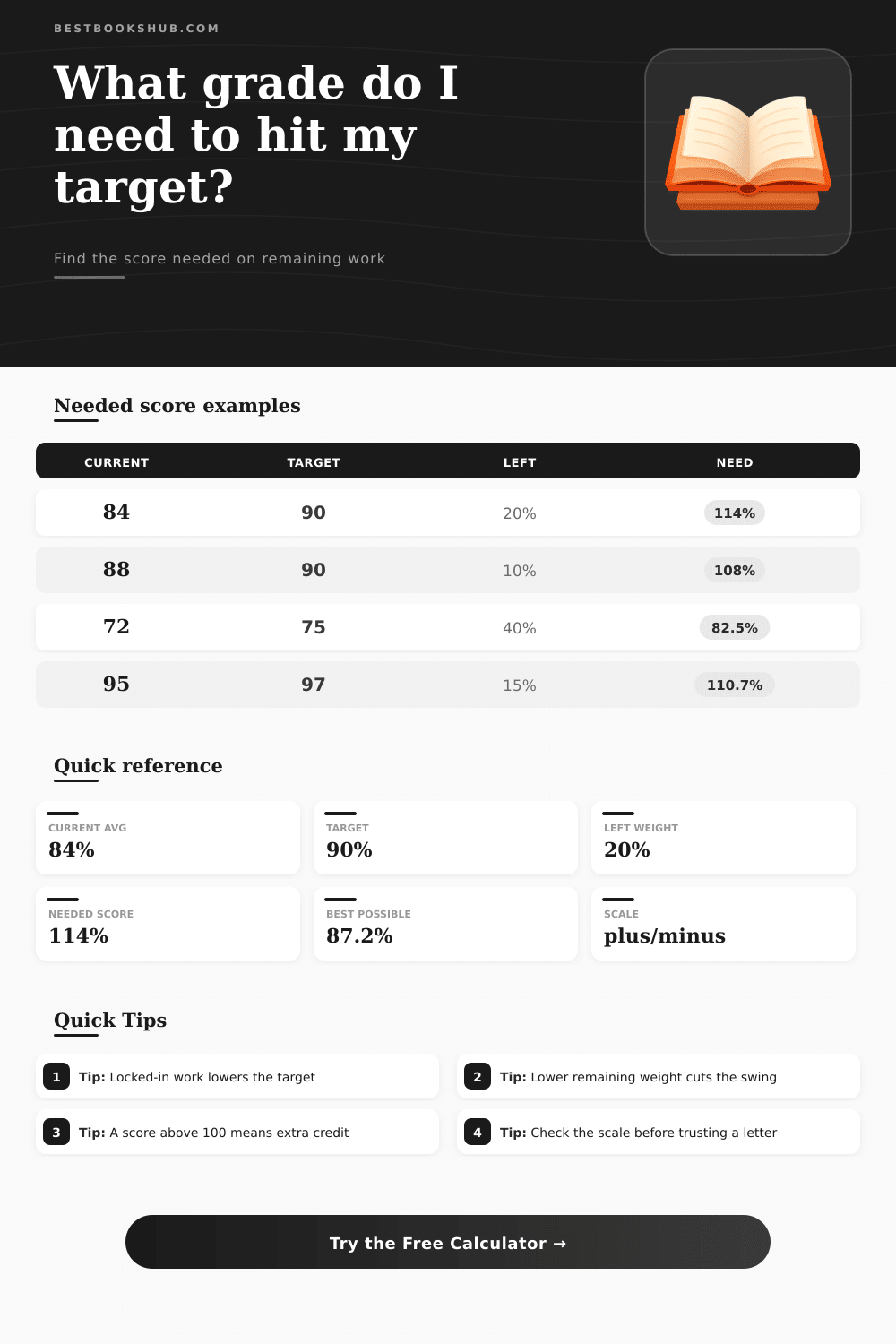
Needed Grade Calculator
See the exact score you need on the remaining part of a course, compare the best-case final, and check whether your target is still realistic.
| Current | Target | Left | Need |
|---|---|---|---|
| 84% | 90% | 20% | 114% |
| 88% | 90% | 10% | 108% |
| 72% | 75% | 40% | 82.5% |
| 95% | 97% | 15% | 110.7% |
| Left | 1 pt lift | 10 pt lift | Note |
|---|---|---|---|
| 10% | 0.1 | 1.0 | Tiny swing |
| 20% | 0.2 | 2.0 | Final counts |
| 30% | 0.3 | 3.0 | Midterm mix |
| 50% | 0.5 | 5.0 | Big leverage |
| Scale | A | B | C |
|---|---|---|---|
| Standard | 90 | 80 | 70 |
| Plus/minus | 93 | 83 | 73 |
| Strict | 92 | 82 | 72 |
| Curve aware | Ask | Ask | Ask |
DISCLOSURE: This post may contain affiliate links, meaning when you click the links and make a purchase, I receive a commission. As an Amazon Associate I earn from qualifying purchases.
Goodreads ratings play a big role in how readers pick their next book. A book with 3.96 stars seems to belong to another group than one with 4.01 That small difference weighs more than you expect. It is a quirk of human thought, like why stores set prices at X.99 instead of rounding up.
Many readers avoid books with 3 stars or less, unless they already like the author or the story strongly attracts them. For a book to be worth the time or money, it mostly needs at least 4 stars. That however creates a probelm.
How Goodreads and Other Sites Change What You Read
Masterpieces that try a new style or test limits commonly receive low notes at Goodreads. Great books stay under 4 on that website.
Older books usually have fewer votes, and their points run low. A practical rule says that books before 2000 deserve half a grade bump mentally. Those from before 1980 can receive a whole grade correction on average.
Think about those things when you choose the next book.
Many in the reading world find the system of Goodreads wrong. Review websites are easily changed, so take published opinions with a grain of salt. Still, the amount of reviews and the details that reviewers give make it useful.
Books with genuinely bad ratings probably are not worth the time. Even so Goodreads and alike pages have a trend to too highly estimate books that succeed at sale.
StoryGraph operates similarly to Goodreads, but lacks social features and big community lists. Readerly offers an alternative, although it now stresses its app, that yet is a bit rough. They launched a forum for discussions, so new features maybe will arrive.
Even users of other websites commonly check ratings at Goodreads.
LibraryThing offers a way to follow your reading. It catalogs books online for free, using data from Amazon, the Library of Congress and thousands of others. Readers can note progress, rate and review, and look at charts of there reading life.
The website gives personal advice, that helps to find the next favorite book. LibraryThing combines almost three million book lovers in a warm community with groups and discussions. There is even an official group for asking for ideas when you are stuck or need a gift.
BookCrossing is entirely different. It leaves books in public, so that strangers find them. Book rings let members pass books to a list of readers, who will send it after two to four weeks.
It reads the barcode of the cover, making registration simple.