📚 Style diagnostics
Nominalization counter
Paste prose to count abstract noun forms, spot weak verb-plus-noun phrases, and decide where hidden actions should become stronger verbs.
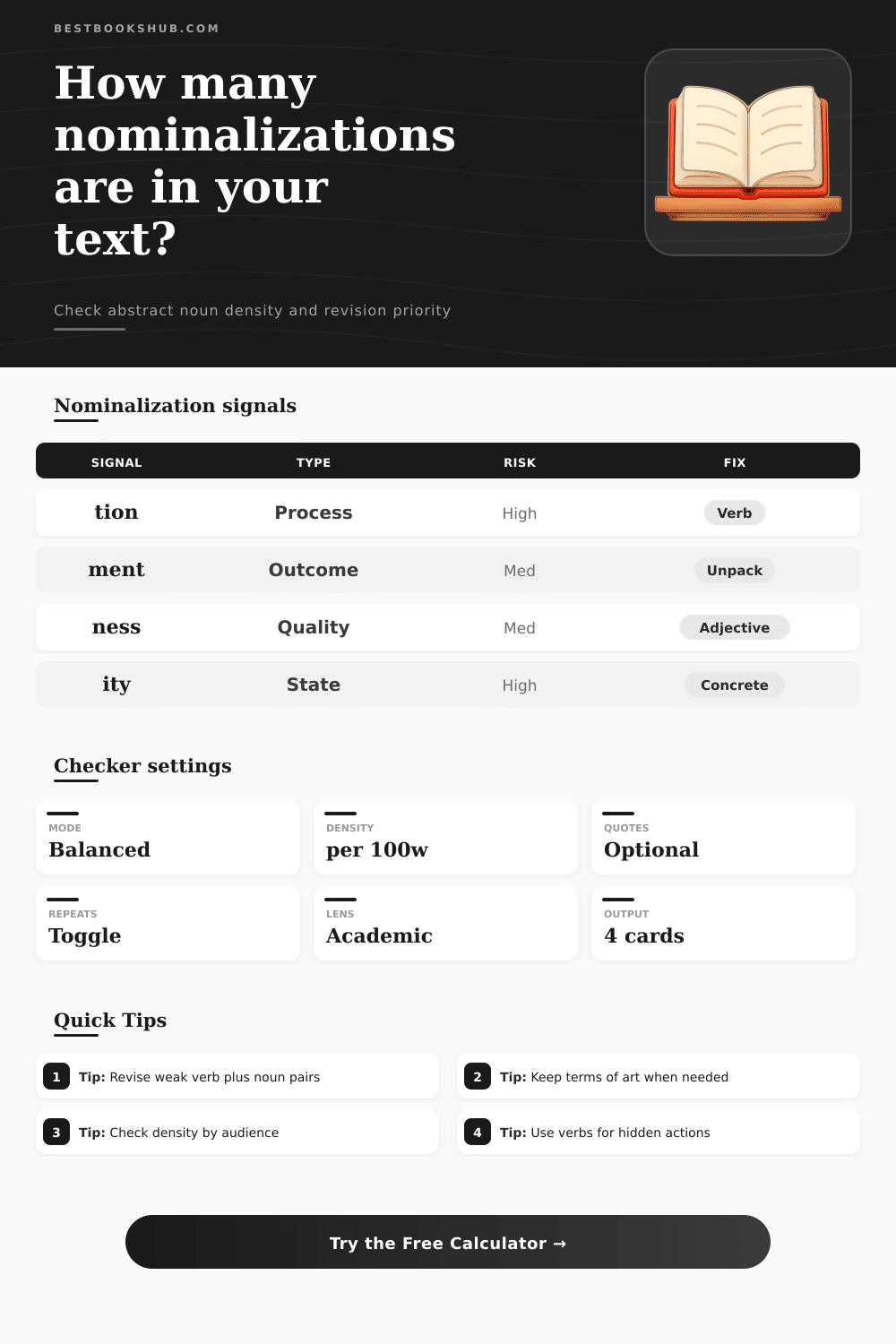
| Suffix signal | Typical source | Editorial risk | Example revision move |
|---|---|---|---|
| -tion, -sion | Verb to process noun | High when paired with weak verbs | Conduct an analysis becomes analyze |
| -ment | Verb to result noun | Medium to high | Make an assessment becomes assess |
| -ance, -ence | Action or state noun | Medium | Show resistance becomes resist |
| -ity, -ness | Quality or state noun | Medium in dense clusters | Improve clarity by naming the actor |
| -ization, -isation | Process escalation | High in policy prose | Operationalization becomes how it works |
| Density band | Per 100 words | Likely reading effect | Revision response |
|---|---|---|---|
| Light | 0.0-2.5 | Mostly concrete and direct | Check only weak verb pairs |
| Moderate | 2.6-5.0 | Acceptable for professional prose | Revise crowded sentences |
| Dense | 5.1-8.0 | Abstract load may slow readers | Turn hidden actions into verbs |
| Very dense | 8.1+ | Reader may lose actors and actions | Rewrite sentence subjects and verbs |
| Writing context | Typical tolerance | Watch closely | Best comparison target |
|---|---|---|---|
| Plain-language article | Low | Clusters of -tion nouns | 2-3 per 100 words |
| Business update | Moderate | Implementation and alignment language | 3-5 per 100 words |
| Academic paragraph | Moderate to high | Theory terms versus hidden verbs | 4-7 per 100 words |
| Legal or policy memo | High | Unclear actor responsibility | 5-8 per 100 words |
| Technical documentation | Moderate | Procedures turned into nouns | 3-6 per 100 words |
| Phrase pattern | Why it feels heavy | Direct alternative | Keep when |
|---|---|---|---|
| Make a decision | Weak verb carries little meaning | Decide | The decision itself is the topic |
| Conduct an analysis | Action is hidden in the noun | Analyze | Naming a formal study |
| Provide clarification | Verb and noun duplicate work | Clarify | Referring to a specific document |
| Reach a conclusion | Slower than the verb form | Conclude | Emphasizing the endpoint |
| Give consideration | Abstract and indirect | Consider | Legal phrase is required |
DISCLOSURE: This post may contain affiliate links, meaning when you click the links and make a purchase, I receive a commission. As an Amazon Associate I earn from qualifying purchases.
By now, you’ve likely encountered an abstract noun. It’s one of those heavy words that pull a sentence down. Nouns that ends in -ity, -ness, -ment, -tion pile on top of each other until it’s hard to remember who did what. And it’s not just a matter of stylistic preference. There’s a reason they call it cognitive load. Reading a paragraph loaded with abstract nouns makes your brain has to work overtime to piece together who did what.
Enter this calculator to help measure that drag so you know where to cut back and where to hold onto the weight. For example, it scans for words ending in “ation” which tend to be hidden verb. So when you see evaluation, the verb is hiding inside. When you use a word like assessment, it hides the fact that you are assessing.
How to Write Clearer Sentences
The reference table on the page show how these words relate to their editorial risks. What’s useful here is realizing why one phrase feels more weighty than another. It is not always because of the noun itself. It is because of the weak verb carrying it along. For instance, nominalizations like make a decision are coupled with supporting verbs that add little or no meaning. Strip them off and you strengthens the sentence.
Ultimately, raw word counts matter less than context. A marketing email requires fewer abstract nouns than an academic paper. That’s why the calculator lets you choose a context baseline to adjust how aggressively it flag words. Some level of abstraction is required when writing precise legal memos; clarity beats abstraction when writing UX research notes for designer. To avoid the frequent error of over-editing technical writing, use the reader tolerance lens to adjust your editing for either specialists or general audiences.
Nominalizations are one such thing people overlook. It’s true, they’re not evil. Nominalizing an activity lets you bundle it up for more efficient communication. I implement a plan. What does implementing mean? It means many months and several team acting over time. But if you’ve got too many nominalizations stuffed in one sentence (or paragraph), that’s where problems occur.
That’s where the density metric comes in: how many times do you use them, on average, per hundred words? If the answer is low, your prose is most likely direct and concrete. If the number is high, there’s a good chance your reader will becomes lost following the actions and their actors. Understanding what exactly that number measures is the trick.
There’s also an option to disable quoted text and other known false positives. If you’re examining a particular section with words that are terms of art, leave them alone. Don’t change innovation to innovate because your suffix detector says so. It’s about making it readable, not enforcing a rule list. If you’re working on a draft that will be published, use the strict mode. If you’re troubleshooting something that sounds clunky in one place, try the broad scan.
So look first at sentences that link abstract nouns with a weak verb. Resist replaces show resistance. Clarify replaces provide clarification. Those little changes make your writing more direct and shorter. You can use the calculator to find those phrases for you, but then it’s up to your judgment which ones to drop. Every nominalization isn’t necessarily bad. Complex arguments often need some sort of anchor. And some of them are simply clutter. Trimming fat without losing muscle, that’s editing.
You want your prose moving. And when it does, movement ceases as soon as nouns comes marching in. I give you the diagnostic data; you make the call about what goes and what stays. Once you get started noticing the pattern, it’s easier than you think. Find the words that sound like actions, but act like objects. Put ’em back where they belong: verbs. The clarity benefits your reader. This results in text that respects their time and attention.